


Bitcoin weekend trading has delivered a small gain since the record close of October 6, 2025, while weekday sessions absorbed the entire 53% decline from that peak.
That is the finding from our review of daily Coinbase Exchange BTC-USD candles, measured in UTC days, from the $124,720 record close through Friday’s close of $58,815.
Compounded, the 116 Saturdays and Sundays in that stretch returned +2.0%. The 294 Mondays to Fridays returned -53.8%.
For Bitcoin investors, that split says a lot about who has been selling, and when.
The bigger question is whether the weekday pressure that built this drawdown is close to running out.
Bitcoin Weekend Trading Has Held Its Ground Since the Peak
Picture two imaginary holders who started with $100 each at the October 6 close.
One owned Bitcoin only on Saturdays and Sundays and sat in cash the rest of the week. That account would be worth about $102 today.
The other owned Bitcoin only on weekdays. That account would be worth about $46.
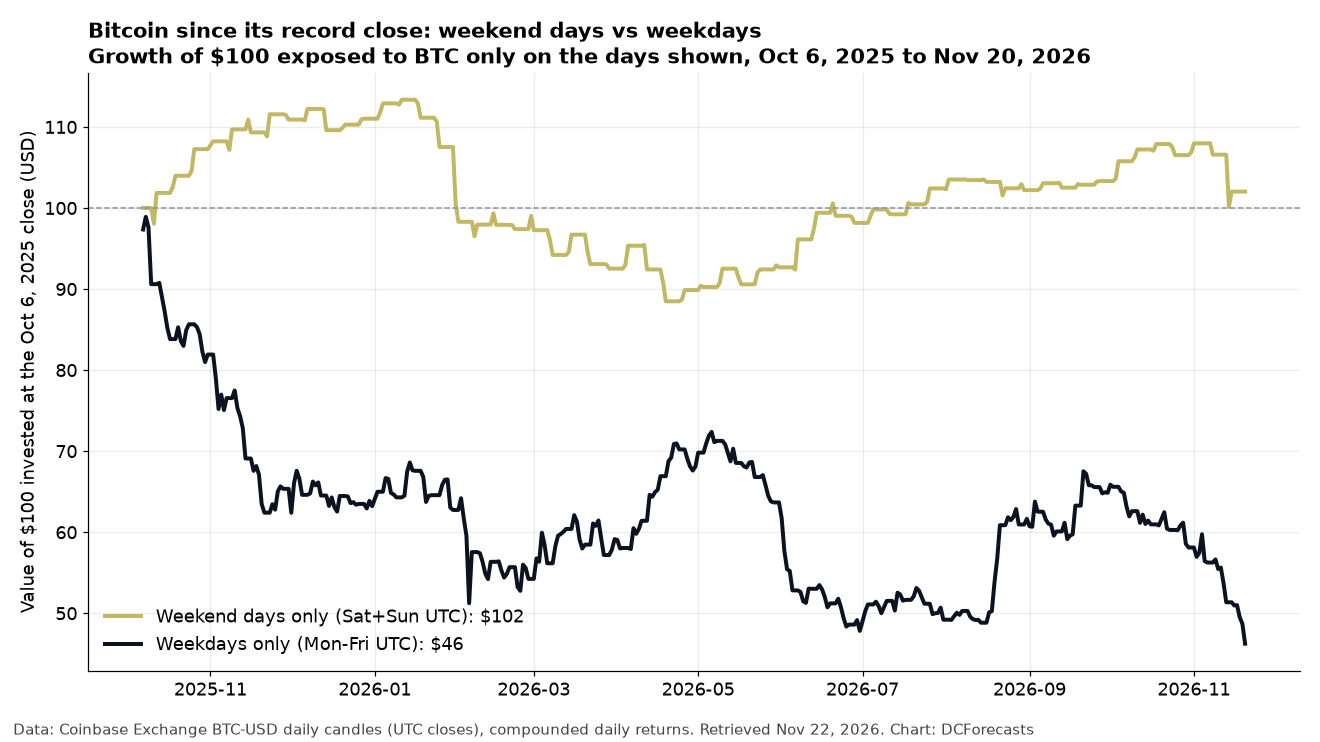
The weekend line has not been a straight ride. It dipped to roughly $88 in the spring before climbing back above $100 by the summer.

Still, after more than 13 months, the weekend market sits slightly above where it started.
Per day, the gap is clear. The average weekday return was -0.23%, while the average weekend day returned +0.03%.
Thursday Did the Most Damage of Any Day
Breaking the same data out by day of the week sharpens the picture.
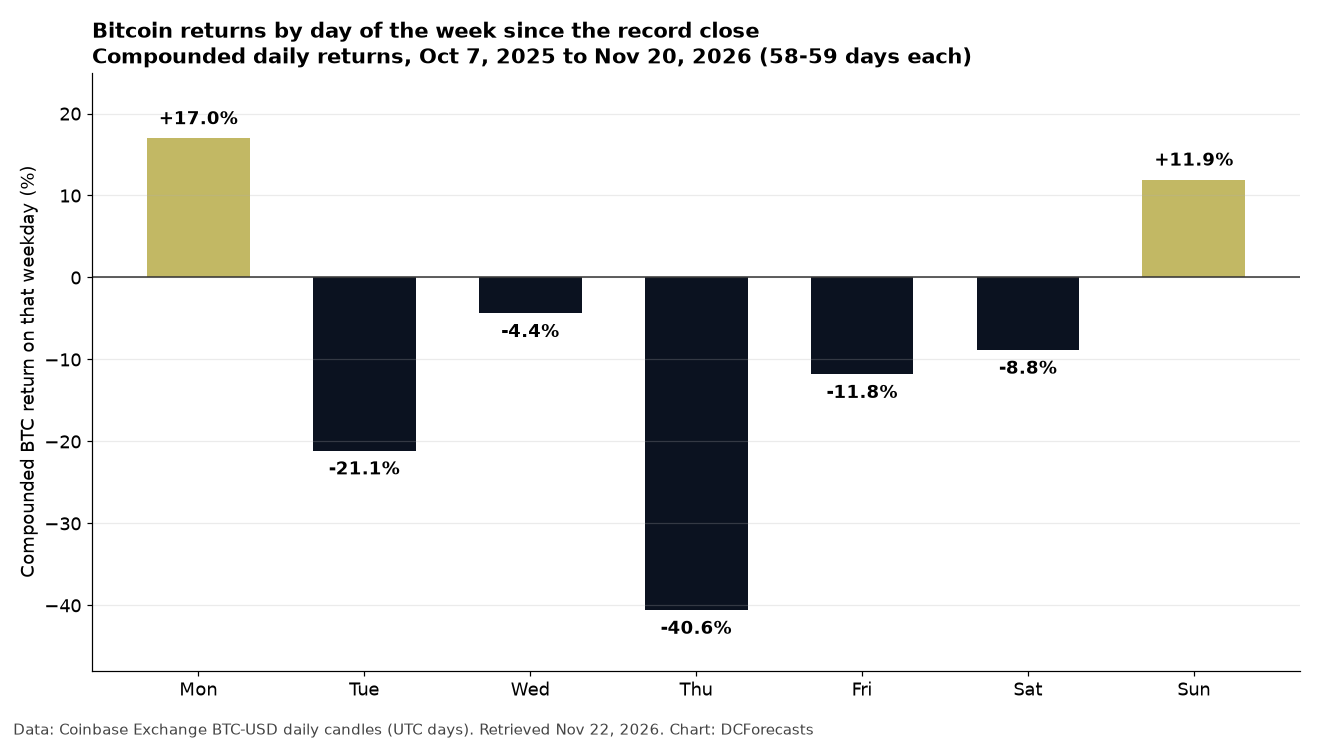
Thursdays alone compounded to a 40.6% loss across 59 sessions, and 34 of those 59 Thursdays closed lower.
Tuesdays lost 21.1% and Fridays lost 11.8%. Saturdays were also negative, at -8.8%.
Mondays, by contrast, gained 17.0%, and Sundays gained 11.9%.
The single worst session in the whole drawdown was also a Thursday. On February 5, 2026, Bitcoin fell 14.0% to $62,791.
The very next day it jumped 12.3%, the best session of the period.
Thursday is a crowded day for U.S. macro data, including the Labor Department’s weekly jobless claims report, released at 8:30 a.m. Eastern.
We would not claim one data release explains a 40% move. A day-of-week pattern over 59 observations can be driven by a handful of large sessions, and it can fade quickly.
Why Weekday Hours Carry the Selling
We believe the weekday skew reflects where the big, rules-driven money now trades.
Spot Bitcoin ETFs create and redeem shares only on U.S. trading days. Futures desks, macro funds and risk-parity models also adjust positions during the week.
The weekend market is different. We think it is dominated by crypto-native traders and long-term holders, without ETF redemptions or stock-market spillover.
On balance, that crowd has not pushed prices lower since the peak.
It is also a thinner market, as our look at Bitcoin’s shrinking weekend volume showed earlier this month. Since the peak, average Coinbase volume on weekend days was about 4,190 BTC, against roughly 9,930 BTC on weekdays.
The average absolute daily move was 1.08% on weekends versus 1.87% on weekdays, and the average intraday range was 2.37% against 3.88%.
In short, weekends have been quieter and better balanced. The heavy volume, and the heavy selling, arrived Monday to Friday.
Weekdays Also Drove the Last Bull Market
This is the part of the data that keeps the analysis honest, and it is also the most encouraging.
Weekdays do not only drive declines. They drive the big trends in both directions.
In 2023, weekend days compounded to +32.3%, while weekdays returned +92.5%. In 2024, weekends added 15.1% and weekdays added 83.3%.
During the 2022 bear market, from the November 8, 2021 close to November 21, 2022, weekends lost 15.0% and weekdays lost 72.6%.
So the current split is not proof that weekdays are permanently bearish. It shows that institutional hours are where Bitcoin’s direction gets set.
For us, the key takeaway is that the same machinery now selling is the machinery that powered 2023 and 2024. When ETF flows and macro conditions turn, weekday sessions have historically been where recoveries accelerate.
What Would Signal a Shift From Weekday Selling?
We would watch three things in the weeks ahead.
- Whether Thursdays and Tuesdays stop closing lower in clusters.
- Whether weekday spot ETF flows move back to net creations.
- Whether weekend gains begin to hold through the following Monday and Tuesday.
The weekend just started has been eventful. On Saturday, Bitcoin dipped to $55,106 on Coinbase before trading back above $60,000, as we noted in our report on the rebound from a two-year low.
A return to the $124,720 record close would require a gain of roughly 112% from Friday’s close.
That is a long road, and nobody can promise a timetable for it.
But the data shows that the crypto-native market has stayed broadly balanced through a 53% drawdown, while the selling has been concentrated in weekday sessions tied to ETFs and macro. With a fixed 21 million supply and the institutional plumbing already in place, we believe that is the kind of base from which past recoveries have started.
The coming weekdays, including a holiday-shortened U.S. week, will show whether that pressure is finally easing.
DC Forecasts is a leader in many crypto news categories, striving for the highest journalistic standards and abiding by a strict set of editorial policies. If you are interested to offer your expertise or contribute to our news website, feel free to contact us at [email protected]












Discussion about this post