



The Invesco Galaxy Bitcoin ETF has quietly traded the custom SEC order it launched under in January 2024 for the generic listing standards that now cover most of the U.S. spot bitcoin market.
Cboe BZX filed the change on Nov. 9, and the SEC published the notice in the Federal Register on Nov. 19.
The filing covers both the Invesco Galaxy Bitcoin ETF and its sister Invesco Galaxy Ethereum ETF. The SEC waived the usual 30-day waiting period, so the switch took effect on filing.
For bitcoin investors, the shares themselves do not change. The bigger question is why one of the original January 2024 issuers took 418 days to make a move that Fidelity, VanEck and BlackRock filed for within nine.
What the Invesco Galaxy Bitcoin ETF Filing Actually Does
Until now, the bitcoin fund traded under the Jan. 10, 2024 approval order that let the first wave of spot bitcoin ETFs list. The ether fund traded under a separate May 23, 2024 order.
Those orders were written around specific proposals. Under the new filing, Cboe says each trust will instead operate under Rule 14.11(e)(4), as amended to include generic listing standards for commodity-based trust shares.
Each trust must meet those standards and keep meeting the continued listing requirements in the rule.
The SEC said waiving the 30-day delay was consistent with investor protection because it allows the shares to keep trading and “does not introduce any novel regulatory issues.”
The agency can still suspend the change within 60 days of filing, and public comments are open until Dec. 10.

Why Generic Listing Standards Matter for Spot Bitcoin ETFs
The SEC approved generic listing standards at Nasdaq, Cboe BZX and NYSE Arca on Sept. 17, 2025. The goal was to let qualifying commodity trusts list without a separate public comment round and Commission approval for each product.
To qualify, each commodity a trust holds must meet one of three tests. It can trade on a market that belongs to the Intermarket Surveillance Group. It can underlie a futures contract that has traded on a CFTC-regulated designated contract market for at least six months. Or, at launch only, an ETF with at least 40% exposure to it can already be listed on a national exchange.
Bitcoin clears the futures test easily. CME bitcoin futures have traded since 2017.
In its approval order, the SEC said the change would “reduce the time frame for bringing the shares to market”.
Galaxy Digital, Invesco’s partner on these funds, backed the idea at the time. In an Aug. 28, 2025 comment letter quoted in the SEC order, a Galaxy research associate said generic standards would “manage the growing backlog of applications, provide clarity to issuers, and expand regulated access to digital assets.”
The standards were widened again this summer. A Cboe change approved in July added a definition of “digital commodity,” allowed actively managed strategies and permitted up to 15% of a trust’s net asset value in holdings that do not meet the eligibility tests.
Nine Bitcoin ETFs Have Now Made the Switch
Our review of Federal Register notices found nine bitcoin funds that have filed to move onto the generic framework since September 2025.
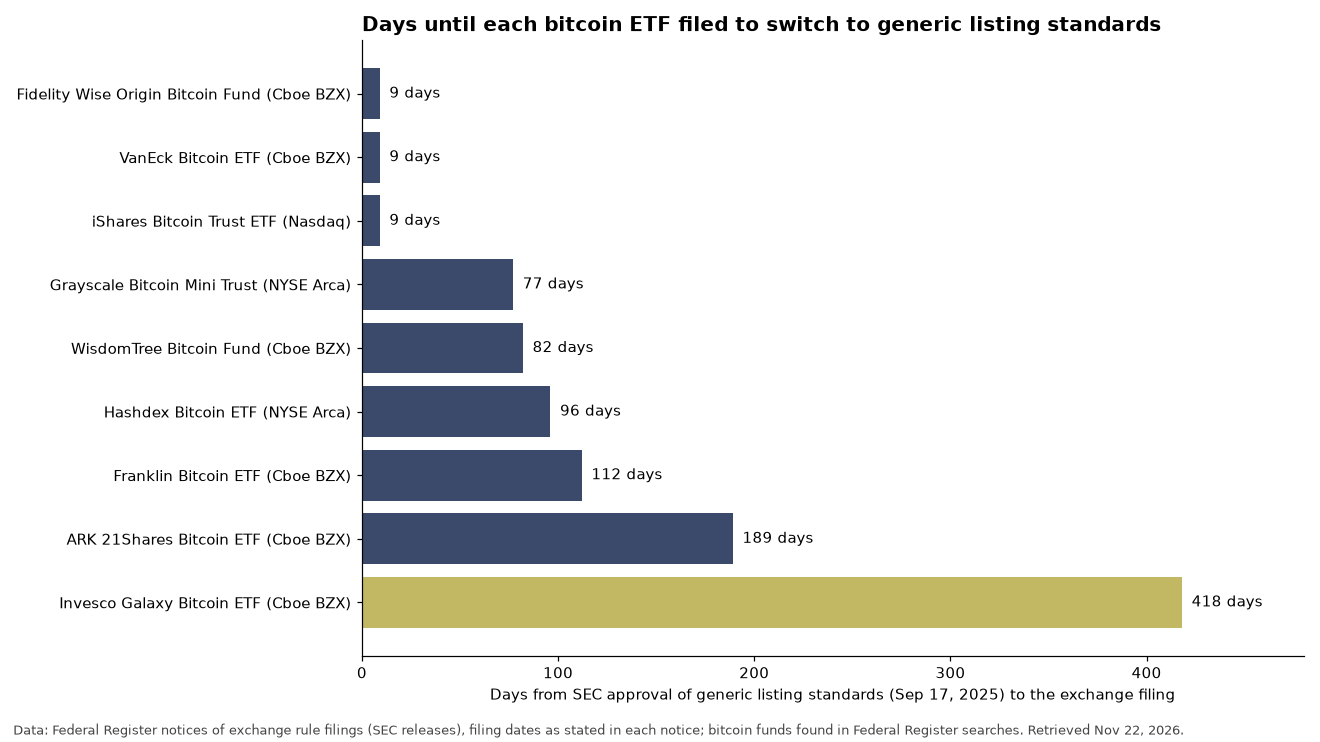
Cboe filed for the Fidelity Wise Origin Bitcoin Fund and the VanEck Bitcoin ETF on Sept. 26, 2025, just nine days after approval. Nasdaq filed for the iShares Bitcoin Trust ETF the same day.
The Grayscale Bitcoin Mini Trust, WisdomTree Bitcoin Fund, Hashdex Bitcoin ETF and Franklin Bitcoin ETF followed between December 2025 and January 2026. The ARK 21Shares Bitcoin ETF came in March 2026.
Even the largest fund needed extra time. Nasdaq’s first filing said IBIT would comply by the first quarter of 2026. A March 31, 2026 filing pushed that to the third quarter to give BlackRock “additional time to operationalize the conversion.”
Our searches did not surface comparable notices for every January 2024 fund, so we treat nine as a floor rather than a final count.
What Changes for Invesco Galaxy Shareholders?
In practical terms, very little day to day. The shares keep their listing on Cboe BZX, and the filing says it is designed to allow them “to continue listing and trading.”
The difference is in how future changes are handled. A fund tied to its own approval order is bound by the representations in that order. A fund under generic standards answers to a common rulebook that applies to every qualifying trust.
We believe that matters for a product line that keeps evolving. Invesco’s bitcoin fund added BNY as a second custodian next to Coinbase earlier this month, as we reported on Nov. 15.
A shared rulebook also helps newer and smaller products. Earlier this month, the Bitwise 10 Crypto Index ETF moved under NYSE Arca’s generic trust rules as well.
A Calm Filing in a Rough Month for Bitcoin
The timing is notable. Bitcoin traded near $60,700 on Sunday afternoon, up about 1.8% over 24 hours according to CoinGecko data, but still well below its highs after a hard November.
ETF outflows have been heavy this month, and that pressure is real. Yet the infrastructure behind these funds keeps maturing regardless of price.
For us, the key takeaway is that spot bitcoin ETFs are being treated less like experiments and more like a standard commodity product class, held to the same surveillance and continued-listing rules as other commodity trusts.
Bitcoin’s fixed supply has not changed. The regulated wrappers around it are simply getting simpler, more uniform and easier to build on.
The coming months will show whether any remaining funds follow Invesco Galaxy, and whether simpler listing rules help bring the next wave of investors back once the selling fades.
DC Forecasts is a leader in many crypto news categories, striving for the highest journalistic standards and abiding by a strict set of editorial policies. If you are interested to offer your expertise or contribute to our news website, feel free to contact us at [email protected]












Discussion about this post