



The OCEAN mining pool now finds roughly one in every 25 Bitcoin blocks, and the tool behind its growth just landed inside software that many mining farms already run.
On Nov. 18, OCEAN and fleet-management company OBM announced that DATUM, OCEAN’s protocol for building block templates on site, can now be installed directly through OBM’s Foreman platform.
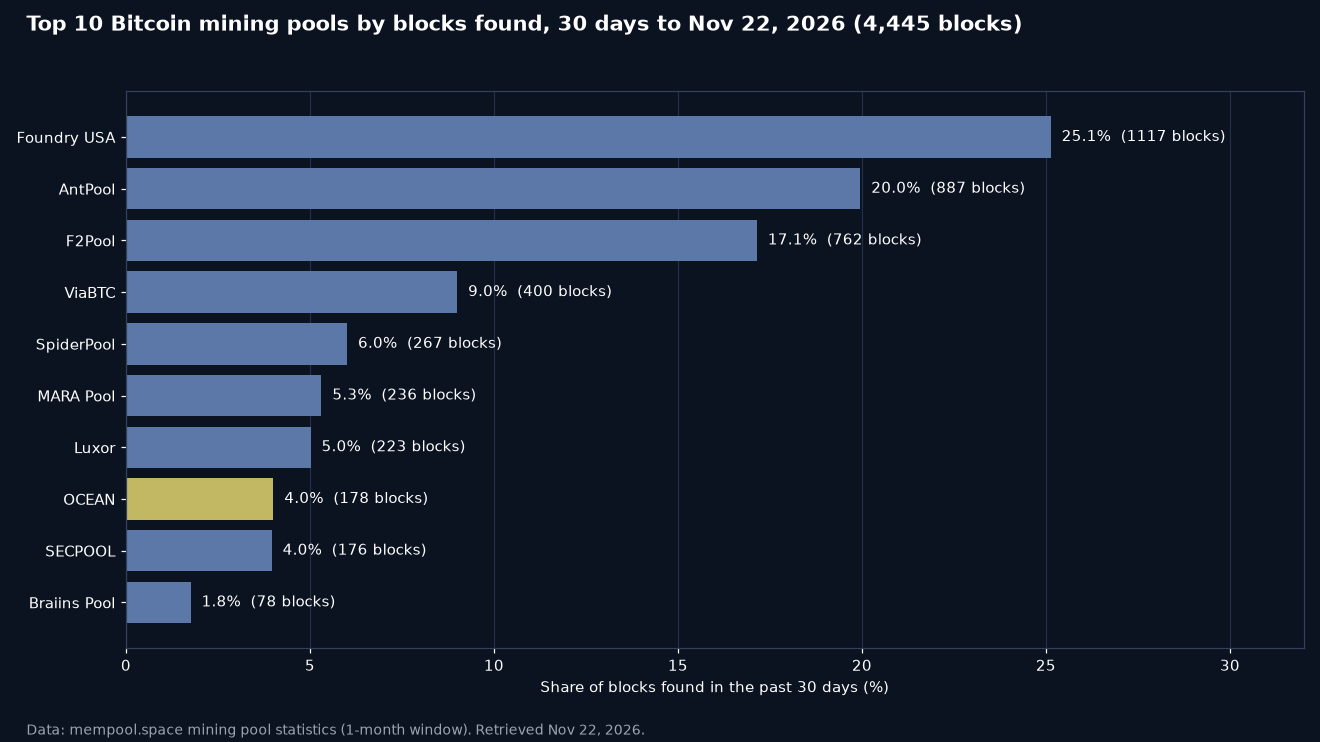
The timing is notable. Over the 30 days to Nov. 22, OCEAN found 178 of 4,445 blocks, or 4.0%, according to mempool.space pool statistics.
For Bitcoin holders, the more interesting story sits underneath the numbers: more miners are choosing which transactions go into blocks, instead of leaving that decision to a handful of large pools.
The bigger question is whether a one-click install can turn that niche habit into an industry default.
What OBM and OCEAN Actually Shipped
DATUM lets a miner build block templates locally while still sharing rewards through a pool. OCEAN developed it and launched it in 2024.
According to the companies’ Nov. 18 release, the Foreman integration installs a Bitcoin Core node and the DATUM Gateway on a supported machine running Foreman Pickaxe.
That matters because operators no longer need a separate, dedicated DATUM box. The same hardware that monitors hashrate, power and curtailment can now handle template creation and work distribution.
The release also says DATUM encrypts traffic between a mining site’s gateway and OCEAN. It contrasts that with Stratum V1 connections, which typically send mining data in plain text unless an extra encryption layer is added.

“With just a few clicks, Foreman customers can reduce wasted work and take control of their block templates without adding new hardware or another system to manage,” said Dan Lawrence, OBM’s CEO and co-founder.
How Big Is the OCEAN Mining Pool Now?
OCEAN is still a mid-sized pool, but its trajectory is steep.
Based on mempool.space weekly estimates, OCEAN’s monthly average share of blocks was 0.14% in January 2024. It averaged 1.36% in November 2025 and 4.24% across the three weekly readings so far this month.
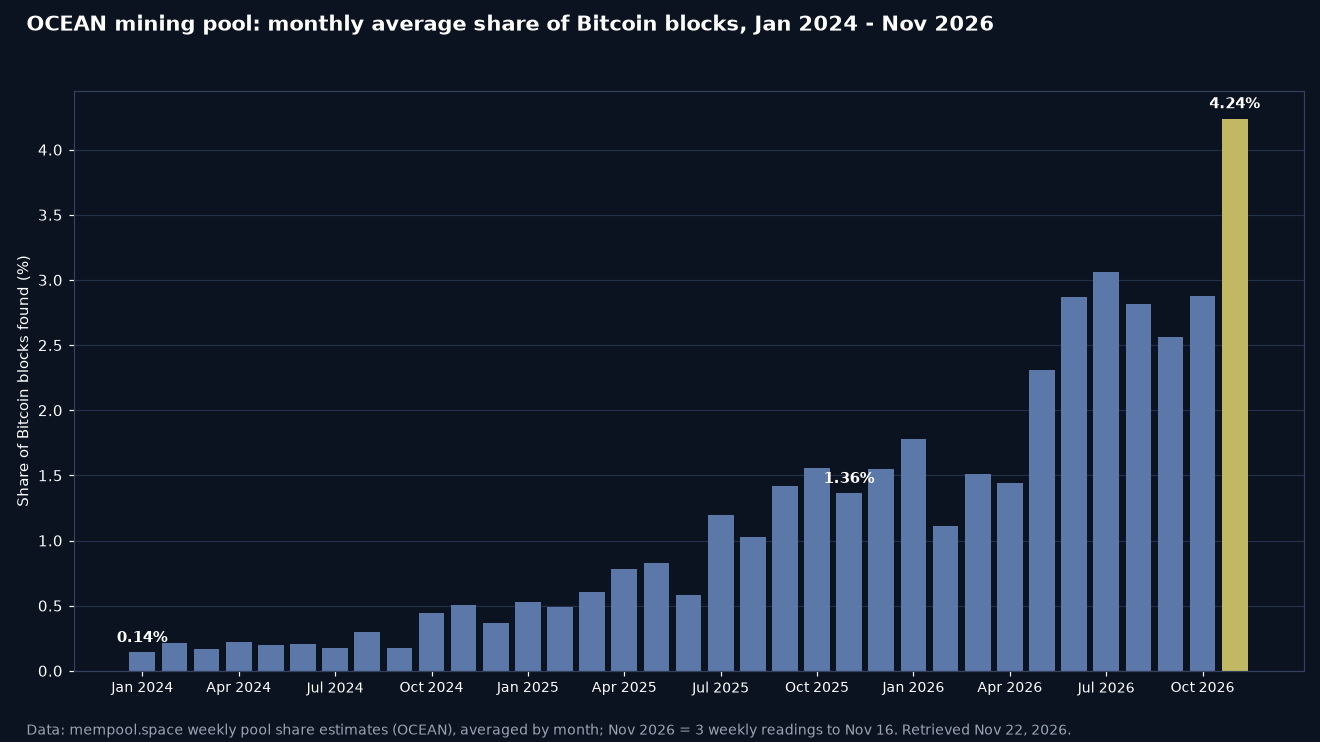
In other words, OCEAN’s share is about three times what it was a year ago and roughly 30 times its early-2024 level.
Its best recent week was the one starting Nov. 9, when it found an estimated 5.63% of blocks. Weekly figures swing with luck, so we put more weight on the 30-day number.
Separately, mempool.space places OCEAN’s estimated hashrate near 41 EH/s, in a network running at about 1.04 ZH/s. OCEAN’s own pool statistics showed 2,317 active users and 95,535 active workers on Nov. 22.
Why Block Templates Matter for Bitcoin’s Decentralization
Hashrate is spread across many companies and sites. Block construction is far more concentrated.
In the past 30 days, Foundry USA found 25.1% of blocks, AntPool 20.0% and F2Pool 17.1%, mempool.space data shows. Together, the top three pools produced 62.2% of all blocks.
In a conventional pool, the pool operator usually picks the transactions and sends the finished template to every machine. With DATUM, that choice moves back to the miner running the node.
We believe this is one of the most constructive trends in mining right now. Every miner who builds their own templates makes it harder for any single operator, or any outside pressure on that operator, to decide what Bitcoin confirms.
That is the kind of quiet resilience that rarely makes headlines but strengthens the network for every holder.
The Margin Pitch: Fewer Stale Shares, Half the Fee
Decentralization is the principle. Profitability is what gets miners to switch.
OCEAN estimates that DATUM’s stale-share and bandwidth improvements can save a 1 EH/s operation between 0.24 and 1.59 BTC per year compared with connecting directly to a pool over Stratum V1.
At Bitcoin’s CoinGecko price of about $60,733 on Nov. 22, that range works out to roughly $14,600 to $96,600 a year. That is OCEAN’s own estimate, not an independent audit, but it gives operators a concrete figure to test.
Fees add to the case. Miners building their own templates with DATUM pay a 1% OCEAN pool fee, half the pool’s standard 2%.
The companies also say DATUM cuts bandwidth by about 96% by combining thousands of machine connections into one upstream link. That helps remote sites running on Starlink or 5G.
“Miners invest heavily in turning electricity into useful work. Delays in getting new jobs to their machines can waste a portion of that work,” said Jason Hughes, OCEAN’s CTO and DATUM’s creator.
Can Easier Tools Keep the Shift Going?
The timing could hardly be more practical. As we covered when Bitcoin hashprice fell to a record low, revenue per unit of hashrate is under heavy pressure, and every fraction of a coin counts.
Large public miners have already been selling output to fund expansion, as our report on MARA and Riot’s 60,845 BTC in 2026 sales showed. Smaller operators, meanwhile, are hunting for any edge on costs.
A lower fee, fewer wasted shares and a setup that takes a few clicks is a strong combination in that environment.
For us, the key signals to watch are OCEAN’s 30-day block share, whether it can hold above 4%, and whether other fleet platforms follow Foreman’s lead.
“Miners deserve to keep more of what their work earns,” said Mark Artymko, OCEAN’s president.
Bitcoin’s fixed supply never changes. What can improve is how widely the work of securing it is shared, and the coming months will show whether one-click template building becomes standard practice across the industry.
DC Forecasts is a leader in many crypto news categories, striving for the highest journalistic standards and abiding by a strict set of editorial policies. If you are interested to offer your expertise or contribute to our news website, feel free to contact us at [email protected]











Discussion about this post