



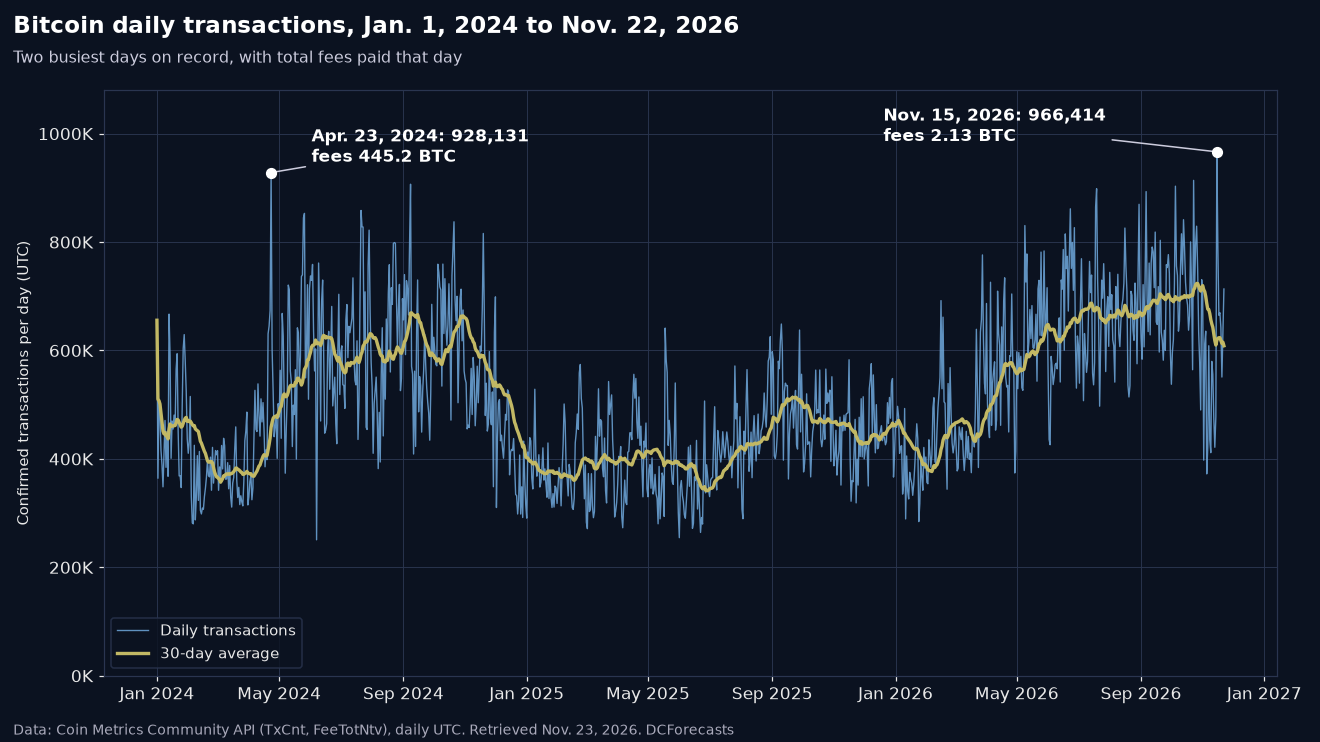
Bitcoin transactions reached a new one-day record on Sunday, Nov. 15, and the network handled the rush for a fraction of what the last record cost.
Coin Metrics data shows 966,414 transactions confirmed that UTC day, about 4% more than the previous high of 928,131 on April 23, 2024.
The fee bill tells the bigger story. Users paid about 2.13 BTC in total on Nov. 15, against roughly 445 BTC on the 2024 record day.
For Bitcoin users, that is the part worth noticing: the busiest day in the network’s history was also one of its cheapest to use.
The bigger question is what produced the spike, and whether the higher activity that followed can last.
How Bitcoin Transactions Set a New Daily Record
Block-by-block data from mempool.space tells the same story. Blocks 975,862 to 976,033, mined during Nov. 15 UTC, carried 963,618 transactions, a count that matches Blockchain.com’s daily series.
The small gap with Coin Metrics comes down to counting methods. Coin Metrics and Blockchain.com both put Nov. 15 at the top of their full histories.
The jump came out of a quiet stretch. Coin Metrics counted 477,443 transactions on Nov. 14, so activity roughly doubled in a single day.
Costs went the other way. Total fees averaged about 220 satoshis per transaction, or roughly 14 cents at that day’s $65,189 close.

On April 23, 2024, during the rush that followed the halving, the average transaction paid about 48,000 satoshis, close to $32. Total fees that day were near $29.6 million. On Nov. 15 they came to about $139,000.
We believe this is the clearest sign yet that the network can absorb record demand without pricing people out.
Why the Record Arrived the Day After a Difficulty Cut
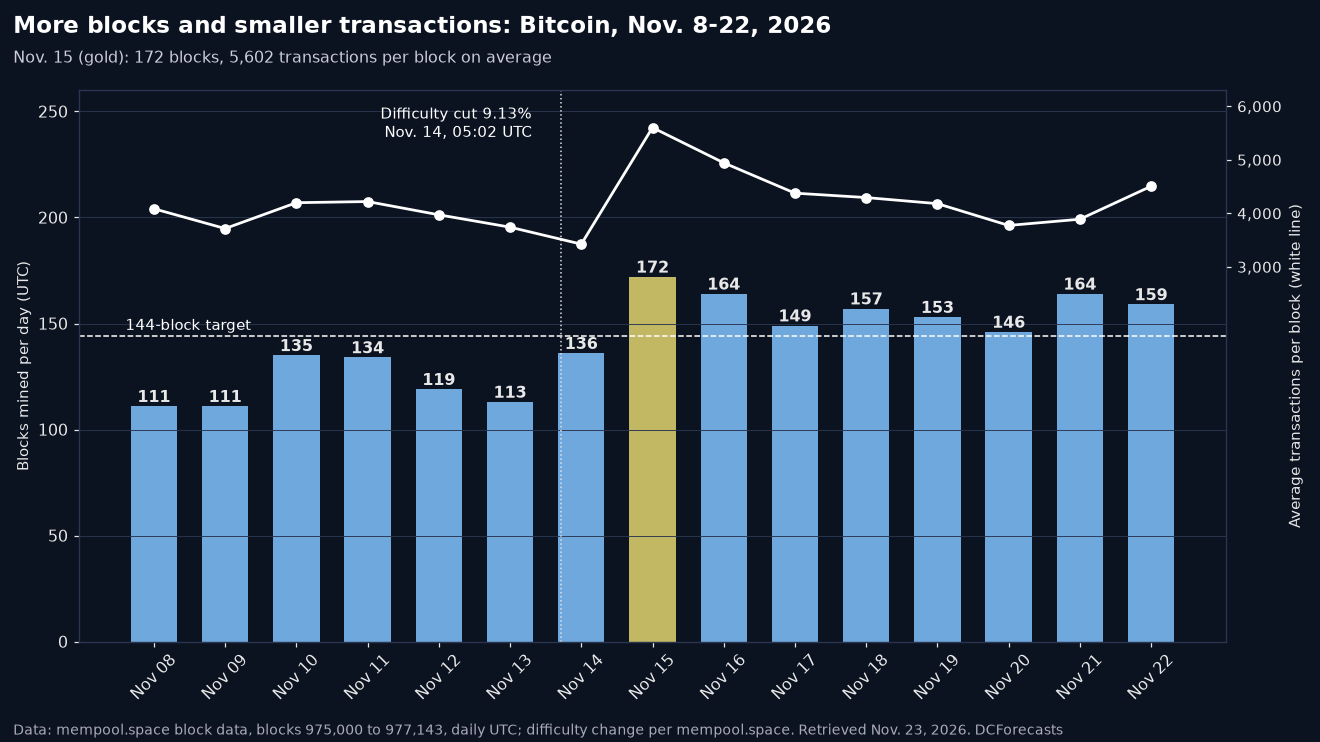
Timing explains part of it. At 05:02 UTC on Nov. 14, with block 975,744, Bitcoin’s mining difficulty fell 9.13%, according to mempool.space.
That Bitcoin difficulty adjustment came after the slowest run of blocks since June. Once difficulty dropped, the same hashrate found blocks faster.
The result was 172 blocks on Nov. 15, against the 144 a day the protocol targets. That alone gave the network about 19% more blockspace than a normal day.
The blocks were also full. In 165 of those 172 blocks, weight topped 3.99 million units against the 4 million limit.
Smaller Transactions, Fewer Addresses: What the Spike Was Made Of
Extra blocks are only half the explanation. The other half is that each transaction was unusually small.
On Nov. 15, the average transaction took up about 176 virtual bytes, compared with about 284 on Nov. 14. Blocks averaged 5,602 transactions, up from 3,425 the day before.
The busiest single block, 975,949 from AntPool, packed 9,957 transactions and collected just 354,601 satoshis in fees.
Two more readings deserve attention. The day created 2,125,181 outputs while spending 1,386,194, so the set of unspent coins grew by about 739,000 entries, the largest daily increase in our Nov. 8 to 22 sample.
Meanwhile, Coin Metrics counted 563,721 active addresses on Nov. 15, about 10% fewer than on Nov. 14.
Twice the transactions from fewer addresses points to a small number of senders splitting funds into many outputs. That could mean batched payouts, wallet housekeeping or low-value data traffic. The public data does not identify them, so we would not read the record as a sudden wave of new users.
The Week After Stayed Busier Than the Week Before
What happened next matters more than one day. From Nov. 16 to Nov. 22, mempool.space blocks carried an average of 668,983 transactions a day.
The seven days before the record averaged 480,010. That is a 39% step up, even as Bitcoin fell to about $55,150 on Nov. 21, its lowest level since September 2024.
It also reverses the cooling seen earlier in the month, when November’s first two weeks were running well below October’s record monthly pace.
Bitcoin fees stayed low through it all. As we reported, fees fell below 1 sat/vB in the typical transaction of 81 of the 144 blocks mined to Nov. 22.
There is a trade-off. Cheap blockspace means thin fee income for miners, who still rely almost entirely on the 3.125 BTC subsidy. For users, though, a busy network that settles transactions for cents is a strong place to build from.
What to Watch Before the Next Bitcoin Difficulty Adjustment
The extra blockspace will not last forever. Mempool.space estimates the next adjustment, at block 977,760, will lift difficulty by about 8.5% around Nov. 27.
If that happens, block production should slow back toward the 144-a-day pace. Daily Bitcoin transactions would then depend more on how much each block can hold than on how many blocks arrive.
We would watch three things:
- Whether daily transactions hold above 600,000 after the difficulty reset.
- Whether average transaction size stays near 200 virtual bytes, which lets each block hold more transactions within the same Bitcoin block size limit.
- Whether median fee rates climb back above 1 sat/vB as blocks slow.
For us, the key takeaway is capacity. Bitcoin processed more transactions in one day than ever before, kept almost every block full, and charged the average user about 14 cents.
The price may be under pressure, but the network itself just logged the busiest day in its history. The coming weeks will show whether that demand holds once blocks return to their normal pace.
DC Forecasts is a leader in many crypto news categories, striving for the highest journalistic standards and abiding by a strict set of editorial policies. If you are interested to offer your expertise or contribute to our news website, feel free to contact us at [email protected]












Discussion about this post