


A solo Bitcoin miner with home-scale hardware found block 977,057 on Sunday, Nov. 22, and collected a reward of about 3.07 BTC.
The block came through the Solo CK service at solo.ckpool.org at 12:54 UTC, according to mempool.space data.
It was the fifth Solo CK block of November. No calendar month has produced more for the service since May 2024, when it found seven.
For Bitcoin, that matters beyond one lucky payout. Any machine on the network, however small, can still win a block.
The bigger question is whether this streak shows anything about mining itself, or simply how luck clusters.
How a Solo Bitcoin Miner Claimed Block 977,057
Block 977,057 paid out 3.1287127 BTC: the 3.125 BTC subsidy plus 0.0037127 BTC in fees from its 584 transactions.
The coinbase transaction split that sum two ways. The miner’s address received 3.06613845 BTC, and 0.06257425 BTC, exactly 2%, went to the service’s operator.
Bitcoin traded near $60,700 at the time, according to CoinGecko data. That put the whole reward near $190,000 and the miner’s share near $186,000.
Solo CK works differently from a regular pool. Miners don’t share rewards. Each one competes alone, and whoever finds a block keeps it, minus the fee.

The service’s public statistics for the winning address show it first connected on Aug. 9, 2026, and last sent work at 17:31 UTC on Sunday.
When we checked on Monday morning, its 24-hour average hashrate was about 2.5 TH/s and its seven-day average was below 1 TH/s.
That fits a small device switched on and off, not a warehouse of machines. The winning share needed no special equipment, just a valid hash at the right moment.
Five Solo CK Blocks in 22 Days
November’s run started with two blocks on Nov. 7, at heights 974,893 and 974,930. The third, block 975,427 on Nov. 11, went to a 161 TH/s setup, as we covered at the time.
Block 976,642 followed on Nov. 19. The service’s stats show that address averaging roughly 435 TH/s over seven days, spread across several workers.
Then came Sunday’s winner, far smaller than any of them.
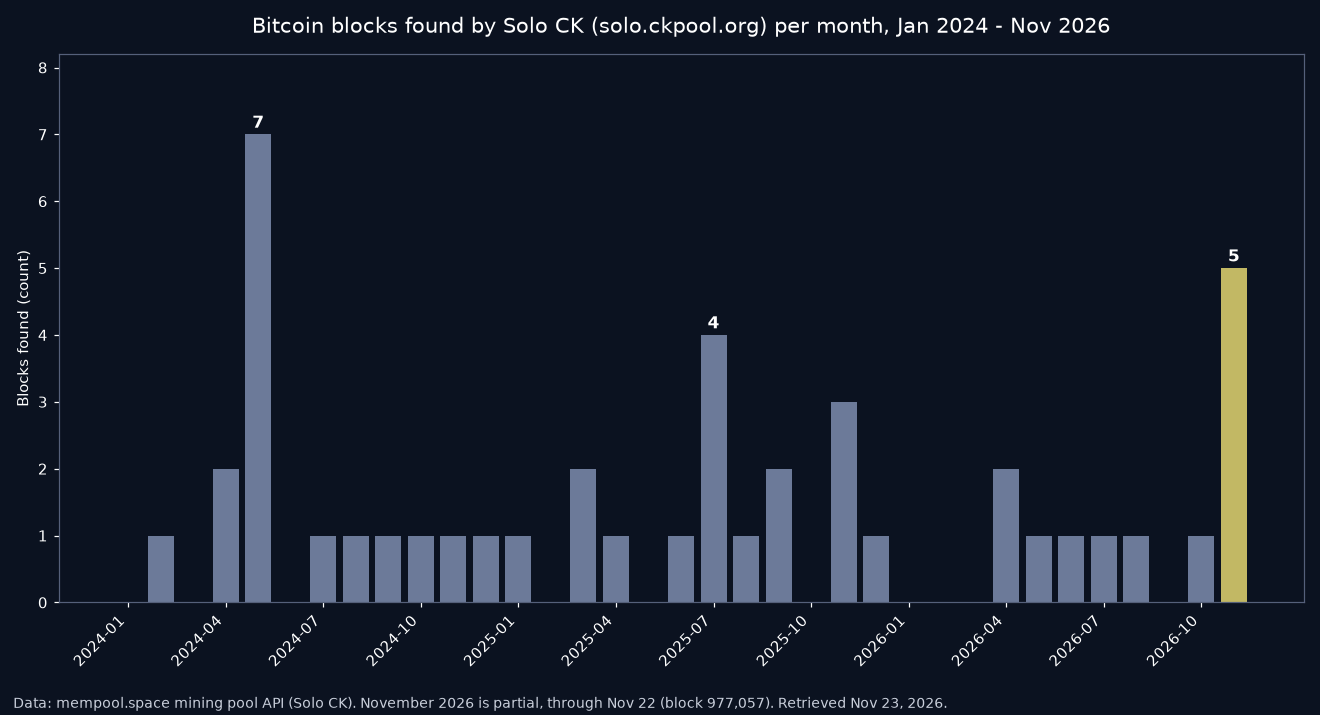
The longer record puts this in context. Solo CK found 12 blocks in 2026 through Nov. 22, and none from January to March.
In 2025 it found 16, with a peak of four in July. November 2026 has already beaten every month since May 2024.
We believe the pattern is worth reading for what it is: a cluster of wins among more than 23,000 independent miners, not a change in the rules.
Why Solo Mining Bitcoin Is Still a Long Shot
The odds are brutal for any single machine. Bitcoin’s difficulty stood at about 134.82 trillion for block 977,057, which implies roughly 965 EH/s of network hashrate.
At that level, a miner running 8 TH/s has about a 1 in 120 million chance of winning any given block, by our calculation.
Its expected wait is close to 2,300 years. A single large 200 TH/s ASIC would still expect to wait about 92 years.
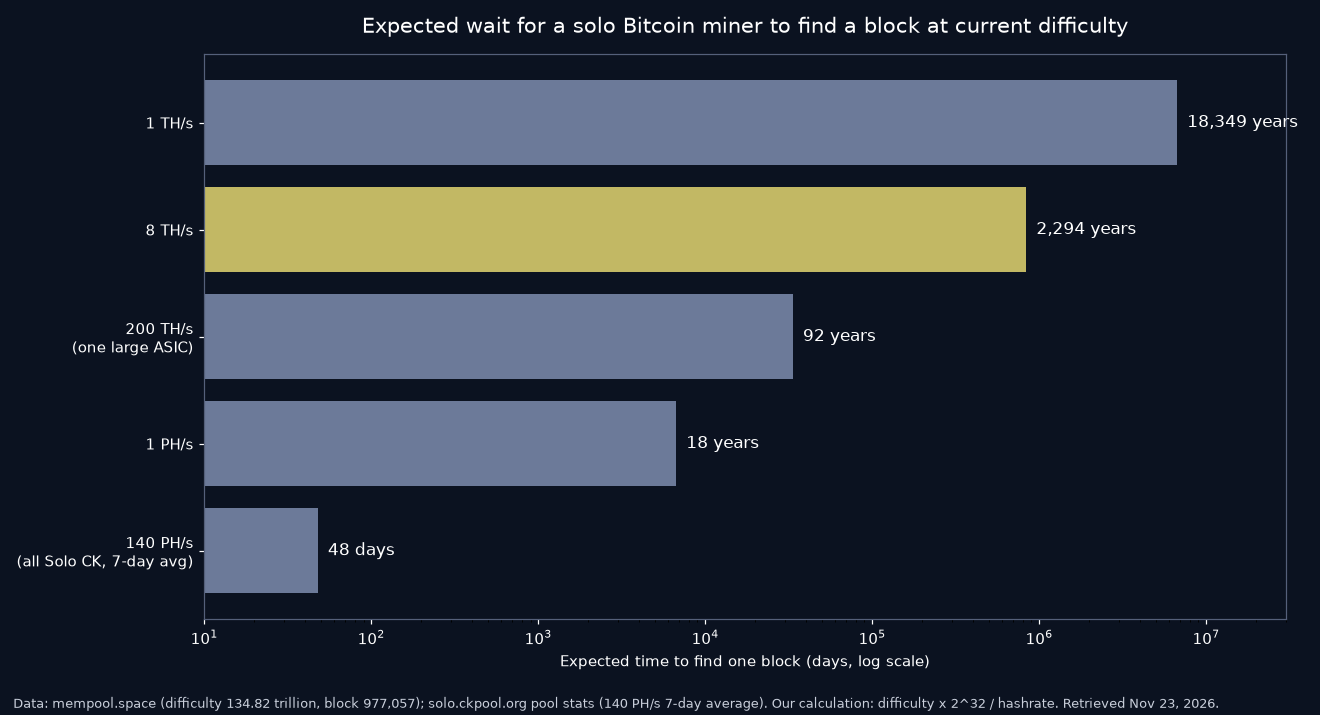
Even the whole service is small. Solo CK listed about 23,142 users and 37,541 workers on Monday, with a seven-day average of about 140 PH/s.
That is close to 0.015% of the network. At that share, the service as a group would expect roughly 0.6 blocks a month.
Over the 22 days of this streak, the expected count was under half a block. Five is an outsized run of good fortune, and we would not count on it repeating.
That is also why solo mining bitcoin is best treated as a lottery ticket that keeps the network decentralized, not as a business plan.
What the Streak Says About Bitcoin’s Open Design
For us, the key point is that nobody granted these miners permission. They pointed hardware at a public endpoint, built valid blocks and were paid by the protocol.
That holds for a 2.5 TH/s device and a 400 TH/s rack alike. Bitcoin’s rules don’t care about size, only about proof of work.
Every block from an independent miner also adds a little variety to who builds Bitcoin’s blocks. Large pools still find the vast majority of blocks, so each solo win is a small counterweight.
The timing adds an extra layer. Industrial miners are working through a tough stretch, with hashprice hitting a record low this month.
Yet hobbyists are still plugging in. We believe that kind of persistence is part of what makes Bitcoin’s security so hard to dislodge.
Can the Bitcoin Block Reward Lure More Home Miners?
Next comes the difficulty adjustment. Mempool.space estimates an increase of about 8.4% at block 977,760, expected around Nov. 27, after a 9.13% cut at the previous retarget.
A higher difficulty makes every solo ticket slightly longer odds. It also signals that blocks have sped up as hashrate returned, a vote of confidence in Bitcoin from the industry.
The Bitcoin block reward itself stays fixed at 3.125 BTC until the next halving, with fees on top.
Fees were tiny on Sunday’s block, at under 0.004 BTC. Busier blockspace would make each block worth more to whoever wins it.
We would watch three things from here: the Nov. 27 difficulty change, the hashrate on Solo CK and fee levels across blocks.
The coming weeks will show whether November’s streak was a one-off. Either way, a small device paid out by Bitcoin’s open protocol is a strong advert for the network.
DC Forecasts is a leader in many crypto news categories, striving for the highest journalistic standards and abiding by a strict set of editorial policies. If you are interested to offer your expertise or contribute to our news website, feel free to contact us at [email protected]












Discussion about this post