



Citrea, the zero-knowledge rollup that settles on Bitcoin, swaps out the engine behind every one of its proofs today in a mainnet upgrade called Pomelo.
The rollout is scheduled to start at 15:00 UTC on Monday, November 23, which is 17:00 in Jerusalem. The team confirmed it in a reminder 12 hours beforehand.
With Pomelo, both Citrea’s rollup proving and the proving behind its Clementine bridge move to SP1, the zkVM built by Succinct.
For Bitcoin holders, the interesting part is not the brand of prover. It is that a live network securing real BTC is changing its cryptographic core in a scheduled, three-hour window.
The bigger question is whether that kind of maturity can turn a small Bitcoin DeFi ecosystem into a larger one.
What the Pomelo Upgrade Changes Today
Citrea announced the upgrade on November 20. It said the switch will be delivered alongside “a series of planned fixes.”
The team warned of possibly “a few minutes” of mainnet downtime inside a 3-hour upgrade window.
The bridge may take longer. Clementine needs its distributed set of signers to finish their own upgrade, and Citrea did not give a fixed end time for that part.
Ordinary users should barely notice. Clementine only handles bridge transfers of 10 BTC or multiples of it, so everyday activity on Citrea continues while the signers catch up.

Full node operators get a short deadline. They should update between Monday and Wednesday, November 25, when the layer 2 fork activates.
Succinct summed it up in its own words: starting Monday, “every Citrea transaction and every BTC withdrawal through its bridge will be backed by SP1 proofs.”
Why Citrea Is Moving Its zk Rollup Proofs to SP1
Citrea runs a two-tier proving system. Batch proofs check that layer 2 state changes were executed correctly, and they are published to Bitcoin together with the state differences.
Light client proofs then aggregate those batch proofs and verify Bitcoin’s own consensus rules, such as proof-of-work and difficulty adjustments.
That chain of proofs feeds Clementine, a BitVM2-based bridge. Citrea says a peg-out is secured under a 1-of-N assumption, meaning one honest party, such as a watchtower, is enough to challenge a bad withdrawal on Bitcoin.
All of these circuits run inside a zkVM. Today, Citrea’s public code still builds on RISC Zero’s zkVM, according to the project’s GitHub repository, where an SP1 module sits commented out.
SP1 is a RISC-V zkVM that proves ordinary Rust code. Citrea’s proving stack is written in Rust, which the team called “a natural fit.”
We believe the swap is a healthy sign. A rollup that can change its prover without changing how users interact with it shows the zk rollup design is maturing beyond a single vendor.
How Citrea’s Bitcoin DeFi Activity Held Up in November
According to DefiLlama, total value locked on Citrea stood at $7.93 million on November 23. That is down 29% from a peak of $11.16 million on September 13.
November alone took the figure from $8.96 million to $7.93 million, an 11.5% drop.
But Bitcoin itself fell much harder over the same stretch, from about $77,520 on November 1 to about $61,490, a decline of roughly 21% in CoinGecko data.
Measured in BTC, Citrea’s TVL actually rose from 115.6 BTC to 128.9 BTC this month. That is within 11% of its 144.7 BTC high from mid-September.
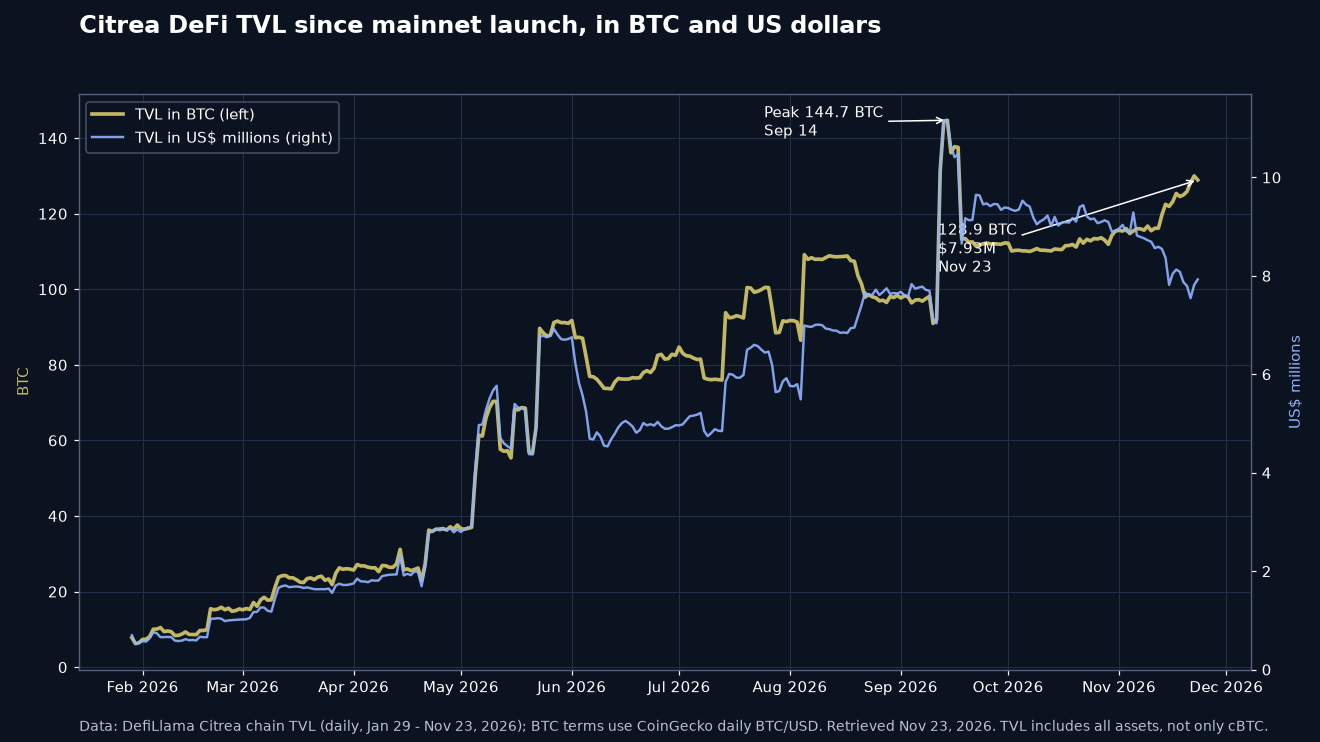
One caveat matters. TVL counts every asset on the network, including stablecoins such as ctUSD, so part of the BTC-denominated gain reflects dollar assets holding value while BTC fell.
Even so, deposits did not rush for the exits during Bitcoin’s slide to a two-year low. For a network less than ten months old, that is an encouraging signal.
Where Citrea Ranks Among Bitcoin Layer 2 Networks
Citrea went live on January 27, 2026. Its launch post promised cBTC, a trust-minimized form of BTC, alongside ctUSD, a stablecoin issued by MoonPay, and more than 30 apps.
Lending dominates today. DefiLlama lists Morpho Blue and Mystic Finance Lending as the two largest apps on the network.
Against older Bitcoin-linked networks, Citrea remains a smaller player. DefiLlama shows Rootstock at $53.12 million and Stacks at $48.85 million, while Citrea’s $7.93 million edges past Merlin at $7.39 million.
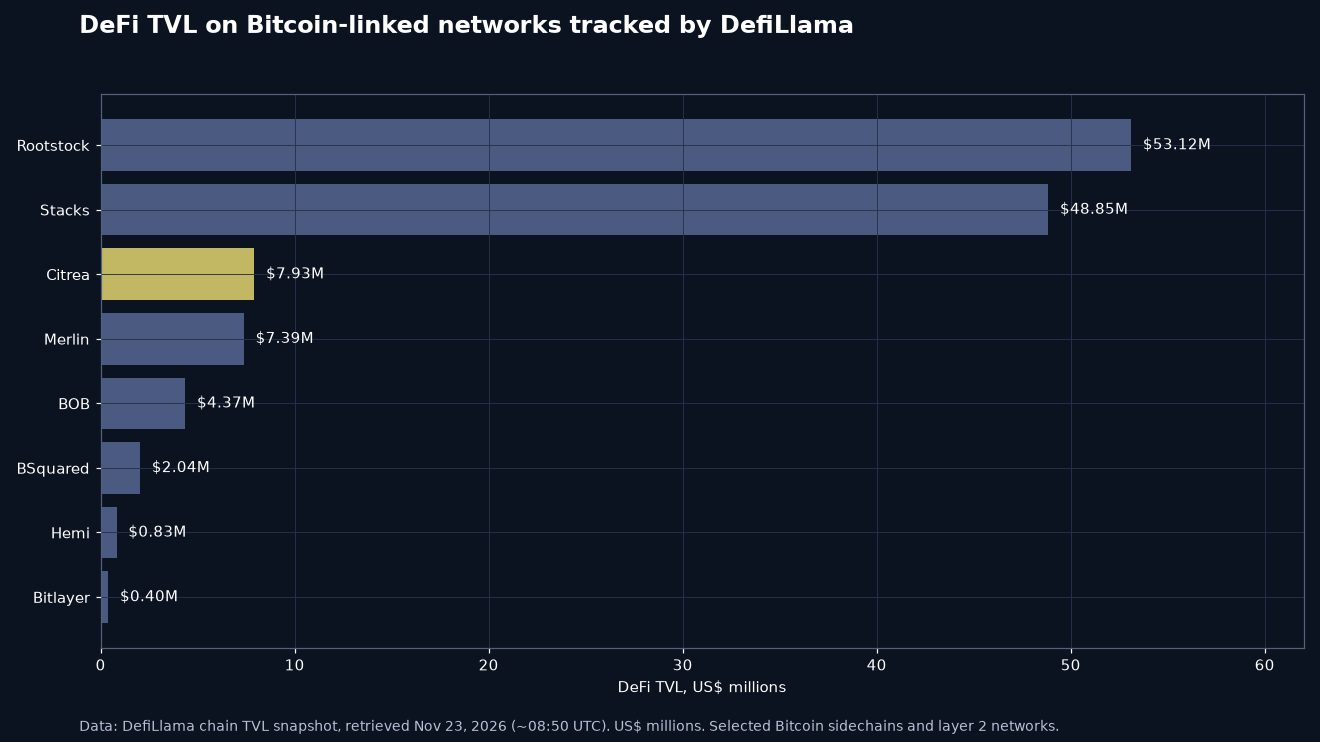
We would read that ranking with care. It measures money deposited in apps, not how secure each design is.
Still, capital is clearly willing to try a BitVM bridge rather than a small federation of custodians.
As we noted when Bitcoin collateral on Aave outgrew its old caps, demand to put BTC to work has kept growing during the drawdown.
What to Watch Through Wednesday
The first checkpoint is today’s window. Citrea has promised a post-upgrade announcement with links to its GitHub code, the SP1 integration and the exact fixes.
The second is Clementine. How quickly the signer set finishes will show how well a distributed bridge can coordinate an upgrade.
The third is November 25, when the layer 2 fork activates and any node that has not updated falls out of sync.
Developers on Bitcoin’s base layer have had a busy month too, from a large Core Lightning release to wallet changes in Bitcoin Core.
We believe that steady building matters more than any single week’s price. Bitcoin’s fixed supply gives these projects a base asset worth building on, and a smooth Pomelo rollout would add one more piece of working infrastructure around it.
If the upgrade lands cleanly, Citrea will head into December with a new prover, a tested bridge process and deposits that held up better in BTC terms than the market around them.
DC Forecasts is a leader in many crypto news categories, striving for the highest journalistic standards and abiding by a strict set of editorial policies. If you are interested to offer your expertise or contribute to our news website, feel free to contact us at [email protected]












Discussion about this post