



Credit spreads, the extra yield companies pay over U.S. Treasuries, are tighter today than they were when Bitcoin set its record close, even though BTC has since lost half its value.
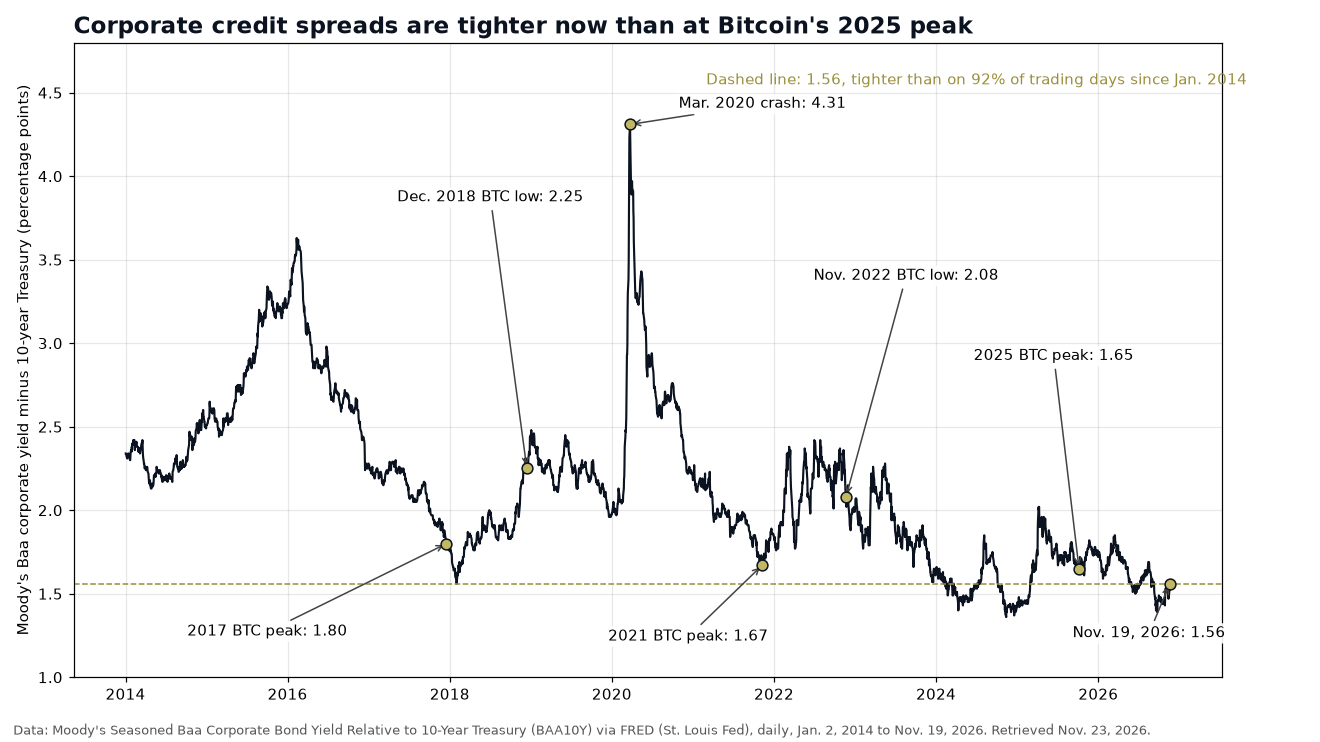
Moody’s Baa corporate bond spread over the 10-year Treasury stood at 1.56 percentage points on Nov. 19, according to St. Louis Fed (FRED) data.
On Oct. 6, 2025, the day of Bitcoin’s record daily close near $124,824 in Coin Metrics data, the same spread was 1.65.
Bitcoin closed Nov. 19 near $61,881, down 50.4% from that peak.
For Bitcoin investors, that gap matters. The deepest crypto lows of the past decade came with stress in corporate credit. This time, the bond market is calm.
The bigger question is whether that calm keeps this drawdown a crypto-specific reset rather than the start of a wider funding squeeze.
What Credit Spreads Measure, and Why Bitcoin Traders Should Care
A credit spread is the premium lenders demand to hold corporate debt instead of government bonds.
When investors fear defaults or need cash, they dump riskier bonds and spreads widen. When money is easy and confidence is high, spreads compress.
That makes corporate bond spreads one of the cleanest real-time gauges of financial stress. Bitcoin, which trades around the clock and is often sold first when portfolios need liquidity, tends to feel that stress quickly.

Over the past 52 weeks, weekly Bitcoin returns and weekly changes in the high-yield spread showed a correlation of -0.24 in our calculation. It is a loose link, but the direction is clear: wider spreads have tended to coincide with weaker Bitcoin weeks.
High Yield Spreads Hit an 18-Month High, Still Far From a Crisis
The riskier end of the market is not entirely quiet, and we want to be clear about that.
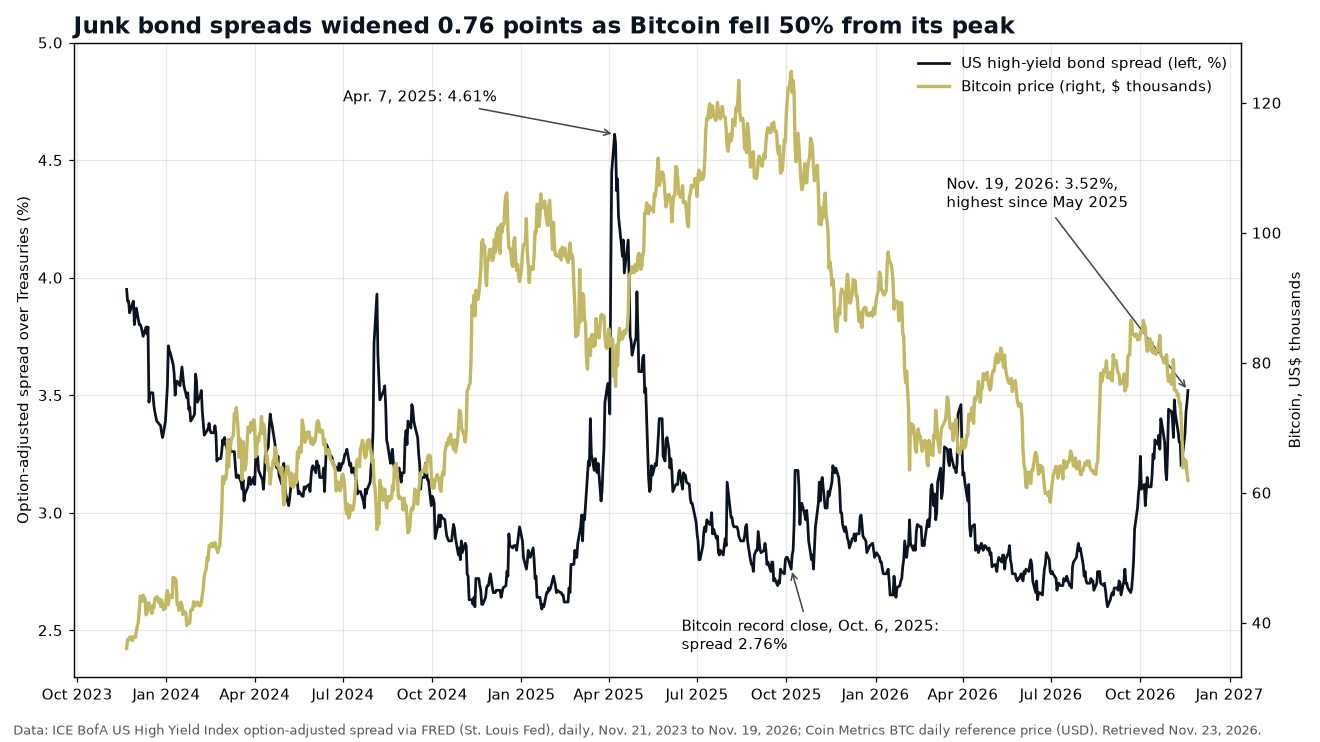
The ICE BofA US High Yield Index option-adjusted spread, the benchmark for junk bonds, rose to 3.52% on Nov. 19. That is up from 2.76% at Bitcoin’s record close and from a 2026 low of 2.60% on Aug. 28.
It is the widest reading since May 9, 2025, when the spread stood at 3.53%.
Stocks are feeling it too. The S&P 500 closed at 7,175.83 on Nov. 19, 8.2% below its Oct. 6 record close, and the VIX volatility index finished at 28.44, its highest close since March 30. We broke down how Bitcoin entered that slide in our look at the stock market correction.
Context still matters. High yield spreads hit 4.61% on April 7, 2025, during the tariff shock, more than a full point above today’s level.
Bitcoin closed that day near $79,422. Three months later it was near $108,249, a 36% gain from the stress point.
How Credit Spreads Behaved at Past Bitcoin Lows
The longer Baa series, which goes back decades, lets us compare this drawdown with earlier Bitcoin cycles.
- 2017-2018: The spread was 1.80 at Bitcoin’s December 2017 peak and 2.25 near the December 2018 low, a widening of 0.45 points.
- March 2020: The pandemic crash pushed it to 4.31 on March 23. Bitcoin closed near $6,486 that day and near $54,564 a year later.
- 2021-2022: It was 1.67 at the November 2021 peak, climbed as high as 2.42 in July 2022 and sat at 2.08 when Bitcoin bottomed in November 2022.
- 2025-2026: It was 1.65 at the October 2025 peak and 1.56 on Nov. 19, a narrowing of 0.09 points.
In both previous bear markets, Bitcoin’s low arrived with corporate credit under visible pressure. Today the Baa spread is tighter than on 92% of trading days since January 2014.
Why a Calm Credit Market Can Favor Bitcoin
We believe this is the most underappreciated feature of the current sell-off.
A 50% fall in Bitcoin with tight corporate spreads points to positioning, leverage and sentiment inside crypto, not to a system-wide scramble for cash.
That distinction matters for recovery speed. When credit seizes up, forced selling spreads across every asset and can last for months. When credit stays open, buyers with capital can step in as soon as crypto-specific selling is exhausted.
The broader liquidity backdrop also looks friendlier than in 2022, as we showed in our analysis of Fed liquidity since quantitative tightening ended.
Investment-grade spreads tell the same story. The ICE BofA US Corporate Index spread was 0.94% on Nov. 19, up from 0.74% at Bitcoin’s peak but still below the 1.17% it showed in November 2023.
None of this guarantees a quick rebound. Bitcoin can still fall further on its own flows. But we think a market that is falling without a credit accident behind it has a cleaner path back once sellers tire.
The Credit Levels We Are Watching From Here
The junk bond spread is the indicator to watch. A move back toward April 2025’s 4.61% would signal that stress is leaking from stocks into credit, and Bitcoin would likely feel it.
If spreads stabilize near 3.5% or start to narrow, it would strengthen the case that Bitcoin’s slide is a self-contained reset.
We will also track the Baa spread. As long as it stays below the 2.0-2.25 zone seen at the last two cycle lows, the bond market is not echoing Bitcoin’s pessimism.
For long-term holders, the bigger picture has not changed. Bitcoin’s supply schedule is fixed, institutional access through ETFs and regulated venues keeps widening, and the credit system that funds new buyers is still open for business.
The coming weeks will show whether credit markets stay calm. If they do, Bitcoin’s 50% drawdown may be remembered as a crypto shakeout that the wider financial system barely noticed.
DC Forecasts is a leader in many crypto news categories, striving for the highest journalistic standards and abiding by a strict set of editorial policies. If you are interested to offer your expertise or contribute to our news website, feel free to contact us at [email protected]












Discussion about this post