


The KOSPI crash has pushed South Korea’s government into its contingency plan, and the first measure takes effect on Tuesday.
The Financial Services Commission said on Monday, Nov. 23, that listed companies can buy back their own shares without the usual daily order cap for three months, from Nov. 24, 2026 to Feb. 23, 2027.
The decision followed an emergency market meeting on Sunday, where officials also agreed to prepare the country’s Stock Market Stabilization Fund for activation “as market conditions warrant.”
The KOSPI closed at 4,708.54 on Monday, down 3.31% on the day and 48.3% below its June 22 record close of 9,114.55, according to Yahoo Finance data.
Over the same stretch, Bitcoin is down about 4%. The bigger question now is whether Seoul’s measures can slow the selling before the next leg of the global tech sell-off reaches Asia.
What Seoul Changed for Share Buybacks
The FSC adopted the change at its 20th regular meeting on Nov. 23, through an expedited resolution, according to its press release.
Under the current rule, a company buying its own stock directly faces a daily limit. It is the smaller of 1% of its issued shares and the larger of two numbers: 10% of the shares it plans to buy, or 25% of average daily volume in the month before the board approved the buyback.
For the next three months, that cap disappears. A company can place orders for the full planned quantity in a single session.
Buybacks run through a trust also loosen. The old ceiling of 1% of issued shares is replaced by the total amount of assets entrusted.

We believe this is the quickest lever Seoul has. It costs the state nothing, and it lets companies that already believe their shares are cheap act at the speed the market is moving.
The Three-Part Contingency Plan
The buyback change is one of three steps agreed at Sunday’s Emergency Market Situation Review Meeting, according to a Ministry of Finance and Economy release.
Deputy Prime Minister and Finance Minister Lee Hyoung Il chaired the meeting with the Bank of Korea governor, the FSC chairman and the head of the Financial Supervisory Service.
- The stabilization fund: the government will “immediately begin the necessary preparations,” including activation procedures, so the fund can be deployed promptly.
- Buybacks: daily share repurchase limits are eased for three months from Nov. 24.
- Short selling and leverage: the FSS and the Korea Exchange will run three months of intensified monitoring for illegal short selling, and will watch margin lending, unsettled trades and forced liquidations to stop “cascading selling pressure.”
Officials blamed volatility on uncertainty around the global AI and semiconductor industries and on possible U.S. interest rate hikes. They pointed to doubts over AI profitability and financing, U.S. rules on data centers and tighter chip export controls.
They also said medium- to long-term expectations for the AI industry “remain largely intact,” and urged investors to avoid panic selling.
How Deep Is the KOSPI Crash?
Monday’s session was rough. The index touched an intraday low of 4,586.80, 5.8% below Friday’s close, before trimming the loss.
It followed a 5.21% drop on Friday, Nov. 20. Across the two sessions, the KOSPI lost 8.4%, and Monday’s close was its lowest since Jan. 13.
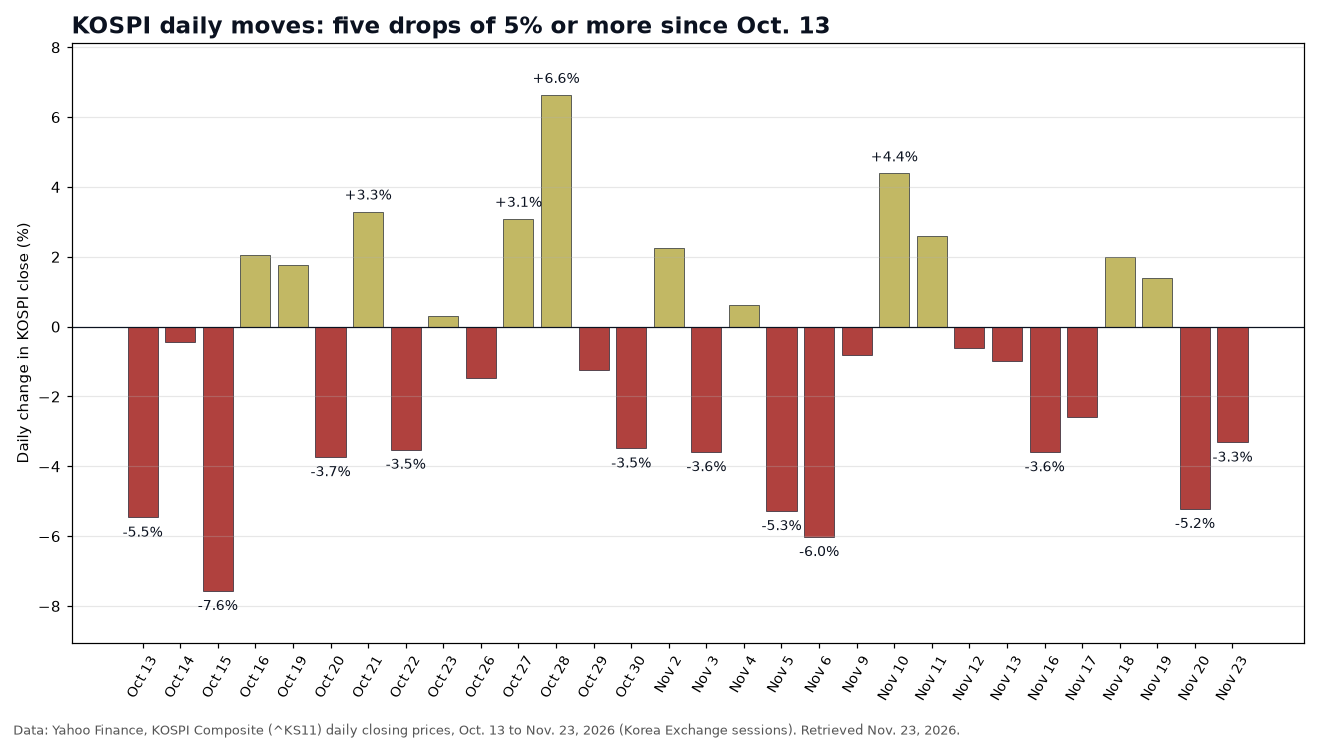
The chart shows how violent the autumn has been. Since Oct. 13, the KOSPI has had five daily declines of 5% or more, with the largest a 7.6% fall on Oct. 15.
Chip heavyweights led the way again. Samsung Electronics closed at 177,500 won on Monday, down 14.7% since Nov. 12, while SK Hynix slipped 2.5% on the day to 1,085,000 won.
Pressure also came from the U.S. Nvidia shares closed at $125.53 on Friday, a 14.0% one-day drop.
There is one constructive detail. Even after the slide, the KOSPI is still 11.7% above where it ended 2025, at 4,214.17.
Bitcoin Held Up Better Than Korean Stocks Since June
The contrast with Bitcoin is striking. BTC closed at about $63,952 on June 22, the day of the KOSPI’s record, and traded near $61,280 at 10:09 UTC on Monday.
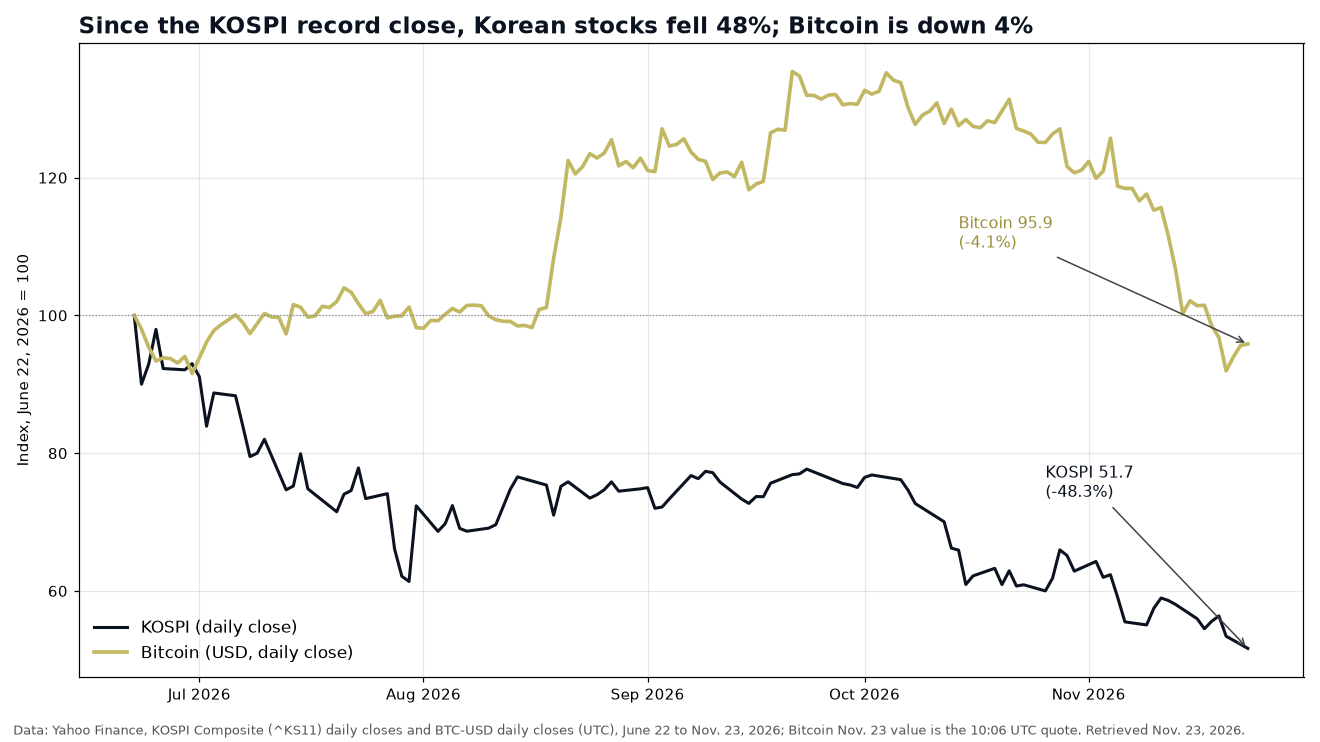
We want to be clear about the limits of that comparison. Bitcoin has had its own deep drawdown since its October 2025 peak, and it fell harder than Wall Street before this month’s stock correction, as we showed in our look at the stock market correction.
Still, Bitcoin has been firmer over the past two sessions. It is up about 4.2% from Friday’s close of $58,799, while the KOSPI lost 8.4%.
Korean crypto markets moved the same way. On Upbit, BTC traded near 83.7 million won on Monday evening, up from 81.1 million won at the close of Friday’s daily candle. Local demand had already shown up in the premium we tracked in our kimchi premium report.
For us, the takeaway is simple. An asset with fixed supply and no single earnings driver is not exposed to the same chip-cycle risks that dominate the KOSPI.
What We Will Watch as the Buyback Window Opens
The first test comes on Tuesday, when the looser buyback rule takes effect. Announcements from large chipmakers and financial groups would show whether companies are willing to use it.
The second is the stabilization fund. Seoul is preparing it, not activating it, and Sunday’s release set no trigger level.
The third is U.S. rates. Korean officials named possible U.S. hikes as a direct source of stress, and the Fed’s December decision now matters for Seoul as much as for crypto markets.
We believe Bitcoin has already shown more resilience than Korea’s benchmark through this sell-off. If the KOSPI crash steadies and global risk appetite returns, BTC could be one of the first assets to benefit.
The coming sessions will show whether Seoul’s measures turn the panic into a floor.
DC Forecasts is a leader in many crypto news categories, striving for the highest journalistic standards and abiding by a strict set of editorial policies. If you are interested to offer your expertise or contribute to our news website, feel free to contact us at [email protected]







Discussion about this post