



Tokenized assets issued on Europe’s licensed blockchain pilot platforms are on track to become collateral for European Central Bank loans, after the ECB’s Governing Council approved the step on Monday.
The decision, announced on November 23, covers marketable assets issued on platforms licensed under the EU’s DLT Pilot Regime.
The Eurosystem plans to publish the detailed requirements in spring 2027, and implementation is planned for June 2027.
For anyone following blockchain adoption, this is the plumbing that matters: what a central bank accepts as collateral shapes what banks want to hold.
The bigger question now is how quickly issuers will bring real volume onto these platforms once the door is formally open.
What the ECB Approved for Tokenized Assets
According to the ECB press release, the assets must meet all of the standard collateral eligibility criteria that apply to any bond.
They also have to reach the Eurosystem through an eligible link to a central securities depository whose settlement system complies with the Central Securities Depositories Regulation and settles in TARGET2-Securities.
A DLT Pilot Regime licence alone will not be enough.
The platforms must also meet dedicated Eurosystem requirements on legal certainty and operational safety, with the ECB naming settlement finality designation and the outsourcing of critical functions as examples.

“We support innovation without lowering our standards,” Executive Board member Isabel Schnabel said in the release.
“A future-proof collateral framework must embrace new technologies without compromising on safety or the rigour of our risk assessment,” she added.
A Second Step After the March Opening
Monday’s move builds on an ECB decision from January 27, 2026.
That earlier ruling made marketable assets issued in central securities depositories using DLT-based services eligible from March 30, 2026, provided they could settle through the existing system.
The new decision reaches one layer further out, to platforms that hold a licence under the DLT Pilot Regime rather than operating as traditional depositories.
It still stops short of assets issued and settled entirely on DLT networks, which the ECB says its roadmap will keep exploring.
We believe that sequencing is sensible. Each step widens the circle of eligible tokenized bonds without asking the central bank to relax its risk rules.
How Big Is the ECB Collateral Pool Today?
The scale of the existing framework puts the decision in context.
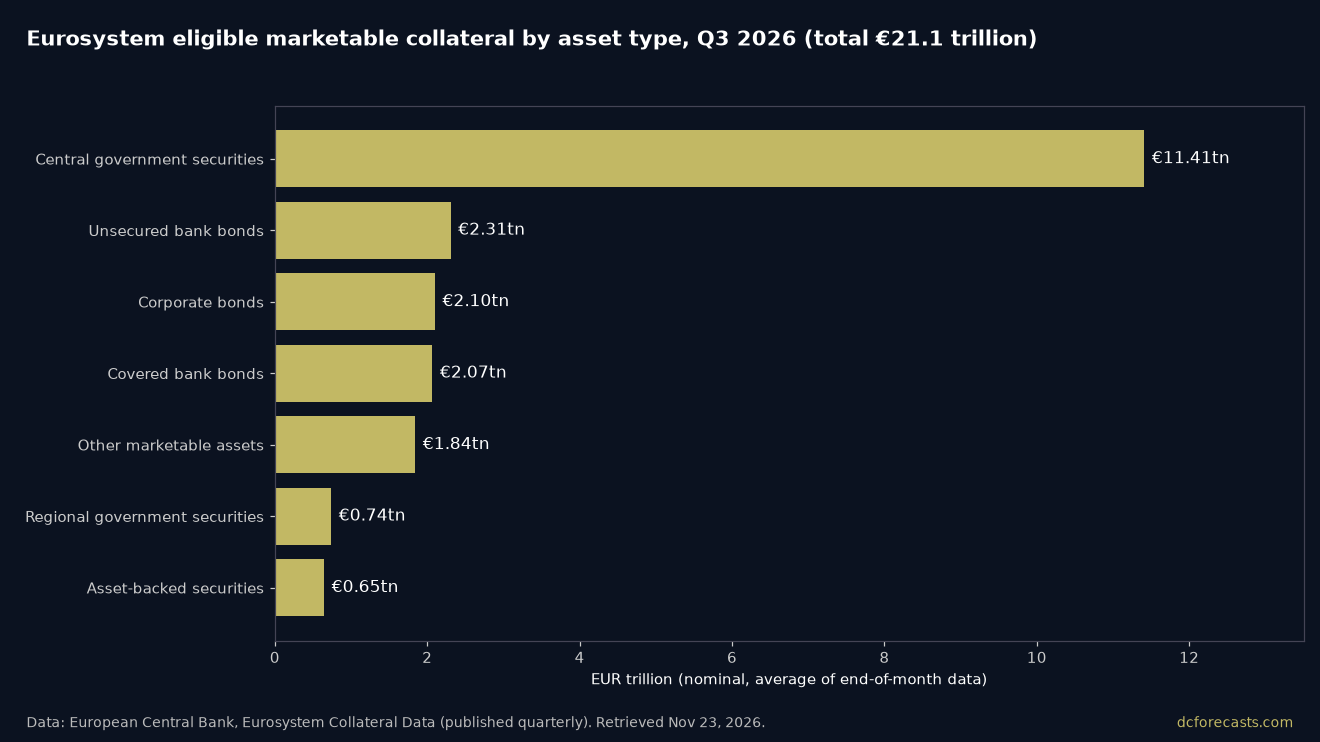
ECB collateral data show the Eurosystem counted €21.1 trillion of eligible marketable assets in the third quarter of 2026, measured as nominal averages of end-of-month data.
Central government securities made up €11.41 trillion of that, more than half of the total.
Tokenized assets will enter this pool under the same criteria as everything else, so they do not get a separate, softer lane.
For issuers, that matters. Collateral eligibility can make a bond more useful to banks, which may help explain why the ECB frames the decision as support for Europe’s tokenized market.
Why ECB Collateral Eligibility Is About More Than Borrowing
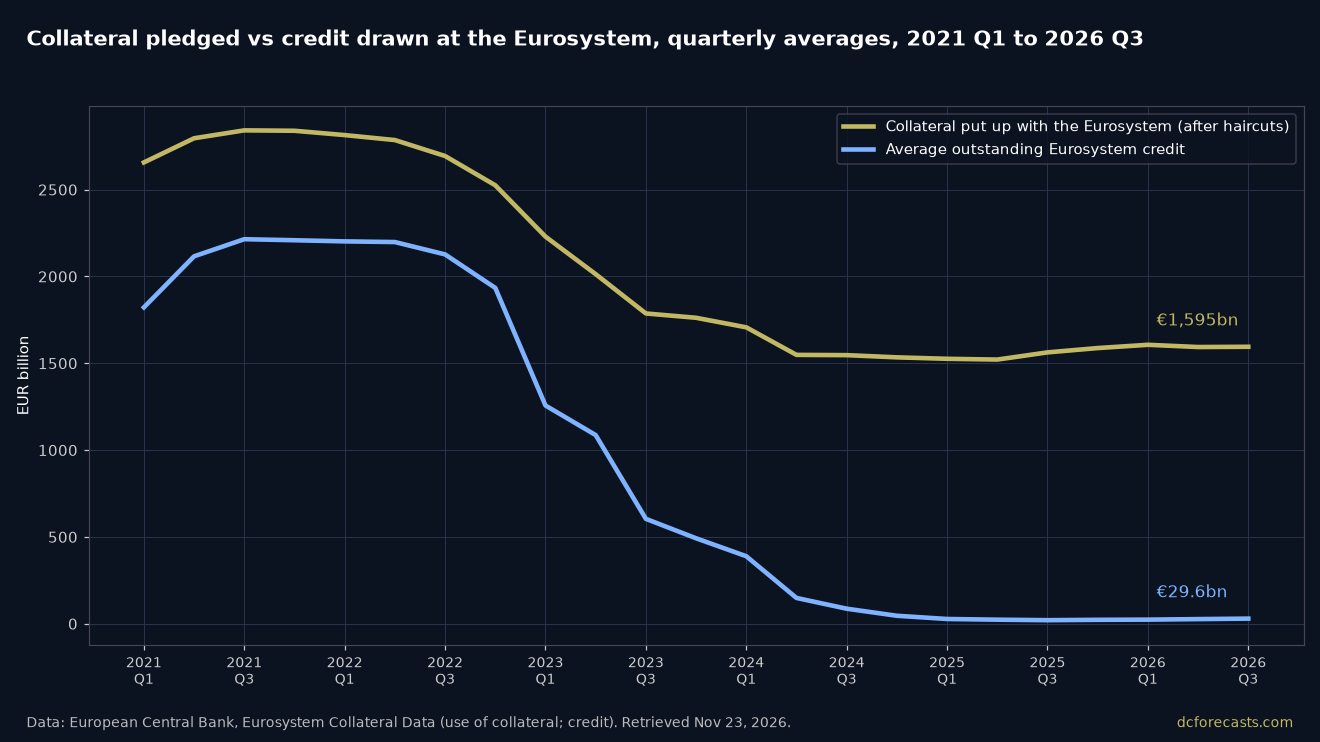
Banks pledge far more collateral than they actually borrow against today.
In the third quarter of 2026, collateral put up with the Eurosystem averaged €1,595 billion after valuation and haircuts, while average outstanding Eurosystem credit was only €29.6 billion.
That gap is much wider than in the third quarter of 2022, when average credit stood at €2,127 billion against €2,693 billion of collateral.
So we would not expect a sudden wave of tokenized borrowing at the ECB in 2027.
The value is in status. An asset that the central bank accepts sits closer to the core of the financial system, and we believe that makes it easier for banks to justify building tokenized bond desks around it.
Pontes, Appia and the DLT Pilot Regime Roadmap
The collateral decision is one piece of a wider Eurosystem programme.
Pontes, the ECB’s link between market DLT platforms and its TARGET payment services, had its initial launch on September 21, 2026, letting wholesale DLT transactions settle in central bank money.
Appia, the longer-term track, aims to deliver a blueprint for a European tokenized financial ecosystem by 2028.
“Pontes and Appia are helping turn Europe’s vision for tokenised finance into reality,” Executive Board member Piero Cipollone said on Monday.
That fits a busy month for the ECB, which recently opened a test bed for tokenized deposits and saw President Christine Lagarde warn that Europe has a short window to build its tokenized market.
The Eurosystem’s own exploratory work in 2024 drew 64 market participants into more than 50 trials and experiments, a sign the industry interest is real.
What Comes Next for Tokenized Bonds in Europe?
The next milestone is spring 2027, when the Eurosystem expects to spell out the extra requirements for DLT platforms.
The June 2027 start date will then show how many pilot platforms can actually meet them.
We would watch three things: how many platforms clear the settlement finality test, how much euro debt is issued on them, and whether banks begin pledging those securities alongside their existing bond collateral.
For Bitcoin holders, the lesson is a broader one. Public blockchains proved that digital assets could settle without a central operator, and Europe’s central bank is now building that idea into its most conservative machinery.
We believe every step that makes blockchain settlement normal for banks also makes the wider digital asset market, with Bitcoin at its center, easier for institutions to understand.
The coming months will reveal whether Europe’s issuers move as fast as its central bank.
DC Forecasts is a leader in many crypto news categories, striving for the highest journalistic standards and abiding by a strict set of editorial policies. If you are interested to offer your expertise or contribute to our news website, feel free to contact us at [email protected]












Discussion about this post