



CleanSpark stock now has more bitcoin behind each share than it did a year ago, even though the miner booked a $987.1 million net loss for the fiscal year that ended on September 30.
The company reported its results on November 24 and filed its annual report with the SEC the same day.
It closed the year with 13,530 BTC, counting coins posted as collateral. That is 519 more than the 13,011 it held twelve months earlier.
Over the same period, shares outstanding fell 8.4%, from 284.3 million to 260.5 million.
For Bitcoin investors, the useful detail is that one of the largest public miners grew its stack in a year when its mining margins were squeezed. The bigger question is how long that holds as CleanSpark spends billions turning sites into AI data centers.
What CleanSpark Earnings Showed for Fiscal 2026
Revenue fell 25% to $576.5 million for the year. Fourth-quarter revenue was $120.9 million, down 46% from a year earlier.
The fourth quarter itself was profitable, with net income of $9.8 million, or $0.04 per share.
The full-year loss came to $3.74 per share. Much of it was accounting rather than cash. The company recorded a $281.6 million fair-value loss on its bitcoin, a $118.7 million loss on bitcoin posted as collateral and $177.1 million of impairments.
Those three items alone add up to about $577 million of the $987.1 million loss.

Chief Executive Matt Schultz called fiscal 2026 “a defining year for CleanSpark as we made significant progress in executing our strategic transformation.”
Why CleanSpark Stock Holds More Bitcoin per Share
The annual report on Form 10-K shows 11,720 BTC on hand at September 30, plus a receivable for 1,810 BTC posted as collateral.
A year earlier, the split was 10,428 on hand and 2,583 in collateral.
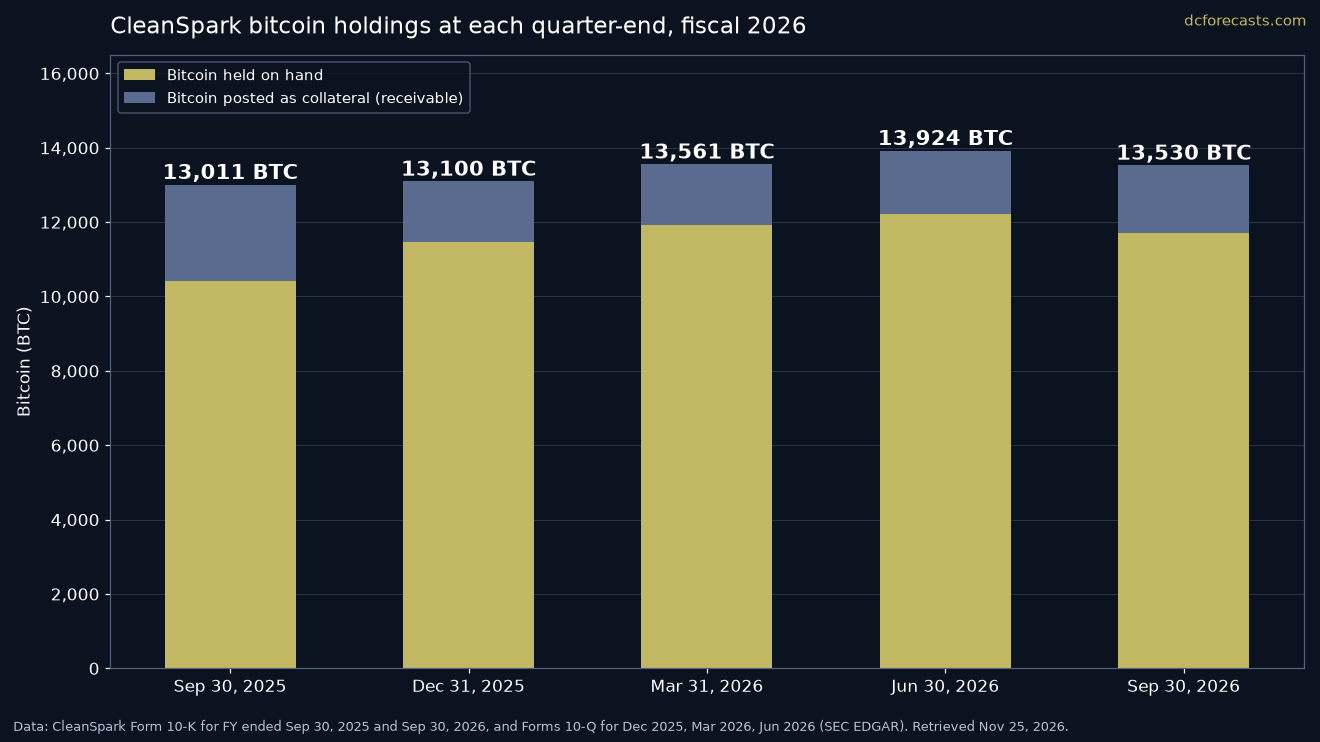
The stack peaked at 13,924 BTC at the end of June before easing in the fourth quarter.
The share count is the other half of the math. In November 2025, alongside a $1.15 billion issue of 0% convertible notes due 2032, CleanSpark bought back 30.6 million of its own shares for about $460 million.
By our calculation, that leaves roughly 51.9 BTC per million shares outstanding, up from 45.8 a year earlier, a gain of 13.5%.
We believe that is the clearest sign that management still treats bitcoin as a core reserve rather than inventory to dump. The company sold 1,532 BTC during the year and moved 6,068 BTC to settle derivative contracts. Its treasury program also used miner purchase deals with Bitmain that were paid in bitcoin and came with options to buy the coins back.
The Bitcoin Mining Cost Squeeze in the Numbers
The mining business had a harder year.
CleanSpark mined 7,236 BTC net of pool fees, down 7.9% from 7,857 BTC. Its September hashrate averaged 36.0 EH/s, against 45.6 EH/s a year earlier.
The company said it switched off some machines when they were unprofitable. It owned about 335,168 miners, of which roughly 199,745 were running at year-end.
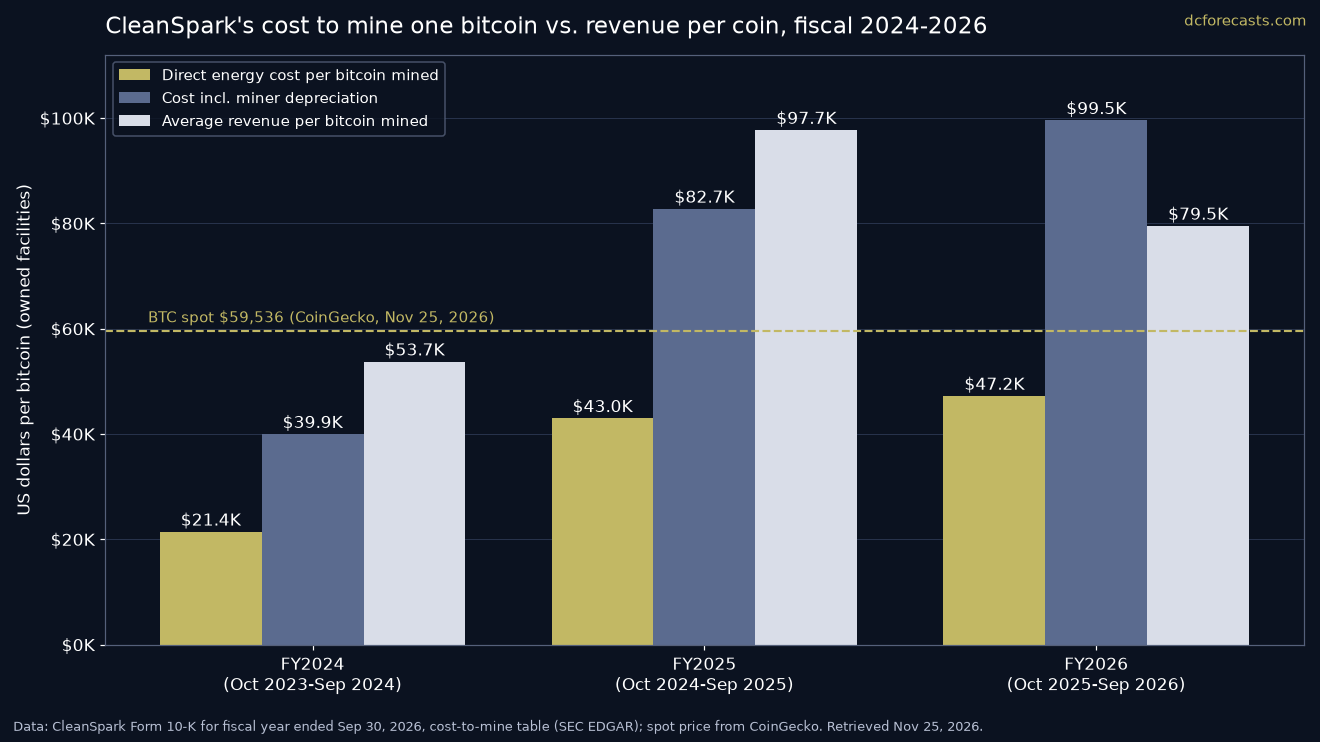
The direct energy cost of each bitcoin rose to $47,196 from $42,956. Including miner depreciation, the cost reached $99,548, while average revenue per coin fell to $79,489.
The fleet did get leaner. Efficiency improved to 14.8 joules per terahash from 16.7, and power cost $0.055 per kWh against $0.057.
With bitcoin at $59,536 on CoinGecko on Wednesday, the spot price sits about 26% above that energy cost, though still below the all-in figure.
As we noted in our look at the first annual hash rate decline since 2021, weaker miners switching off is part of how the network rebalances. The 10-K puts global hashrate at 987 EH/s at the end of September, down from 1,060 EH/s.
From Hashrate to AI Data Center Leases
The bigger story in the results is the pivot. CleanSpark now describes itself as a data center developer, with up to 2.1 GW of power, land and data centers across the United States.
- Sandersville, Georgia: a 20-year, $6.6 billion triple-net lease with a high investment-grade tenant, funded by $2.276 billion of 7.875% senior secured notes due 2031. The first data hall is planned for November 2027.
- Texas: acquisitions at Sealy (285 MW) and Brazoria (up to 600 MW), with 585 MW given conditional Batch Zero baseload status.
The trade-off sits on the balance sheet. Long-term debt rose to $3.99 billion from $644.6 million, partly offset by $2.14 billion of restricted cash. Stockholders’ equity fell to $786.0 million from $2.18 billion.
The data center business had not yet produced any revenue as of September 30.
We think investors should read the bitcoin stack as the company’s bridge: about $1.13 billion of liquid reserves, alongside $204.8 million of cash, while the first data hall is still about a year away.
What to Watch Next for CleanSpark and Bitcoin
For us, three markers stand out over the coming quarters.
- Whether bitcoin per share keeps rising as the company funds construction.
- How much hashrate CleanSpark keeps switching on while bitcoin trades near $60,000.
- Progress at Sandersville toward the November 2027 data hall.
Investors can track it alongside the wider group in our study of how bitcoin mining stocks now trade more like chipmakers.
A miner that kept adding to its stack through a year of curtailments and a 25% revenue drop is sending a message about how it values the asset.
Bitcoin’s fixed supply means every coin held through a downturn is one fewer available when demand returns. The coming quarters will show whether CleanSpark can build its AI business without letting go of that reserve.
DC Forecasts is a leader in many crypto news categories, striving for the highest journalistic standards and abiding by a strict set of editorial policies. If you are interested to offer your expertise or contribute to our news website, feel free to contact us at [email protected]












Discussion about this post