



Is Bitcoin dead? Judging by how many people bothered to look it up this summer, the crowd seemed to think so, yet the latest reading data points the other way.
English Wikipedia’s “Bitcoin” article averaged just 2,788 human page views a day in July 2026, according to the Wikimedia Pageviews API. That is the weakest month since the foundation’s per-article records began in July 2015.
November tells a different story. From Nov. 1 to Nov. 23, the article drew 4,085 views a day, 34% more than in October and 46% more than in July.
That rebound arrived while Bitcoin fell from about $77,400 at the end of October to roughly $59,800 on Nov. 24, based on Coin Metrics reference prices.
For investors, the question is not whether attention is high. It plainly is not. The question is what a quiet, slowly returning audience says about where this cycle stands.
Is Bitcoin Dead, or Just Out of the Headlines?
Search-style questions like “is Bitcoin dead” tend to spike when prices slide. Wikipedia traffic is a cleaner gauge than social media chatter because it counts people actively looking for an explanation.
We used the “user” agent type, which strips out traffic Wikimedia identifies as bots and crawlers.
On that basis, the article had its 30 quietest days on record in the stretch ending Aug. 18, 2026, at 2,594 views a day. Over those 30 days, Bitcoin’s daily reference price stayed between about $62,700 and $66,400.
Then curiosity returned in waves. Daily views jumped to 7,955 on Nov. 4, the busiest day since Sept. 25, and the seven-day average held near 4,000 through the week to Nov. 23.

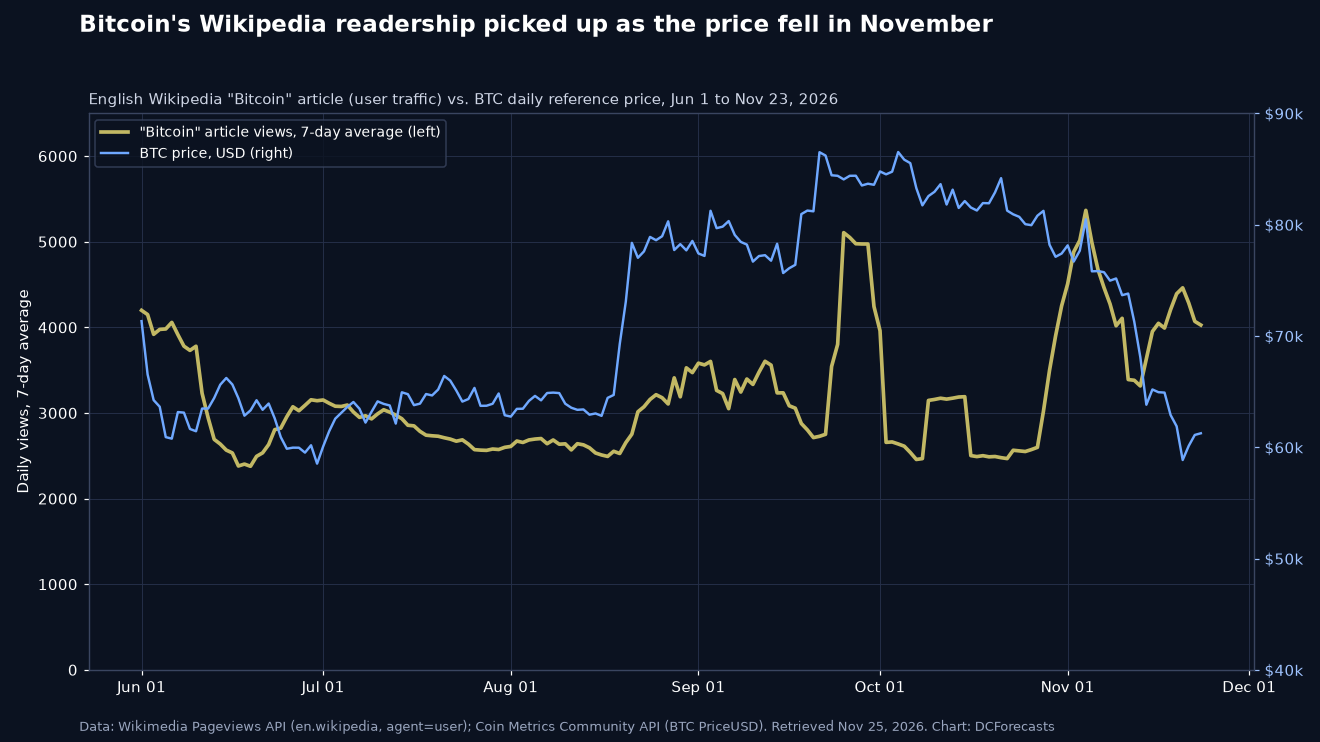
The pattern is worth noting. People came back to read about Bitcoin precisely as it dropped, which is the opposite of the indifference the summer lows suggested.
The interest has also spread. The English “Ethereum” article averaged 702 views a day in November so far, up 31% from October.
Wikipedia Is Shrinking, So We Adjusted the Count
Raw page views overstate the decline in interest, because Wikipedia itself is losing readers.
Human traffic to the whole English Wikipedia averaged 188.8 million views a day from Nov. 1 to Nov. 23, down from 232.9 million in the same stretch of 2025. That is a 19% drop for the entire site.
So we measured Bitcoin’s share instead: views of its article per million English Wikipedia views.
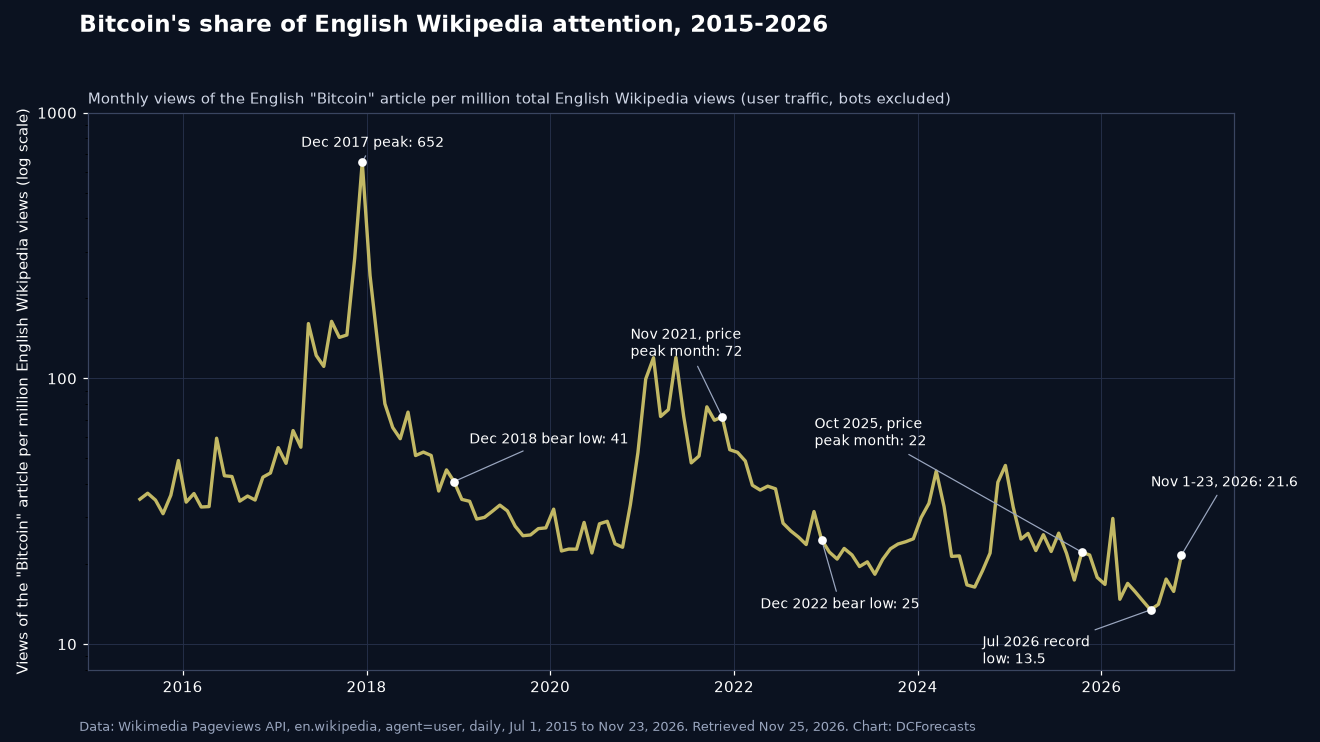
That share stands at 21.6 so far this month. A year ago, over the same 23 days, it was 22.0.
In other words, Bitcoin is holding almost exactly the same slice of the encyclopedia’s attention it held twelve months ago, when the price was far higher. The share is also up 37% from October’s 15.8 and 60% from July’s record low of 13.5.
The 2025 Record High Never Drew a Crowd
The longer history is the most striking part of the data.
In December 2017, as Bitcoin ran toward $20,000, the article averaged 157,167 views a day, or 652 per million Wikipedia views. The single busiest day, Dec. 8, 2017, logged 344,686 views.
In November 2021, the month of that cycle’s peak, the share was 72 per million.
In October 2025, when Bitcoin closed at a record $124,824 on Oct. 6, it was just 22.2. That is lower than December 2022, deep in the last bear market, when the share was 24.7.
We believe this is the key point. Bitcoin’s latest all-time high was built without a retail frenzy.
Spot ETFs, corporate treasuries and long-term holders did the lifting. The kind of mass curiosity that marked the 2017 top, and to a lesser extent 2021, never showed up.
Why a Quiet Crowd Can Be a Strength
Retail manias usually end badly for latecomers. When attention explodes, it often means new buyers are arriving late and chasing price.
This Bitcoin cycle has largely skipped that phase, and so far its decline has also been milder. As we noted when we found that the longest Bitcoin bear market has also been the shallowest, the drawdown has been far smaller than the 76% to 93% falls of earlier cycles.
We see a connection. With less froth on the way up, there was less forced, panicked selling on the way down.
The other implication is more forward-looking. A large pool of potential retail buyers has never really been tapped this cycle.
That said, readers should not treat Wikipedia views as a timing tool. After each previous Bitcoin bottom, in 2018 and 2022, attention kept fading for months: the share averaged 29.2 per million across 2019 and 2020, and 21.9 in 2023, even as prices recovered.
Curiosity tends to follow price rather than lead it.
What Would Turn Curiosity Into Conviction?
The current rebound in reading looks more like worry than excitement. Bitcoin sentiment gauges agree, as our look at this year’s run of extreme fear readings showed.
We would watch three things in the weeks ahead.
- Whether the share holds above 20 per million into December rather than slipping back toward July’s lows.
- Whether rising views come with a firmer price, which would suggest readers are turning into buyers.
- Whether interest in the wider crypto market, such as the Ethereum article, keeps rising alongside Bitcoin.
So, is Bitcoin dead? The data says no. The network keeps producing blocks, its fixed 21 million supply is unchanged, and the public is quietly coming back to read about it.
For long-term holders, a market where attention is near multi-year lows and the price is far below its record is not a sign of failure. In our view, it looks more like the early, unglamorous stage that has preceded every previous recovery.
DC Forecasts is a leader in many crypto news categories, striving for the highest journalistic standards and abiding by a strict set of editorial policies. If you are interested to offer your expertise or contribute to our news website, feel free to contact us at [email protected]







Discussion about this post