



The Gemini exchange wants to borrow directly from its own customers again, and this time the IOU carries Gemini’s name.
On Nov. 25, Gemini Space Station filed to sell up to $50 million of “Gemini Premium Yield Notes” to U.S. individuals through its app.
The notes are unsecured, pay a floating rate set by a three-person internal committee, and take at least 30 days to cash out.
For Bitcoin investors, the revealing detail is where the money goes: margin loans for traders on the platform.
The bigger question is whether retail cash can become a cheaper, steadier funding source than the bitcoin-backed loans Gemini leans on today.
What Did Gemini File on November 25?
The filing is a Form S-3 registration statement for “Variable Denomination Floating Rate Demand Notes,” marketed as Premium Yield Notes. It is available on the SEC’s EDGAR system.
The registration is not yet effective, and no rate has been announced. The rate, and any change to it, will appear in pricing supplements filed with the SEC, with 30 days’ notice.
The basic terms:
- Investors must be U.S. residents investing in their own name with a Social Security number or ITIN.
- The first investment must be at least $1,000, funded only with dollars held in a Gemini account.
- Interest is paid monthly, and there is no stated maturity.
How the Gemini Exchange Notes Fund Crypto Margin Trading
The use of proceeds is unusually specific. Gemini says it intends to use the money “for the funding of margin loans callable on short notice.”

A same-day free writing prospectus put it plainly: the notes are meant to provide “liquidity to support customer margin trading activity.”
“Gemini is continually exploring ways to strengthen the infrastructure underpinning digital asset markets while creating new opportunities for our customers to earn more on their money,” said John York, Gemini’s chief operating officer. As we reported this week, York became COO on Nov. 18 after a management role at the U.S. Treasury.
In short, savers lend dollars to Gemini, and Gemini lends them on to traders who borrow to buy more crypto.
Gemini’s quarterly report says those loans are collateralized by customer assets on the platform and subject to liquidation. Margin lending fees had “no comparable activity” a year earlier.
We read that as a sign of demand. Traders paying for leverage after a sharp sell-off are signaling confidence, not retreat.
Why This Is Not Gemini Earn, and Why the Comparison Matters
Gemini has offered yield before. Its Earn program, run with lender Genesis, began in February 2021 and froze in November 2022 when Genesis halted redemptions.
According to Gemini’s 2025 IPO prospectus, about 232,000 Earn users lost access to roughly $1.05 billion in digital assets.
The ending is where Bitcoin shines. Earn users received a coin-for-coin recovery, so someone with 1 BTC in the program, worth about $21,000 at the bankruptcy, got 1 BTC back. The prospectus puts the value of assets returned at about $2.18 billion, more than twice their value at the filing.
The new notes differ in three ways:
- They are Gemini’s own debt, not a loan to a third-party lender.
- They are registered with the SEC, with risk disclosures in the prospectus.
- They are dollar claims. Holders earn interest, not bitcoin.
The fine print is candid. The notes are not bank deposits, not FDIC-insured and not a money market fund. Gemini keeps no reserves for them, and the prospectus warns it is possible to “lose some or all of your investment” if Gemini cannot pay its debts.
Exits are slow by design. A redemption is due the first business day after 30 calendar days, and under “Extreme Market Conditions,” including crypto exchange disruptions, Gemini can delay it up to 30 more days.
A Balance Sheet Built on Borrowed Bitcoin
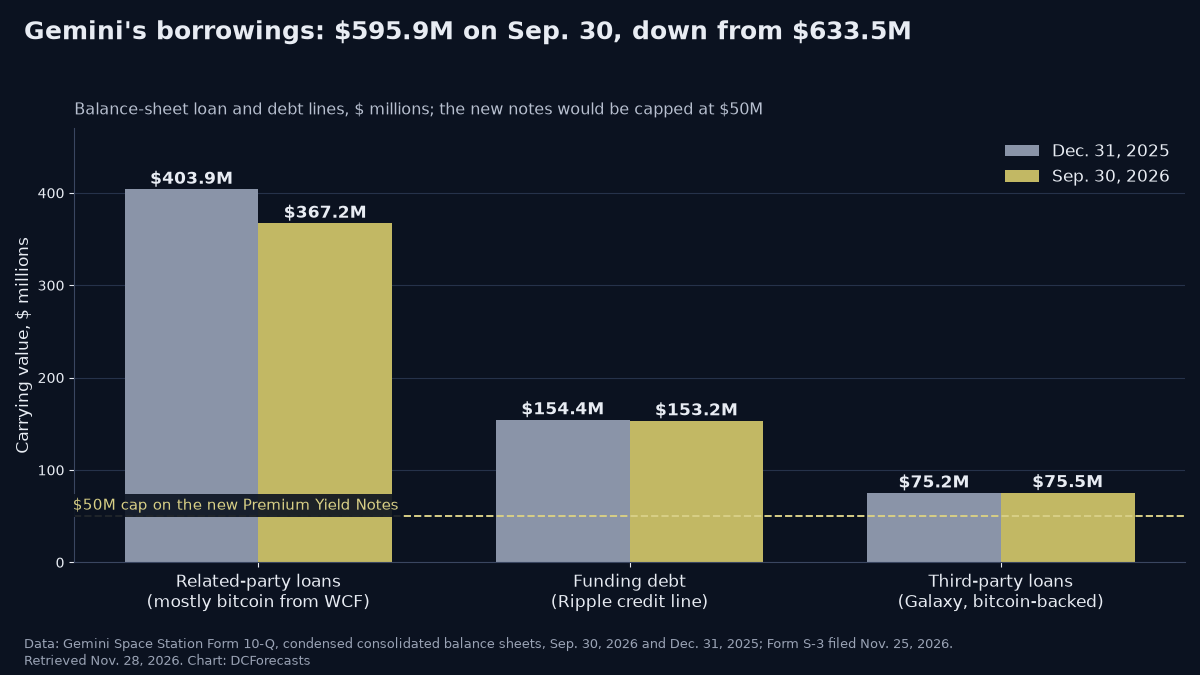
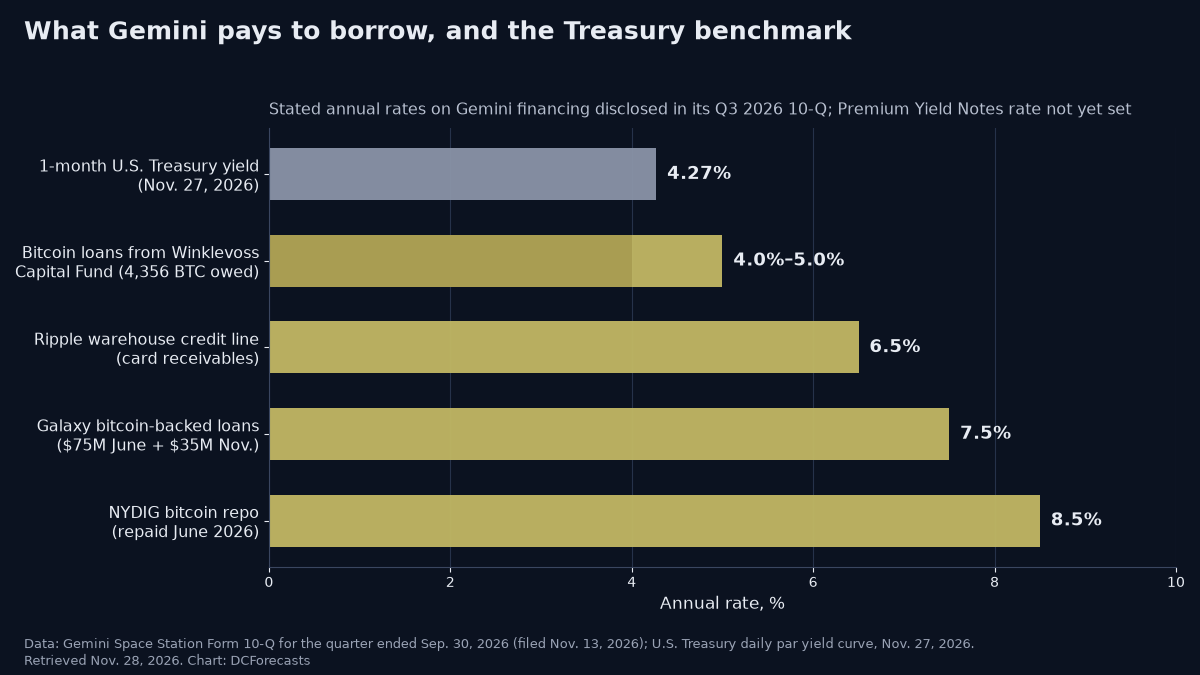
As of Sept. 30, Gemini owed 4,356 bitcoin to Winklevoss Capital Fund, a related party through common ownership, under loans with fees of 4% to 5% a year. Those loans carried a value of about $364 million.
It also had a $75 million Galaxy loan at 7.5%, secured by 1,595 pledged bitcoin, and a 6.5% Ripple credit line backed by card receivables. On Nov. 10, it added a second $35 million Galaxy loan, also bitcoin-backed at 7.5%.
Bitcoin-backed loans come with margin calls. The Galaxy agreement keeps collateral between 145% and 165% of the loan.
At $59,926 per bitcoin on CoinGecko early on Nov. 28, the 1,595 BTC pledged at quarter-end would cover about 127% of $75 million. That is why the 10-Q shows another 1,230 BTC set aside for possible top-ups.
Dollar notes from savers carry no such trigger. For us, that is the real appeal: funding that does not tighten every time bitcoin dips.
Gemini is still losing money. Its accumulated deficit grew by about $275 million in the first nine months of 2026, and cash fell to $194.1 million from $252.2 million. Its credit card already out-earns its exchange.
What Rate Would Make the Notes Worth It?
The benchmark is easy to find. The one-month Treasury yield stood at 4.27% on Nov. 27, according to Treasury’s daily yield curve.
A Gemini note adds unsecured credit risk and a 30- to 60-day exit, so we would expect its rate to clear Treasury bills comfortably. Gemini has room: anything below the 7.5% it pays Galaxy lowers its funding cost.
We will watch three things: the first pricing supplement, how quickly the $50 million fills, and whether margin lending income grows in Gemini’s next quarterly report.
Earn’s lesson still stands. Its users were made whole in bitcoin, an asset capped at 21 million coins, and that repayment ended up worth more than twice the dollar loss. We believe that is worth remembering before chasing a few points of yield on dollars.
DC Forecasts is a leader in many crypto news categories, striving for the highest journalistic standards and abiding by a strict set of editorial policies. If you are interested to offer your expertise or contribute to our news website, feel free to contact us at [email protected]












Discussion about this post