



Gemini’s credit card has become the company’s biggest single revenue line, overtaking the crypto exchange the business was built around.
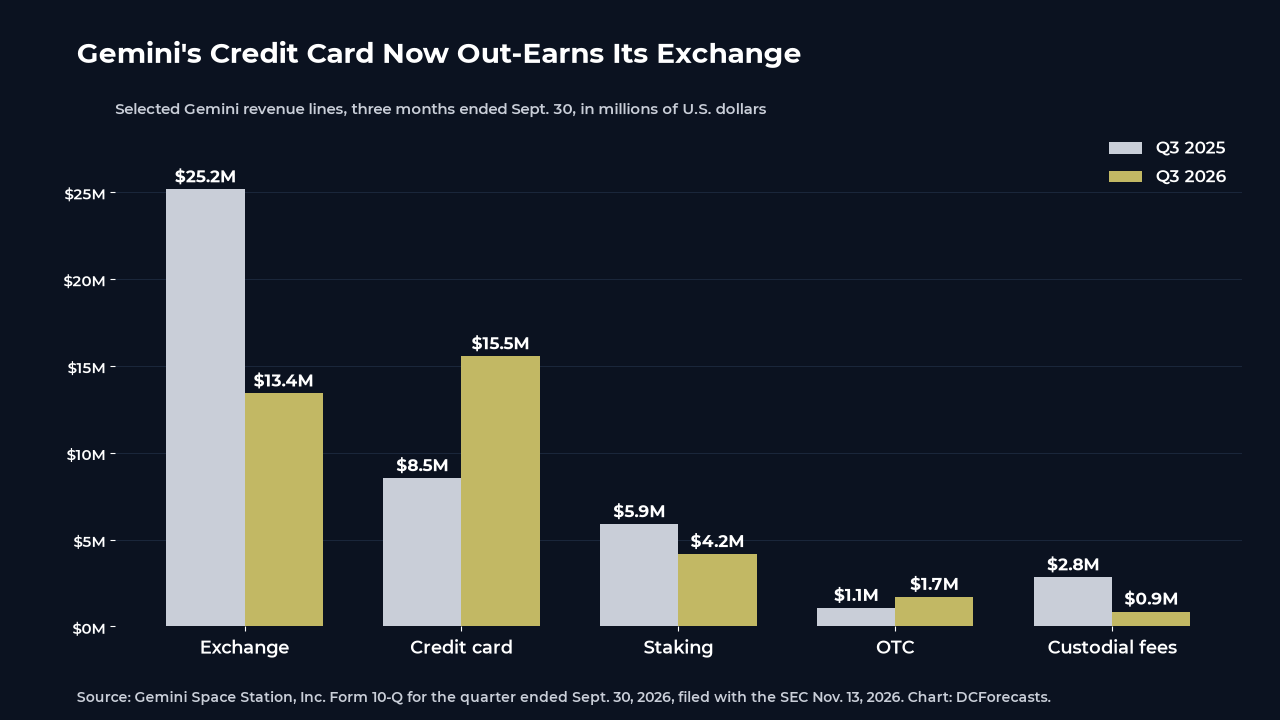
In its quarterly report filed with the U.S. Securities and Exchange Commission on Nov. 13, Gemini Space Station, Inc. said credit card revenue rose 82% to $15.5 million in the three months ended Sept. 30. Exchange revenue fell 47% to $13.4 million over the same period.
The shift came in a slower quarter for crypto trading. Gemini’s trading volume dropped to $4.5 billion from $16.4 billion a year earlier. Even so, the company cut its net loss by almost two-thirds, helped by deep cost reductions.
Gemini Credit Card Revenue Nearly Doubled
Gemini said the gain was “primarily driven by the expansion of the Gemini Credit Card program, including user base growth and increased cardholder activity.” Over the first nine months of 2026, card revenue climbed 171% to $46.4 million.
That growth came from existing cardholders rather than a flood of new ones. Approved card applications fell to about 3,400 in the third quarter, from about 63,700 a year earlier.
The drop lines up with a sharp pullback in promotion. Sales and marketing spending fell 75% to $8.3 million, and advertising expense dropped to $0.4 million from $17.9 million.
The card was not the only line that grew. Over-the-counter trading revenue rose to $1.7 million from $1.1 million. Gemini Predictions, the company’s prediction markets platform regulated by the Commodity Futures Trading Commission, added $0.8 million, a revenue line the company did not report a year earlier.
A Smaller Loss Despite Lower Revenue
Total revenue fell 19% to $40.9 million from $50.6 million. But the net loss narrowed to $58.6 million from $159.5 million, a 63% improvement.
Adjusted EBITDA, a non-GAAP measure the company reports, improved to a loss of $11.6 million from a loss of $52.4 million.

Total operating expenses fell 30% to $119.9 million. Much of that reflects a restructuring announced in February 2026, which included a reduction in force of about 200 employees and exits from offices in London, Malta and San Francisco. Employee compensation, excluding stock-based pay and severance, fell 36% in the quarter.
Gemini said it believes its cash, its remaining bitcoin and available borrowing capacity, together with its lower cost base, will cover its working capital needs for at least the next 12 months. Cash and cash equivalents stood at $194.1 million on Sept. 30.
Trading Volume Fell Sharply
The exchange side was weaker. Trading volume fell 73% from a year earlier, and assets on the platform dropped to $13.4 billion from $21.3 billion.
Monthly transacting users were roughly flat at 577,000, compared with 587,000 a year earlier. Lifetime transacting users rose about 8% to 1.73 million.
Bitcoin trading volume came to $1.6 billion, down from $5.6 billion. Ether volume fell further, to $0.6 billion from $6.8 billion. Privacy coin Zcash was an unusual standout, accounting for $1.0 billion of volume and more than 10% of the quarter’s total.
Bitcoin Still Pays the Bills on the Exchange
Bitcoin held its place as Gemini’s most important trading asset. It produced about $7 million of the company’s $13 million in rounded exchange revenue in the quarter, more than three times the $2 million from ether.
A year earlier, bitcoin generated $10 million out of $25 million. Its share of exchange revenue rose to roughly half from about 40% as trading in other assets faded faster.
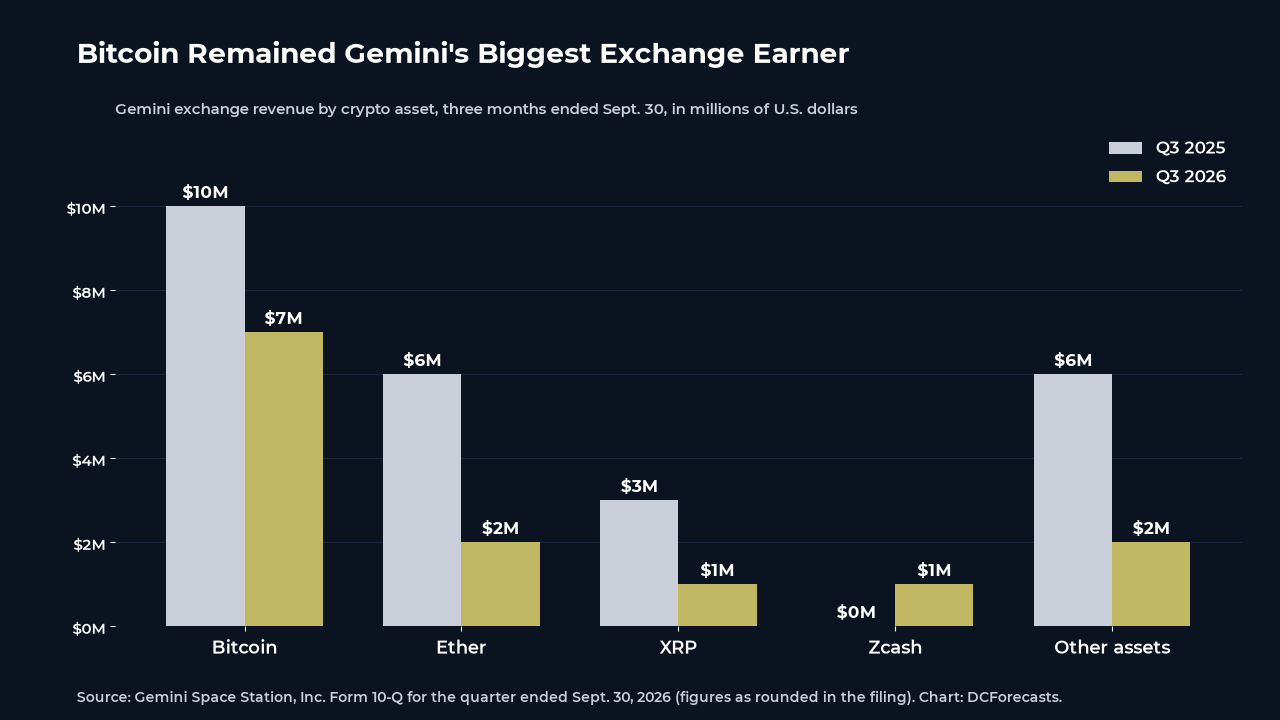
The numbers suggest Gemini’s customers concentrated their trading in bitcoin as interest in many smaller tokens faded.
Gemini Keeps Bitcoin on Its Balance Sheet
The filing also shows how Gemini thinks about its own treasury. “We utilize crypto assets, specifically bitcoin, as a treasury asset,” the company wrote, citing “our belief that bitcoin is a better store of value and hedge against inflation than fiat.”
For that reason, Gemini said, it has generally chosen to borrow in U.S. dollars rather than sell bitcoin.
Some of that bitcoin came from its founders. On May 14, 2026, Gemini sold 7,142,857 Class A shares to Winklevoss Capital Fund at $14.00 each, for $100 million paid in bitcoin. Gemini sold part of that bitcoin to fund operations and held 294 BTC, worth $24.6 million, on Sept. 30.
Gemini also began market-making through a subsidiary in the third quarter to support liquidity on its spot exchange and prediction markets.
A More Diversified Crypto Business
The quarter shows a crypto company leaning less on trading fees. Transaction fees made up 38.9% of Gemini’s third-quarter revenue, while services such as the card, staking and custody brought in more than half.
That mix gives Gemini income that does not rise and fall with every swing in trading activity. Other crypto firms are also building beyond trading, from federally chartered custody to prediction markets now at the center of a legal fight between the CFTC and the states.
For now, the bitcoin-funded balance sheet and a card that keeps users spending are giving Gemini a steadier base while trading volume recovers.
This article is for information only and is not investment advice.
DC Forecasts is a leader in many crypto news categories, striving for the highest journalistic standards and abiding by a strict set of editorial policies. If you are interested to offer your expertise or contribute to our news website, feel free to contact us at [email protected]












Discussion about this post