


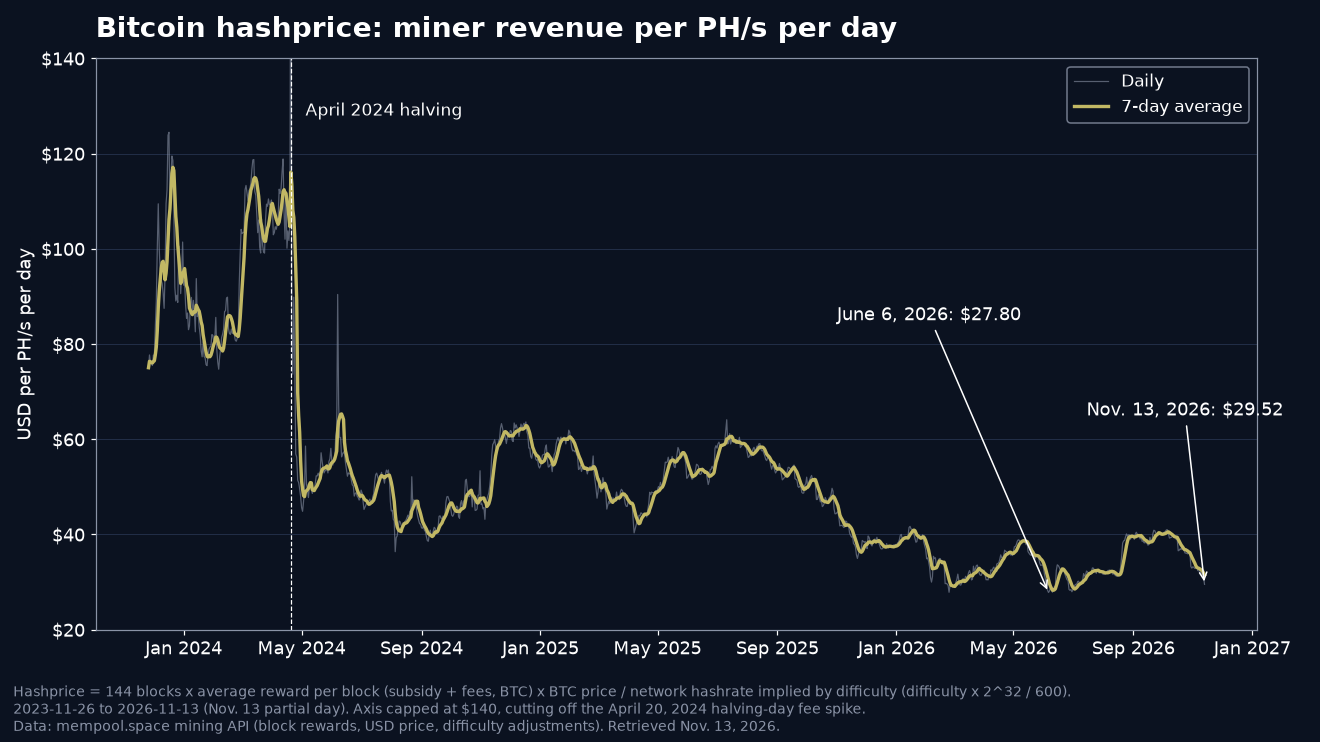
Bitcoin miners are earning less for their work than at any point since early July. By our calculation, hashprice, the revenue a miner earns per petahash per second of computing power each day, fell to about $29.52 on Friday as Bitcoin slipped below $69,000.
That is only about $1.70 above this year’s low. Yet the miners themselves show little sign of panic. The network’s hashrate trend still points up, and a difficulty cut due within hours should give their revenue a lift.
Here is what the data shows about miner health right now.
What Hashprice Measures
Hashprice turns the economics of mining into one number. It takes everything miners earn in a day, the new coins from each block plus transaction fees, and divides it by the total computing power competing for those rewards.
We built our series from mempool.space data. For each day, we multiplied 144 blocks by the average reward per block and the average Bitcoin price, then divided by the network hashrate implied by the current mining difficulty.
On Friday, the average block paid about 3.156 BTC, almost all of it the fixed 3.125 BTC subsidy. Fees made up less than 1% of rewards over the last 144 blocks. At roughly $68,971 per coin, the network as a whole is earning about $31.3 million a day.
Spread across roughly 1,062 exahashes per second of difficulty-implied hashrate, that works out to $29.52 per petahash per day.
Closer to June’s Low Than October’s High
Hashprice has been trending lower for more than two years. Before the April 2024 halving, it sat above $100. The halving cut the block subsidy in half overnight, and rising competition has kept pressure on it since.
A year ago, on Nov. 13, 2025, hashprice was about $41.85. It started 2026 near $37.48 and hit its lowest point in our three-year dataset on June 6, at $27.80.

From there, miners got some relief. Hashprice climbed back to about $40.97 by Oct. 5, helped by Bitcoin’s summer rally. Friday’s reading of $29.52 is the lowest since July 8.
For the most efficient operators, that can still be profitable. For miners running older machines or paying high power prices, margins get tight at these levels. That is why hashprice is worth watching closely during price pullbacks.
The Hash Ribbons Show No Capitulation
If miners were in real trouble, we would expect to see it in the hashrate. When revenue drops below costs, the weakest operators switch off their machines, and the network’s computing power falls.
A popular way to track this is the hash ribbon. It compares the 30-day average hashrate with the 60-day average. When the shorter average drops below the longer one, it signals that miners are unplugging, a pattern often called miner capitulation.
Right now, that is not happening. Based on mempool.space daily hashrate estimates, the 30-day average sits near 1,021 EH/s, comfortably above the 60-day average of about 995 EH/s.
The 30-day average crossed back above the 60-day on Aug. 27 and has stayed there for 78 days. Earlier this year, the two lines spent long stretches inverted, including June 9 to July 22, as hashprice sank to its lows.
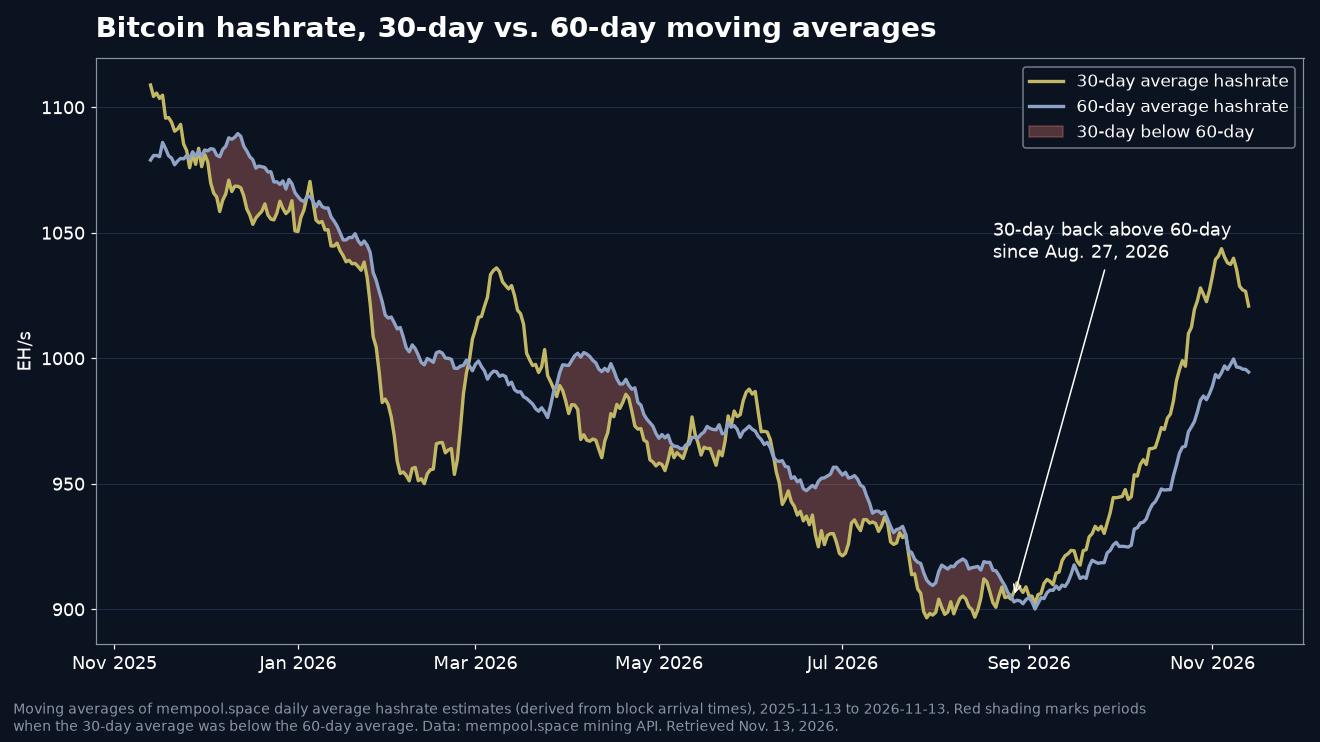
Daily hashrate estimates are noisy because they depend on how quickly blocks happen to arrive. Single-day drops, like the one seen this week, are common and do not by themselves mean miners are leaving. The moving averages smooth out that noise.
A Difficulty Cut Is Hours Away
Miners are also about to get help from Bitcoin’s own design. Blocks in the current period have been arriving more slowly than the 10-minute target, so the protocol will make mining easier at block 975,744.
As of Friday evening, mempool.space estimated an 8.58% difficulty cut, with about 40 blocks to go. That is larger than the 6.8% estimate when we first covered the upcoming adjustment on Nov. 10.
If the cut lands near that estimate and the Bitcoin price holds steady, hashprice would rise to roughly $32.30, about 9% higher than today. The final figure depends on how quickly the last blocks arrive.
What Happened After June’s Low
Past patterns are not a promise, but the most recent example is encouraging. When hashprice bottomed at $27.80 on June 6, Bitcoin was trading near $61,000, based on mempool.space’s daily price data.
Within weeks, hashrate stabilized and the hash ribbons turned positive again. By Aug. 31, Bitcoin was trading near $78,700, and hashprice had recovered to about $39.56.
This time, miners have not even reached the capitulation stage. They kept adding computing power through October, pushing hashrate past the 1,000 EH/s mark, as we noted when the network first held that level.
Some large miners have been raising cash in other ways. MARA, for example, sold 13,597 BTC to repay loans earlier this month. But across the network, the machines are still running.
Why Miner Resilience Matters for Bitcoin
We believe miner behavior is one of the most underrated signals in Bitcoin. Miners are the network’s long-term investors. They commit capital to hardware and power contracts years in advance, and they tend to switch off only when the math stops working.
Mining difficulty is still within about 5% of its all-time high of 155.97 trillion, set in October 2025, which means the network remains extremely well secured. Every exahash committed makes Bitcoin’s transaction history harder to rewrite.
The level to watch is June’s $27.80 low. If hashprice holds above it after the difficulty cut, and the hash ribbons stay positive, this pullback will look like a squeeze on margins rather than a miner exodus.
DC Forecasts is a leader in many crypto news categories, striving for the highest journalistic standards and abiding by a strict set of editorial policies. If you are interested to offer your expertise or contribute to our news website, feel free to contact us at [email protected]












Discussion about this post