


Bitcoin trading volume now clusters on weekdays far more than it used to. On Coinbase, the largest U.S.-dollar spot venue with a public candle feed, Saturdays and Sundays accounted for 13.8% of BTC-USD volume between January 1 and November 10, 2026. In 2017, the same two days carried 24.0%.
If trading were spread evenly across the week, weekends would hold 28.6%, two days out of seven. Bitcoin never trades closed, yet its weekend share is now less than half of that even split. The calm shows up in price too. In 2026, the median Saturday range has been 1.44%, compared with 3.06% to 3.55% on weekdays.
How we measured it
We pulled every daily BTC-USD candle Coinbase Exchange has published since January 1, 2016, a total of 3,967 complete days through November 10, 2026. Days are in UTC. For each year we summed the volume traded on Saturdays and Sundays and divided it by the year’s total. Coinbase reports volume in bitcoin, not dollars, so the share is not skewed by price changes during the year.
For volatility we used each day’s high-low range as a percentage of the low, and took the median rather than the average. The median is less sensitive to rare bad prints and one-off crash days, which can distort averages badly in older exchange data.
Two caveats apply. Coinbase is one exchange, not the whole market, and offshore venues and derivatives are not included. UTC days also do not line up perfectly with American or Asian weekends.
The weekend share has been halved
The trend is steady rather than sudden. Weekend share sat between 19.5% and 24.0% from 2016 to 2021. It dropped to 15.7% in 2022 and 15.0% in 2023, then fell to a low of 11.1% in 2024. It has hovered around 13% to 14% since.
Absolute activity tells the same story. In 2016, an average Saturday on Coinbase traded about 5,080 BTC, between 72% and 89% of a typical weekday. In 2026, the average Saturday has traded about 3,680 BTC, against roughly 9,000 to 10,200 BTC on each weekday, or only 36% to 41%. Weekday volume has grown while weekend volume has shrunk, turning Saturday and Sunday into a thinner, separate session.
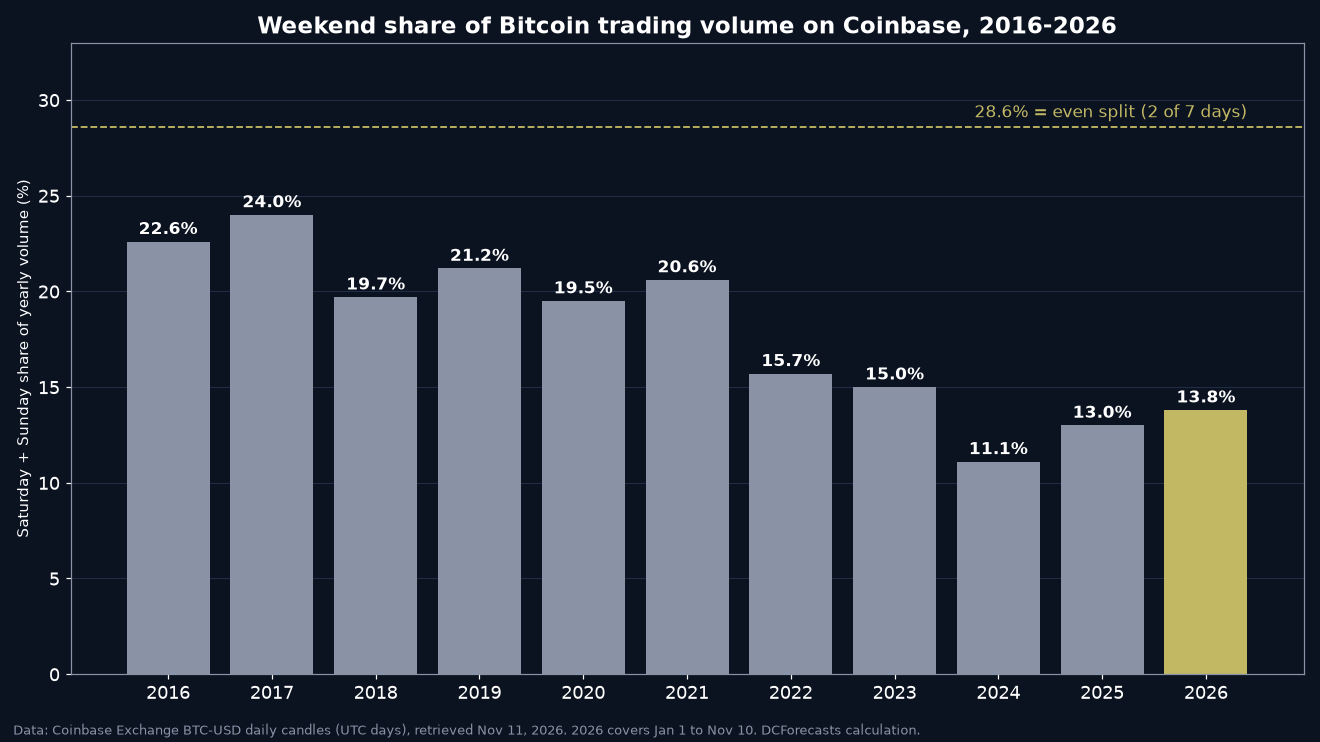
The 2024 low coincided with the first full year of U.S. spot bitcoin ETFs, which began trading in January 2024. Those funds, like regulated CME bitcoin futures, operate on exchange schedules that pause over the weekend. The data shows timing, not cause, but it fits a market whose biggest buyers and hedgers now work Monday to Friday.
Saturdays are the quietest day of the week
Breaking 2026 down by weekday makes the pattern sharper. Weekdays each carried 16.1% to 18.1% of Coinbase volume this year. Saturday carried 6.6% and Sunday 7.3%.

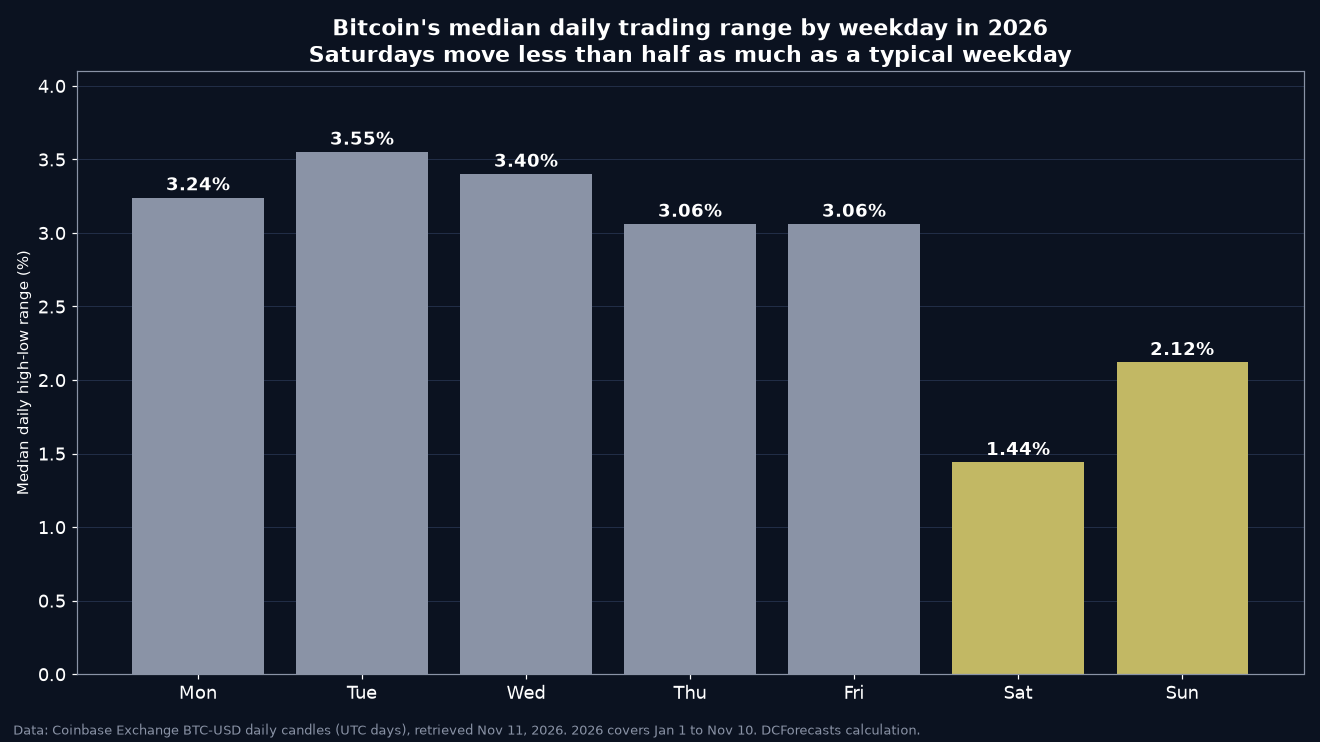
Price ranges follow volume. The median weekend range in 2026 is 1.77%, compared with 3.27% on weekdays, a ratio of 0.54. Back in 2016, weekend and weekday ranges were almost identical, with a ratio of 1.01. Since 2023, that ratio has stayed between 0.49 and 0.56.
Sunday is a little livelier than Saturday, with a median range of 2.12%. That fits the run-up to Asian markets opening and CME futures reopening on Sunday evening U.S. time. Positioning for the week ahead tends to begin before Monday’s U.S. open.
Why a quieter weekend is a sign of maturity
A decade ago, Bitcoin’s market was mostly retail traders on crypto exchanges, active at all hours. The flattening weekend says the center of gravity has moved. Price discovery now happens largely when ETFs, futures desks and corporate treasuries are at work, which is how deep, institutional markets behave.
That has helped tame Bitcoin’s overall swings. We showed recently that Bitcoin volatility has nearly halved since 2021, and its link to Wall Street hours shows up elsewhere too: the 30-day correlation with the S&P 500 reached a 2026 high this week. A market that sleeps on weekends is one that big allocators can model, hedge and size into.
What it means for traders
Thin weekend books cut both ways. Most Saturdays are calm, but lower liquidity means a large order can move price further than it would on a Tuesday. The biggest 2026 weekend range on Coinbase came on Saturday, January 31, at 11.2%, proof that quiet is not the same as safe.
For long-term holders, the takeaway is simpler. Weekend price action carries less information than it used to. A soft Saturday drift on light volume is often reversed or confirmed once weekday flows return, so it pays to wait for Monday’s volume before reading too much into a weekend move.
The network itself never takes a day off. Blocks keep coming every day of the week, and transactions settle the same way on Sunday as on Wednesday. What has changed is the people trading it. More of them now keep office hours, and that is a sign of how far Bitcoin has come.
DC Forecasts is a leader in many crypto news categories, striving for the highest journalistic standards and abiding by a strict set of editorial policies. If you are interested to offer your expertise or contribute to our news website, feel free to contact us at [email protected]











Discussion about this post