



DeFi Development Corp. wants investors to see its new preferred stock as the strongest product in digital credit. Yet the stress test in its own third-quarter letter tells a more nuanced story, and Bitcoin-backed paper comes out of it looking sturdy.
The Solana treasury company, whose DFDV stock trades on Nasdaq, published the letter with its results on Nov. 12. It compares its CHAD preferred with two Bitcoin-backed rivals: Strategy’s STRC and Strive’s SATA.
With prices unchanged, CHAD looks well covered. After a 50% fall in the underlying coin, however, the company’s figures show STRC still holding 3.7 times its notional in net assets, while CHAD drops to 0.4 times.
What DeFi Development Reported
According to the shareholder letter filed with the U.S. Securities and Exchange Commission, the company held 2,609,829 SOL and SOL equivalents as of Nov. 9. That is up 13% since mid-August and 19% from a year earlier.
Third-quarter net income rose 18.9% to $66.6 million, helped by a $37.9 million gain on digital assets. Revenue, however, fell 47.4% to $2.4 million, and diluted earnings per share slipped to $1.91 from $1.95 as the share count grew.
The company says it now runs at “over 9x amplification.” In plain terms, every unit of net value belonging to common shareholders supports a treasury nine times larger, funded by convertible notes and preferred stock.
CEO Joseph Onorati was candid about the trade-off. “Amplification works in both directions,” he wrote, “and shareholders felt its impact over the last year as SOL fell.”
CHAD Reached Par Faster Than STRC and SATA
CHAD is a variable-rate perpetual preferred with a $10 stated amount. It pays dividends daily, and its annual rate rose to 14% on Nov. 2.
The company highlights how quickly the shares found their footing. CHAD began trading on Sept. 8 and first closed at par on Oct. 26, 48 calendar days later. The letter puts the comparable figures at 71 days for SATA and 98 days for STRC.

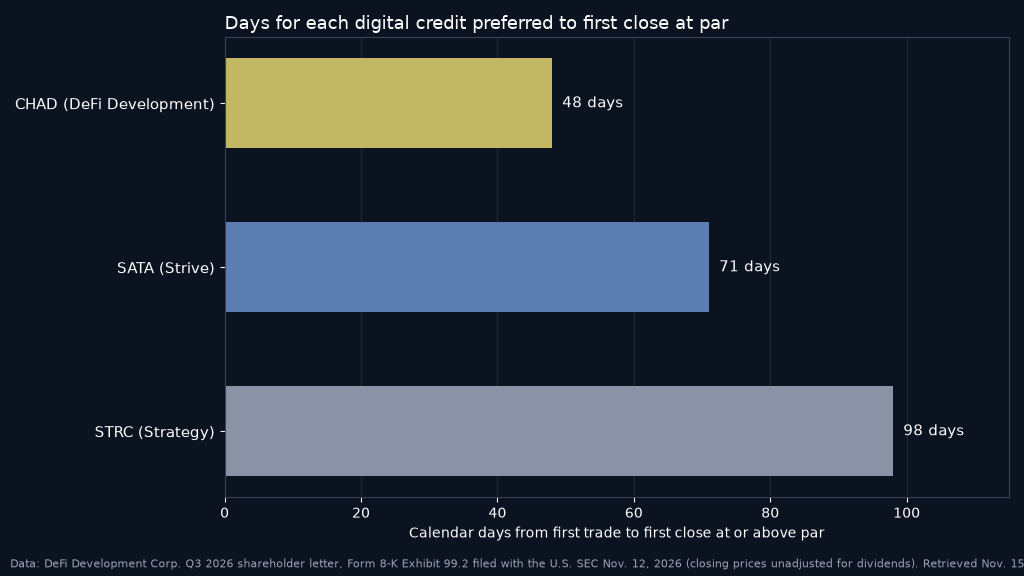
Speed to par is a fair signal of demand. Still, CHAD is a much smaller issue, and the company itself notes that its outstanding notional “remains small relative to our treasury.” A small issue is easier to support than a large one.
The model rests on a treasury the company values at $243.3 million in gross assets, including $21.5 million of cash, stablecoins and securities. It uses reference prices of $84.99 for SOL and $74,570 for BTC, both as of Nov. 11.
The Stress Test Shows Bitcoin-Backed Credit Holding Up
The most useful part of the letter is a table that measures assets left after convertible debt against each issuer’s variable-rate preferred. The price declines apply to SOL for DeFi Development and to Bitcoin for Strategy and Strive.
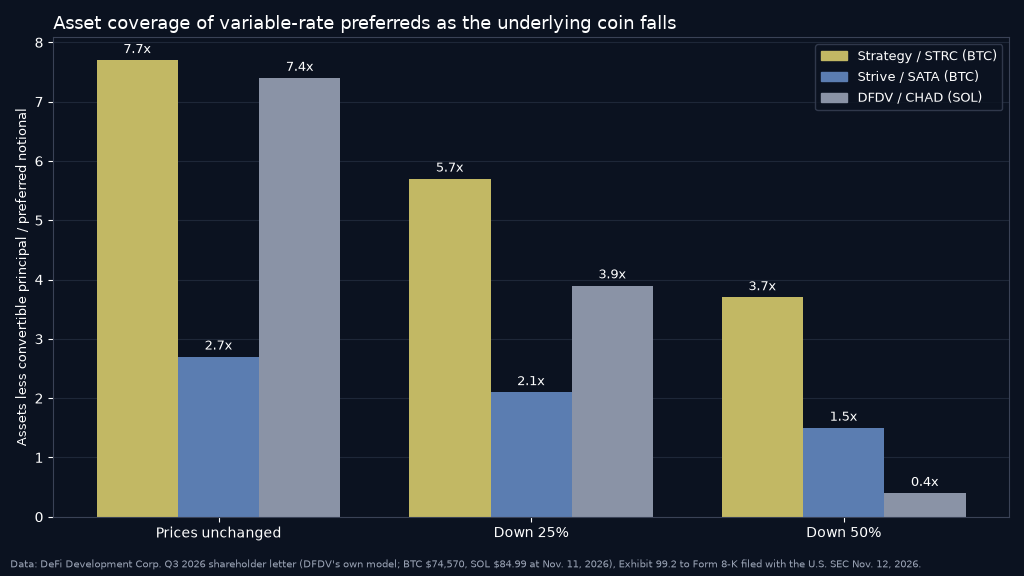
At today’s prices, STRC sits at 7.7 times and CHAD at 7.4 times. After a 25% drop, STRC holds 5.7 times against 3.9 times for CHAD.
The gap widens after a 50% decline. STRC still shows 3.7 times coverage and SATA 1.5 times, while CHAD falls to 0.4 times. The main difference is the convertible notes that DeFi Development must deduct before preferred holders.
The company also modeled income. Assuming a 5% yield on its SOL, treasury income covers CHAD dividends five times today. After a 50% SOL fall, that income would cover about 63% of combined CHAD dividends and convertible interest, leaving a shortfall of roughly $3.3 million a year.
In fairness to CHAD, the company points to strengths elsewhere. On an issuer-wide basis, it calculates gross assets at 109.9 times annual preferred dividends, against 47.9 times for Strategy and 13.0 times for Strive. It also earns staking income, which Bitcoin holdings do not generate natively.
Why This Matters for Bitcoin Treasury Companies
We think the comparison is a useful reminder of what makes Bitcoin-backed credit work. Strategy’s preferred sits on top of the largest corporate Bitcoin treasury, and even a competitor’s stress model shows it keeping several times its notional after a halving in price.
That matters at a time when Bitcoin has had a rough stretch. It has just logged five straight weekly losses, and Strive recently raised SATA’s dividend to 13.25% after the shares spent a month below their floor. Strategy has also faced pressure on the index side, with MSCI confirming its exit from the ACWI index.
Against that backdrop, a deep asset cushion is exactly what preferred investors need. Bitcoin’s liquidity and market depth let large treasuries carry sizable preferred programs while keeping coverage intact through sharp drawdowns.
The figures carry caveats. They are DeFi Development’s model, not audited disclosures from Strategy or Strive, and they hold asset quantities constant. Series-specific ratios also do not reserve assets for other preferred classes.
What to Watch Next
DeFi Development says it intends to “scale CHAD aggressively” and use its at-the-market program to reduce reliance on selling common shares. As the issue grows, its coverage ratios will shrink unless SOL rises or treasury income keeps pace.
For Bitcoin investors, the takeaway is encouraging. The digital credit market is expanding to new coins, but on the numbers a rival chose to publish, preferreds backed by large Bitcoin treasuries remain the benchmark for resilience.
DC Forecasts is a leader in many crypto news categories, striving for the highest journalistic standards and abiding by a strict set of editorial policies. If you are interested to offer your expertise or contribute to our news website, feel free to contact us at [email protected]












Discussion about this post