


Monday’s Treasury auction results show buyers absorbing $69 billion of new 2-year notes at 4.700%, while the primary dealers who backstop every sale kept just 10.4% of the competitive awards.
Bidding closed at 1:00 p.m. Eastern Time on Nov. 23. The notes priced with a 4.625% coupon, mature on Nov. 30, 2028, and drew a bid-to-cover ratio of 2.65, up from 2.59 in October.
The yield itself barely moved from last month’s 4.708%. A year ago, the same auction cleared at 3.489%.
For Bitcoin investors, the 2-year note matters because it is the bond market’s cleanest read on where Federal Reserve policy is heading.
The bigger question now is whether short-term rates have finally stopped climbing, and what that could mean for risk assets heading into the Fed’s December meeting.
What the Treasury Auction Results Show
According to TreasuryDirect data, bids totaled about $182.8 billion for the $69 billion on offer.
Bids ranged from 4.570% to the 4.700% high, with a median of 4.650%.
The split among buyers was the striking part. Indirect bidders, a group that typically includes foreign central banks and overseas investors bidding through dealers, won $35.0 billion, or 51.5% of competitive awards.
Direct bidders, usually domestic funds and institutions bidding on their own account, took $25.9 billion, or 38.1%.

Primary dealers bid for roughly $98.5 billion but were awarded only $7.1 billion.
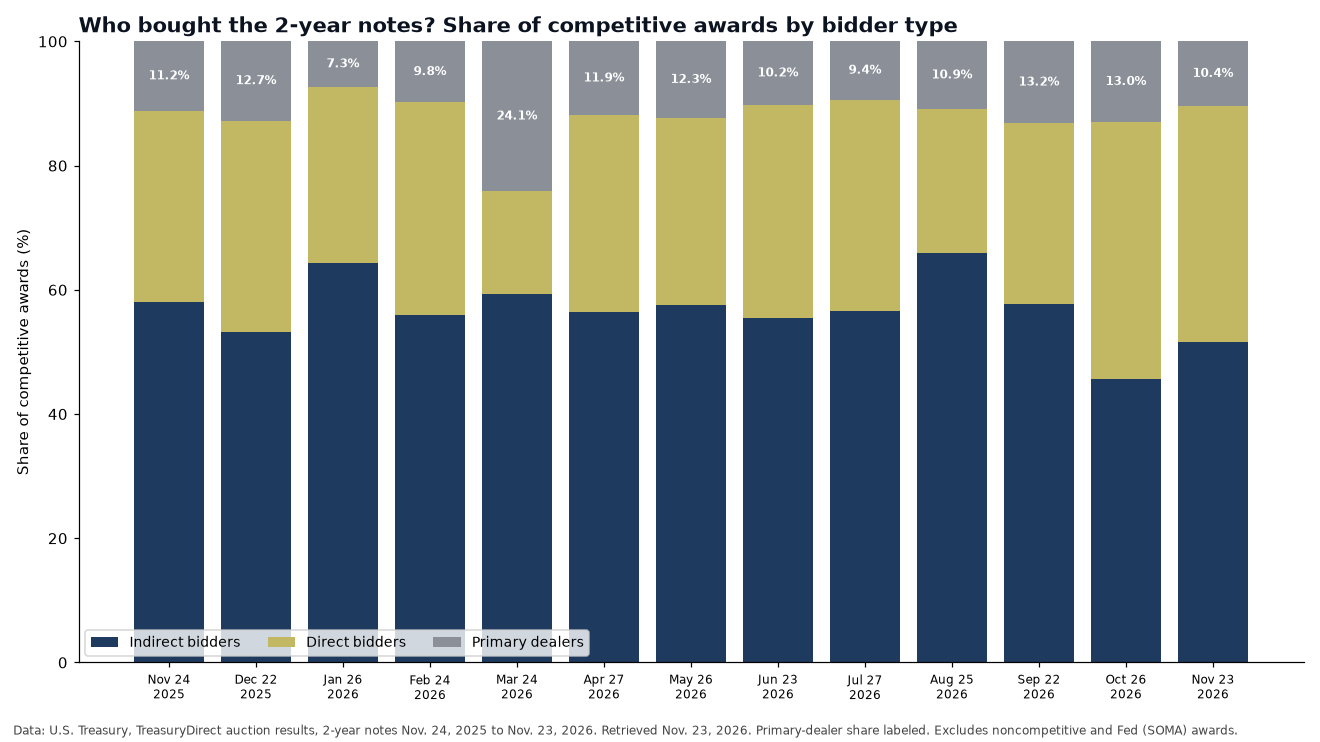
We believe that dealer number is the cleanest signal in the release. Dealers have to bid at every auction, so they end up holding whatever end investors do not want.
A 10.4% take is below the 12.2% average of the previous 12 two-year sales. It is a long way from the 24.1% dealers were left with in March.
Not every detail was strong. The indirect share was the second-lowest of the 26 monthly 2-year auctions since October 2024, beaten only by October’s 45.7%. Domestic direct bidders filled the gap, as they did last month.
Separately, the Federal Reserve rolled over $7.1 billion of maturing holdings into the new notes. Treasury issued that amount on top of the $69 billion offering.
Why the 2-Year Treasury Yield Leads the Fed
Two-year notes cover the window the Fed is debating now, so their yield tracks expected policy.
The Fed held its target range at 3.75% to 4.00% on Oct. 28. Two of 12 voters, Lisa Cook and Beth Hammack, dissented because they preferred a quarter-point hike.
An auction yield of 4.700% sits 70 basis points above the top of that range. In plain terms, buyers of 2-year paper are still demanding compensation for the possibility of a higher policy rate.
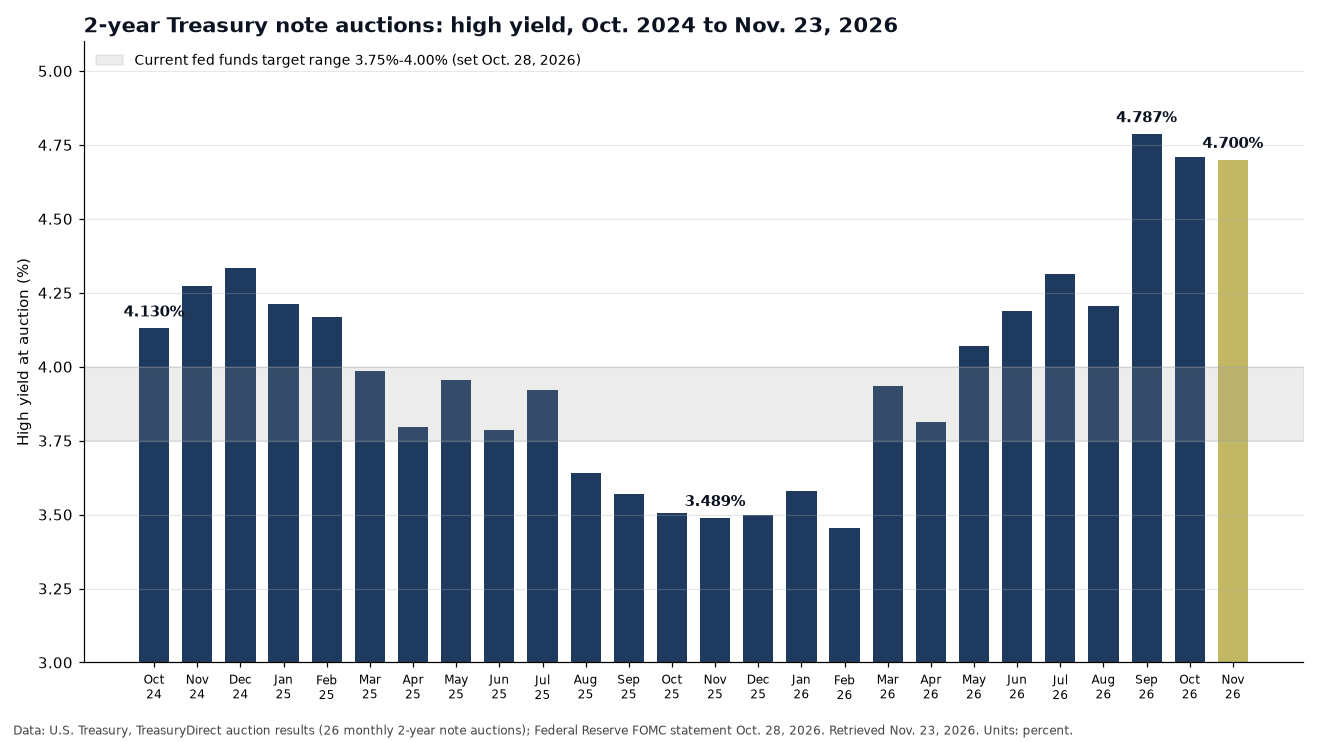
The chart also shows the turn. September’s 4.787% was the highest stop of any 2-year auction in the 26-sale record we reviewed. October came in at 4.708%, and Monday edged lower again to 4.700%.
The secondary market tells a similar story. Treasury’s daily par yield curve put the 2-year at 4.63% on Monday, down from 4.88% on Nov. 13 and 4.92% on Sept. 28.
That is not a rate cut, and we would not treat it as one. But a plateau in front-end yields is a different environment from the climb that ran from February to September.
Bitcoin and the Fed Rate Hike Debate
Rising short-term yields have been a clear headwind for Bitcoin this year. When cash and 2-year notes pay close to 5%, holding assets with no yield has a higher opportunity cost.
Bitcoin traded near $61,207 on Monday evening, according to CoinGecko data, up about 1.1% in 24 hours. Around the same auction a year ago, it was near $86,740, so it is down roughly 29% over a period in which the 2-year auction yield rose 121 basis points.
We do not think that link is a coincidence, but we also do not think it is permanent. We saw the same squeeze further out the curve when the 10-year Treasury yield returned above 5%.
Monday’s auction does not prove that the peak is in. It does show a $69 billion sale clearing slightly below the previous two, with dealers lightly loaded. We believe that is how a top in short-term yields would begin to look.
What Comes Next for Treasury Yields
The test continues this week. Treasury will auction $70 billion of 5-year notes on Tuesday, Nov. 24, and $44 billion of 7-year notes on Wednesday, Nov. 25, according to its auction schedule.
Inflation data comes next. As we covered in our preview of the last PCE inflation update before the Fed’s December hike debate, that report could shift expectations quickly in either direction.
The Fed’s final meeting of the year runs Dec. 8-9 and comes with fresh economic projections.
For us, the watch list is simple: the 5-year and 7-year results this week, the dealer share at each sale, the 2-year market yield relative to 4.63%, and Bitcoin’s ability to hold above $60,000 while those numbers come in.
Can Bitcoin Turn a Rate Plateau Into a Recovery?
Bitcoin does not need lower rates to survive. It has already absorbed a 121-basis-point rise in the 2-year auction yield in 12 months.
What it could use is a pause. If 2-year yields hold below their September peak and the Fed signals that one more move is the limit, the opportunity cost of holding Bitcoin stops rising.
That would bring the focus back to the parts of the story that do not depend on the Fed: a fixed 21 million supply, and spot ETFs that let institutions buy through standard brokerage accounts.
We believe the bond market sent a quietly constructive message on Monday. The next two auctions will show whether it was a one-off or the start of a trend, and if short-term rates have topped, Bitcoin investors may soon look beyond the Fed again.
DC Forecasts is a leader in many crypto news categories, striving for the highest journalistic standards and abiding by a strict set of editorial policies. If you are interested to offer your expertise or contribute to our news website, feel free to contact us at [email protected]











Discussion about this post