



Trezor has confirmed that three of its Safe 5 hardware wallets were sold with a hidden spy board inside, and it has answered by cutting its reseller network by about 80%.
The company published the findings on Nov. 12, a day after it shipped firmware 2.13.1, an update it says stops the implants found so far from capturing anything.
All three devices came from CryptoBilis, a former authorised reseller in Southeast Asia. No owner has reported losing funds.
The case does not show a flaw in the wallet’s chip or code. It shows how attackers can target the trip a device takes from the factory to the buyer, and why that trip now matters as much as the wallet itself.
What Trezor Found Inside the Safe 5
According to Trezor’s investigation update, the implant is an extra circuit board fitted between the Safe 5’s main board and its screen.
It only listens. Trezor says it copies whatever the screen shows, including what the owner types on the device, and does not alter the firmware or the Secure Element chip.
When recovery words appear, the board recognises and stores them. That covers the words shown when a new wallet backup is created and the words typed in when an existing wallet is restored. A passphrase entered on the screen is captured the same way.
The stolen data is encrypted and sent over a mobile network to a server run by the attackers. If there is no signal, the implant keeps the data and keeps trying.
Trezor says the design works the same way as the implants previously found in Ledger devices sold through the same reseller, adapted to the Safe 5’s display.

How the Trezor Safe 5 Case Unfolded
The first report reached Trezor’s security team on Oct. 28 through responsible disclosure from a customer in Indonesia, who had bought the device from CryptoBilis in August via Tokopedia.
Trezor went public two days later, before it had the device in its lab. It told anyone who bought a Trezor from CryptoBilis from March 2026 onward to move funds to a new wallet with a new seed phrase.
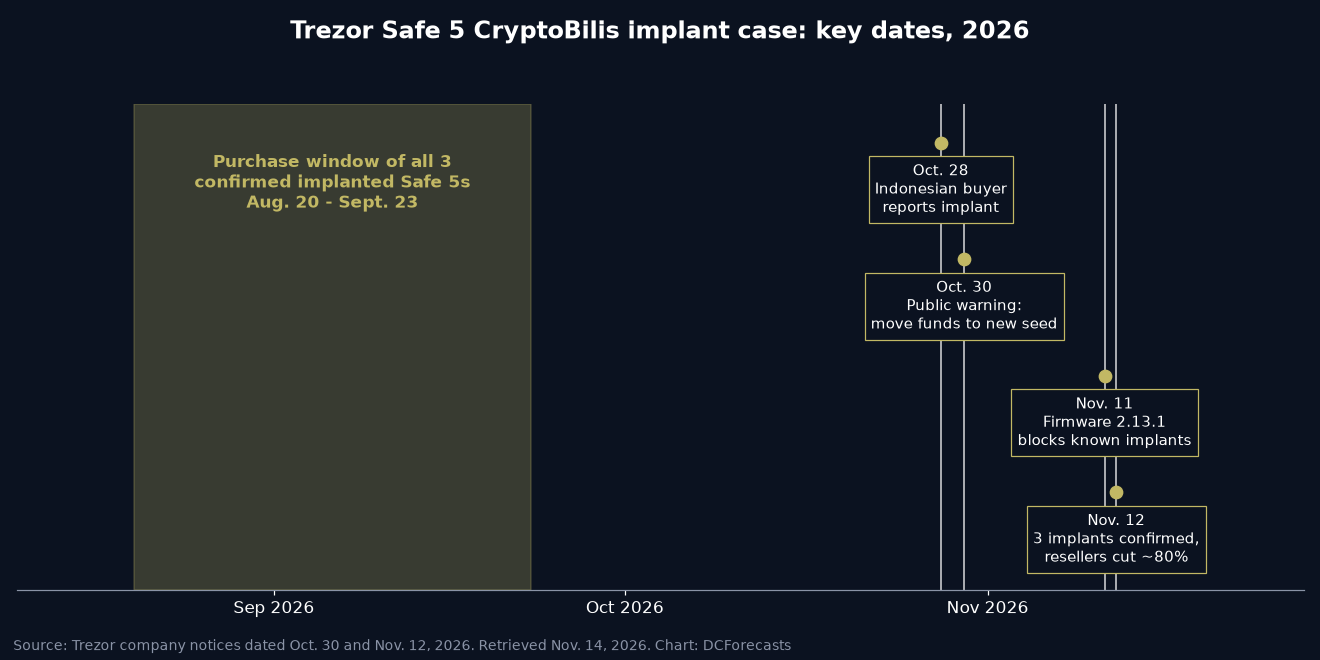
The Nov. 12 update narrows the picture. Trezor’s lab examined the original device, and two more implanted units were identified from photos their owners sent in.
All three were bought between Aug. 20 and Sept. 23, 2026, through CryptoBilis’s Tokopedia and Shopee stores or directly from the reseller.
Trezor says it has found no implant in devices from any other reseller, and none in any Trezor model other than the Safe 5.
48 Buyers Checked, Three Implants, Zero Reported Losses
After the October warning, Trezor asked CryptoBilis buyers to come forward. So far, 48 have done so, and their devices are being checked in the lab or from photos of the internals.
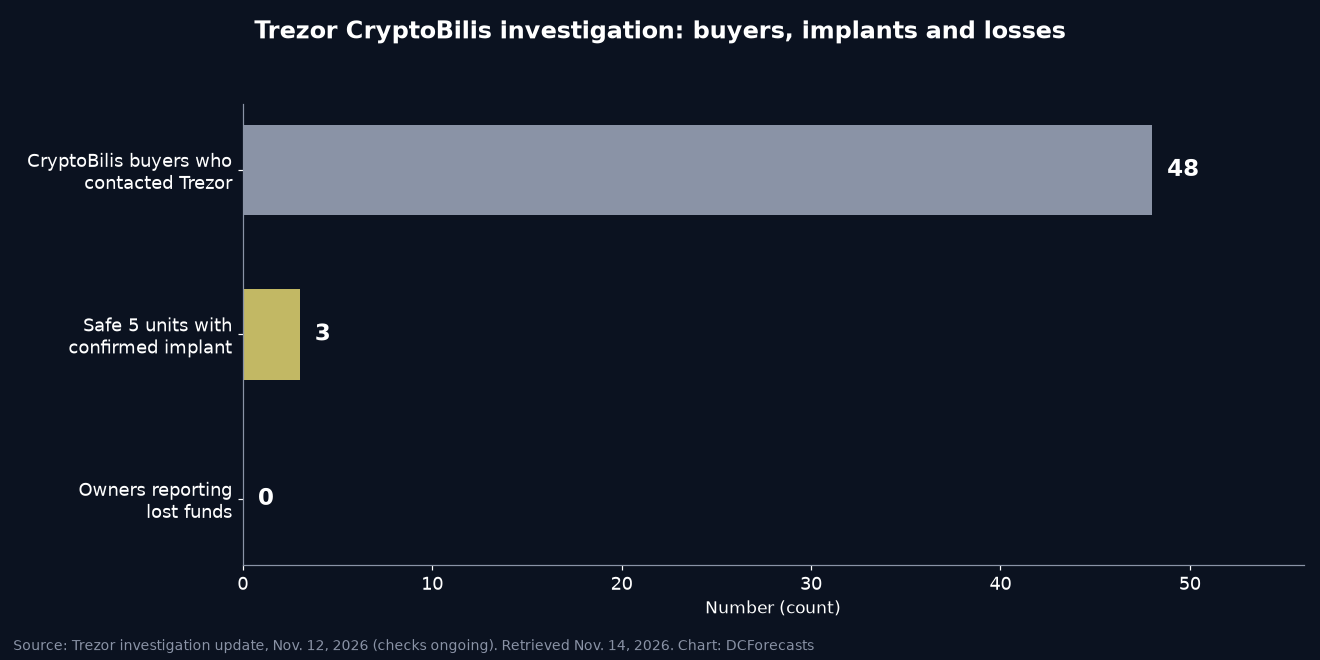
Every device examined apart from the three showed no sign of tampering, the company said. Checks on wallets from its other resellers in the region also came back clean.
These numbers come from Trezor’s own investigation and remain open. The company has promised dated updates if it confirms an implant outside CryptoBilis, in another model, or any loss of funds.
Why Trezor Dropped 80% of Its Resellers
The firmware fix handles today’s implants. The reseller cut is aimed at the next batch.
Trezor stressed that the partners it removed “were trustworthy and posed no immediate threat.” They simply did not fit the much stricter rules every remaining reseller must now follow, covering how devices are sourced, stored and who can access them.
That is a meaningful trade-off for a hardware wallet maker. Fewer resellers can mean less local availability, but a shorter supply chain leaves fewer hands between the factory and the customer.
Ledger reached a similar conclusion after its own CryptoBilis losses, tightening retail rules so returned devices can never be resold. We covered that response when Ledger’s CEO argued that “everybody will be hacked”.
What Firmware 2.13.1 Fixes, and What It Cannot
Trezor says firmware 2.13.1, released on Nov. 11, makes “the current batch of implants useless” on any device that runs it.
It cannot undo earlier exposure. If a recovery phrase was shown or typed on an implanted device before the update, it may already be in an attacker’s hands.
That is why Trezor’s guidance for CryptoBilis buyers has not changed: move funds to a new wallet with a new seed phrase. Entering the old backup into another wallet does not solve the problem, because the backup itself may be compromised.
Buyers from March 2026 onward can get a replacement device. Where shipping rules prevent that, Trezor may offer a different model with a refund of the price difference, delivery to another country, or a refund.
The company also warns that scammers are posing as support staff offering replacements. Trezor says it will never ask for a recovery phrase.
A Supply Chain Attack, Not a Broken Wallet
For Bitcoin holders, the encouraging part is what did not fail. The implant had to sit outside the security chip and read the screen, because the cryptography inside the device held.
The weak link was distribution. A supply chain attack like this depends on a buyer trusting a device that passed through the wrong hands.
Recent incidents point the same way. In the Unocoin case this week, funds moved because two keys sat in places attackers could reach, not because the wallet math broke.
Simple habits close most of that gap: buy a Trezor hardware wallet or any other device directly from the manufacturer, generate a fresh seed phrase on a device you trust, and never type a recovery phrase into anything you cannot account for.
We see Trezor’s quick public warning, firmware patch and reseller overhaul as a sign the self-custody industry is hardening fast. For anyone holding Bitcoin in their own wallet, the lesson is to control the keys and know where the device came from.
DC Forecasts is a leader in many crypto news categories, striving for the highest journalistic standards and abiding by a strict set of editorial policies. If you are interested to offer your expertise or contribute to our news website, feel free to contact us at [email protected]












Discussion about this post