



A supply chain attack through Optimizely, the website experimentation service used by many of the world’s biggest brands, put a crypto-stealing script in front of visitors to 178 organisations on Nov. 16, including hardware wallet maker Ledger.
The code swapped any wallet address it found on a page or in the clipboard for one controlled by the attacker.
Yet for all that reach, the on-chain haul was small. Wallets named by researchers received about $7,150 in crypto, and roughly three-quarters of it arrived in bitcoin.
For bitcoin holders, the more useful lesson is where the attack happened. It hit the web pages around crypto, not the Bitcoin network or the hardware that guards private keys.
How the Optimizely Supply Chain Attack Worked
Optimizely customers load a JavaScript snippet from the company’s servers to run A/B tests. Each snippet can carry custom code that runs on every page.
According to a detailed report by Scott Helme, founder of website security firm Report URI, the attacker wrote a loader into that field across many unrelated customer projects. The rest of each file was untouched, and it was still served from Optimizely’s own trusted domain.
Report URI checked 1,611 distinct Optimizely snippets and found the code in 188 of them, belonging to 178 organisations. The list includes Zoom, the BBC, CNN, Salesforce, GitLab, IKEA, HSBC, Equifax, Air France-KLM and Peacock.
Banking and finance was the largest group, with 32 organisations. Six were crypto and trading firms, among them Ledger, IG and OANDA.
The first injection appeared at 04:21 UTC on Nov. 16, and the payload was rebuilt 26 times that day, Report URI’s timeline shows.

Optimizely said in a status update at 01:02 UTC on Nov. 17 that an unauthorized party had exploited a vulnerability in its Experimentation product to add malicious JavaScript to some customer projects. It said the flaw is fixed and the code removed.
Report URI saw every infected file cleaned by 23:11 UTC on Nov. 16. How the attacker got write access to so many projects has not been explained.
What the Bitcoin Trail Shows
The script looked for valid addresses on Bitcoin, Ethereum and other EVM chains, Tron, Solana, TON, Litecoin, Bitcoin Cash and Dogecoin. It checked each address’s checksum, so it only replaced real ones.
A visitor who copied an address while an affected tab was open could have pasted the attacker’s instead.
Because Bitcoin’s ledger is public, the results can be checked by anyone. Block explorer data from mempool.space shows the attacker’s bitcoin address received five payments on Nov. 16, totalling 0.08529 BTC.
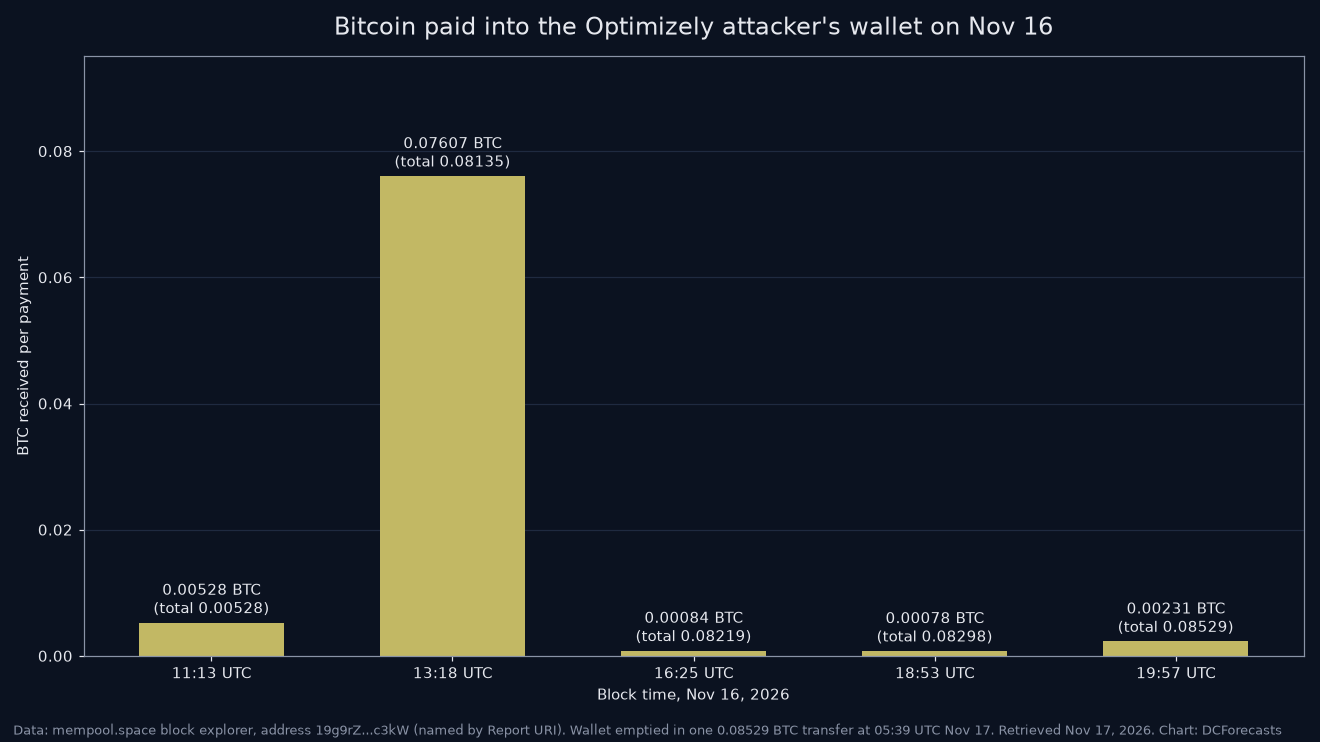
One payment of 0.07607 BTC, confirmed at 13:18 UTC, accounted for about 89% of that total. The other four were all below 0.006 BTC.
Report URI valued the bitcoin at about $5,489. It counted another $760 in Litecoin, $719 in USDT and TRX on Tron, $101 in ether and $82 in USDT on BNB Chain.
The attacker emptied the wallets early on Nov. 17. Report URI said one Tron cash-out address had been used in earlier operations, linking the actor to other attacks.
We believe that traceability matters: a thief can move bitcoin, but cannot hide that it moved.
Why Ledger Users’ Keys Were Not the Target
Ledger’s website carried the code until the clean-up, and Report URI’s timeline records its snippet being fixed at 20:41 UTC.
In replies on X on Nov. 17, Ledger said the malicious code is no longer being served through its website. “This incident does not affect the security architecture of Ledger devices. Your private keys remain protected by your Ledger device,” the company wrote.
The script could alter what a browser displayed or pasted. It could not reach keys held on a hardware wallet.
The practical defence is simple and old: check the receiving address on the hardware wallet’s own screen before approving any transfer. That step defeats address swapping because the device shows the address that will actually be paid.
Address tampering keeps coming up in different forms. As we covered this week, decoy transfers swarmed the wallet that drained a Gnosis Safe within minutes, a tactic built on users copying the wrong address. A breach at a Trezor shipping partner also showed risk sitting with third parties.
The Websites That Blocked the Script
Report URI also tested affected organisations’ Content Security Policy, or CSP, a browser rule limiting which scripts a site loads and where it sends data.

Of the 159 organisations classified, 68 had no CSP at all and 50 had a policy that let the payload run and send data out. Another 17 blocked the data theft, though address swapping, which happens inside the page, still worked.
Only 24, or 15%, blocked the payload outright. Report URI said a strict list of allowed script sources was what separated them from the rest.
What Visitors and Site Owners Should Do Now
Report URI advises anyone who visited an affected site on Nov. 16 to check every crypto transfer made that day and watch card statements. iPhone and iPad users should update to iOS 18.7.3 or 26.3 or later, as the script also targeted older iOS versions.
Site owners should review custom Optimizely code, rotate credentials and tighten their CSP.
The attacker’s main server domain stopped resolving on Nov. 17, Report URI said. It cannot see how many cards or devices were compromised, so the full cost may exceed the on-chain figure.
For bitcoin holders, the takeaway is reassuring. The weak point was a trusted web tool, and the money that moved left a permanent public trail. Self-custody with on-device address checks remains the strongest answer, and the coming days should show whether Optimizely explains how its systems were opened.
DC Forecasts is a leader in many crypto news categories, striving for the highest journalistic standards and abiding by a strict set of editorial policies. If you are interested to offer your expertise or contribute to our news website, feel free to contact us at [email protected]












Discussion about this post