



Jane Street bitcoin exposure looks very different after the third quarter. The trading firm ended September holding about $1.91 billion of spot bitcoin ETF shares, nearly double the $992 million it reported three months earlier.
The figures come from Jane Street Group’s quarterly 13F report, which it filed with the SEC on Nov. 12. The same filing shows a much larger stake in Strategy and an almost complete exit from Coinbase stock.
Jane Street is one of the biggest market makers in U.S. exchange-traded funds, so its book is not a simple bet on price. Still, the direction of its inventory says a lot about where trading demand sat during the quarter.
A Bitcoin ETF Book That Nearly Doubled
We added up every U.S. spot bitcoin ETF share position in the filing, leaving options out. The total came to $1,907 million at Sept. 30, up about 92% from $992 million at June 30.
That is also the largest quarter-end figure in the last four filings. The position stood at $1,562 million at the end of 2025 before dropping to $415 million in the first quarter of 2026.
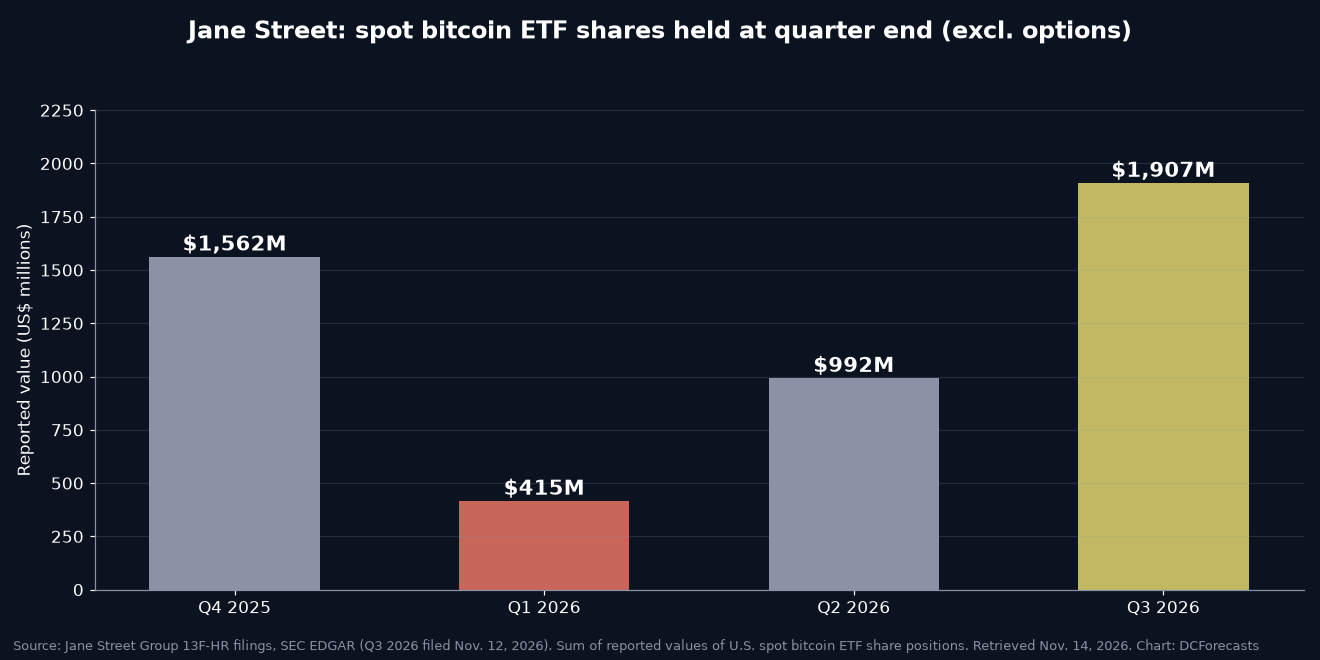
The book also got wider. Jane Street listed 12 different spot bitcoin funds in the third quarter, up from nine in the second, including a new $11.5 million position of 478,351 shares in the Morgan Stanley Bitcoin Trust.
Fidelity and ARK Funds Did the Heavy Lifting
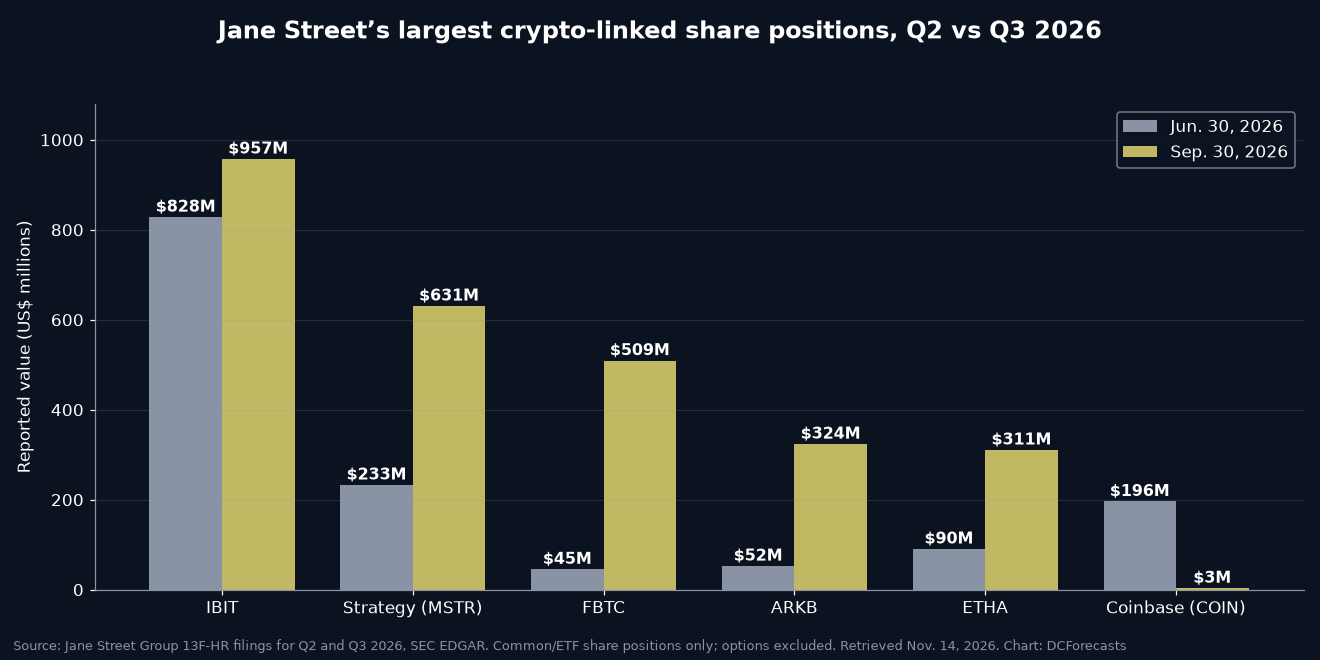
BlackRock’s iShares Bitcoin Trust (IBIT) is still the firm’s largest bitcoin fund holding, valued at $957.3 million. Oddly, Jane Street held fewer IBIT shares than before, 20.2 million against 24.9 million at the end of June.
The value rose anyway because of price. The reported numbers work out to about $47.34 per IBIT share on Sept. 30, compared with $33.29 on June 30.
The real growth came from other issuers. Jane Street’s Fidelity Wise Origin Bitcoin Fund (FBTC) stake jumped from 886,736 shares worth $45.3 million to 7.01 million shares worth $509.2 million.

Its ARK 21Shares Bitcoin ETF (ARKB) position grew from 2.7 million shares to 11.7 million, with the reported value rising from $52.5 million to $323.7 million.
Put together, FBTC and ARKB made up about $833 million of the quarter-end bitcoin fund total, up from less than $100 million in June. IBIT’s share of the book fell from roughly 83% to about 50%.
That kind of rebalancing is typical for a liquidity provider. When clients trade more of a particular fund, the market maker needs more of its shares on hand to fill orders and create or redeem units.
Banks reported a similar mix this season. Barclays rebuilt its IBIT stake while Citi opened an FBTC position, and JPMorgan nearly quadrupled its IBIT shares over three quarters.
Strategy Up, Coinbase Nearly Gone
The biggest single-stock change was in Strategy, the company that holds the largest corporate bitcoin treasury. Jane Street owned 4.12 million shares at the end of September, up from 2.68 million, and the stake’s reported value climbed from $232.8 million to $630.6 million.
Coinbase went the other way. The firm reported about 1.34 million Coinbase shares worth $196.1 million at mid-year. By Sept. 30, that had shrunk to roughly 17,700 shares worth $3.3 million.
The Coinbase exit does not say much about the exchange itself. Market makers trim single stocks for many reasons, including lower client flow or a shift in hedging needs.
Ether exposure rose too. The iShares Ethereum Trust (ETHA) holding more than doubled in share count to 15.4 million, valued at $310.6 million.
Why a Market Maker’s Holdings Still Matter
A 13F only shows long stock, ETF and listed option positions. It does not show short sales, futures or swaps, and a market maker usually hedges most of what it holds.
Options make that clear. The filing lists IBIT put options tied to $2.15 billion of underlying value and calls tied to $1.66 billion, along with Strategy calls and puts of about $2.1 billion each. That is two-way activity, not one big directional wager.
So the useful signal is not whether Jane Street is bullish. It is where the firm needed inventory to keep markets running smoothly for its clients.
On that score, the third-quarter filing points to more demand to trade bitcoin funds, a broader spread of issuers and heavy activity around Strategy. We believe that kind of deep, competitive liquidity is one of the quiet strengths behind Bitcoin’s spread into mainstream portfolios.
Tighter spreads and more firms making markets lower the cost of buying and holding Bitcoin through a brokerage account. That makes it easier for advisers, pensions and endowments to keep adding exposure, as Harvard’s 3.04 million-share IBIT stake shows.
What to Watch in the Next Round of Filings
The Q3 deadline falls this weekend, so more large funds and banks should publish their reports on Monday. Those filings will show whether the swing toward FBTC and ARKB was a Jane Street pattern or a wider trend.
The next set of 13Fs, covering the fourth quarter, is due in mid-February. It will show how market makers handled the October and November pullback, when Bitcoin slid back toward its long-term averages.
For now, the record is plain. One of the busiest ETF traders on Wall Street ended the third quarter with more bitcoin fund shares than at any point in the past year.
DC Forecasts is a leader in many crypto news categories, striving for the highest journalistic standards and abiding by a strict set of editorial policies. If you are interested to offer your expertise or contribute to our news website, feel free to contact us at [email protected]












Discussion about this post