



Kazakhstan plans to sell tokenized bonds backed by the state in the first quarter of 2027, after its central bank placed its own notes on a blockchain-based platform for the first time.
National Bank Governor Timur Suleimenov announced the plan on Nov. 13 at the 14th Congress of Financiers of Kazakhstan in Almaty. The government bonds will be issued jointly with the Ministry of Finance.
“We plan to issue tokenized government bonds jointly with the Ministry of Finance in the near future. This will probably take place in the first quarter of next year,” Suleimenov said, according to remarks reported from the congress.
A $21.5 Million Test Run on Nov. 9
The announcement follows a live trial. On Nov. 9, the National Bank placed 10 billion tenge, or about $21.5 million, of 91-day notes through the digital financial assets platform of the Kazakhstan Stock Exchange (KASE).
The notes were auctioned in both traditional and tokenized form. Their weighted average yield was 15.72% a year.
That came less than two weeks after private issuers sold the first tokenized bonds on the same KASE platform on Oct. 27. Suleimenov said the two deals proved the system works end to end.
“The successful conduct of these trades means that we have tested the full readiness of the infrastructure, all institutional arrangements and so on, to expand this mechanism,” he said.
Why the 15.72% Yield Matters
The tokenized notes priced almost exactly in line with the central bank’s policy rate. Kazakhstan’s base rate stands at 15.75% after a 50 basis point cut on Oct. 23.
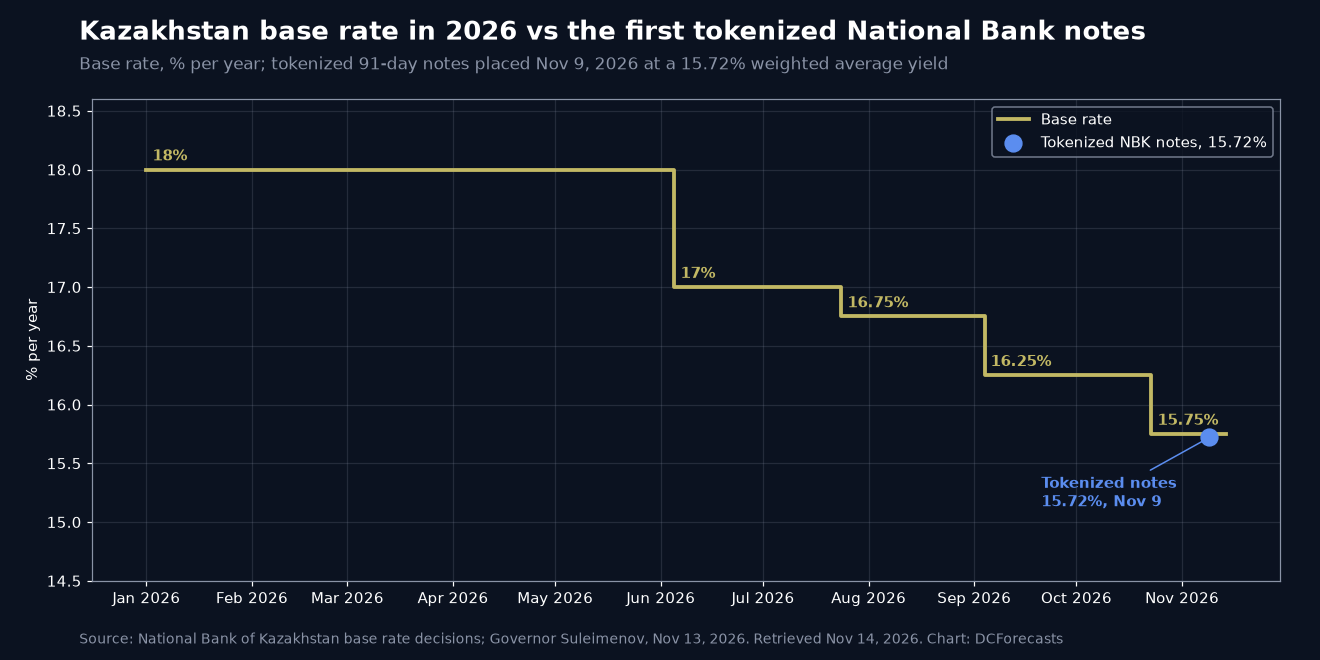
The rate started 2026 at 18%. The National Bank then cut it four times, in June, July, September and October, as annual inflation slowed to 9.3% in September.

The central bank aims to bring inflation back to its 5% target in 2028. Its next rate decision is due on Dec. 4. The bank has said a change before the end of 2026 is unlikely.
That pricing suggests investors treated the tokenized notes like any other central bank paper, without demanding a premium for the new format. For a first issue on new rails, that is an encouraging result.
The yield is high by global standards because Kazakhstan’s rates are high. The U.S. 3-month Treasury bill rate was 4.06% on the same day, according to Federal Reserve data.
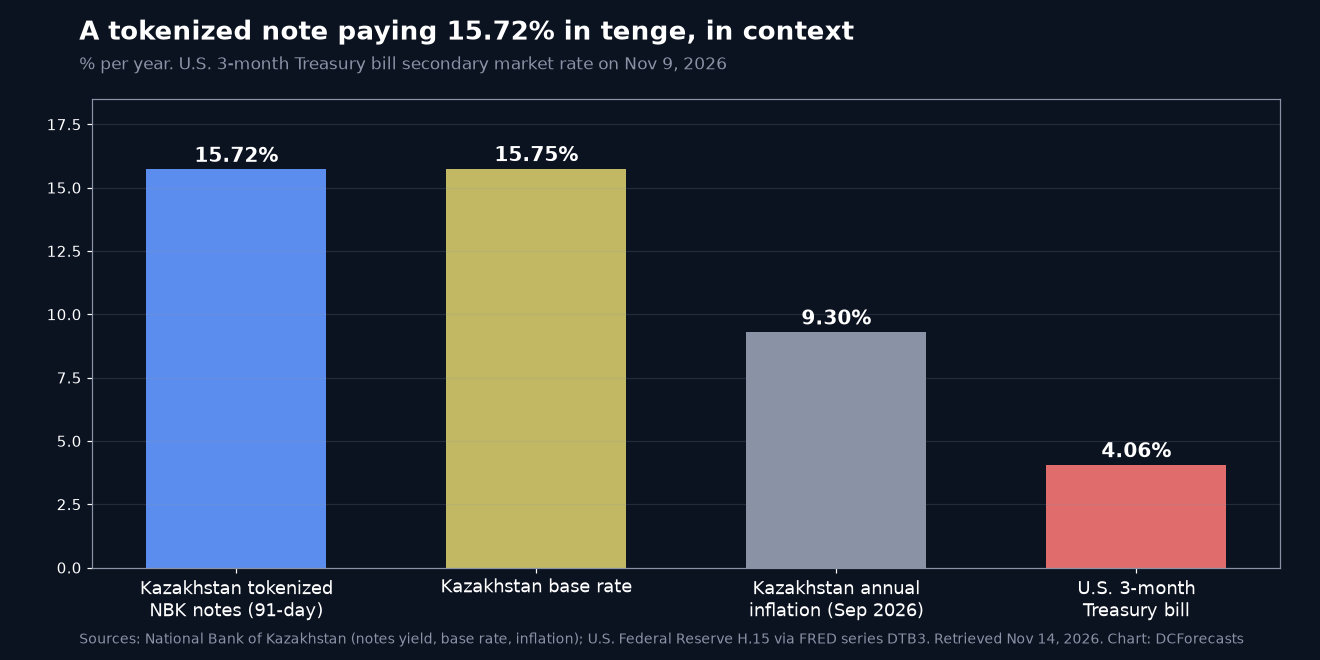
The comparison is not like for like, since the notes pay in tenge and carry currency risk for foreign holders. Still, it shows why a tokenized tenge instrument could attract attention once access widens.
What Kazakhstan Has Already Built for Tokenized Bonds
Kazakhstan has spent 2026 laying the groundwork. Suleimenov said the legal framework for digital financial assets came fully into force on May 1, according to Kazakh business outlet Kursiv.
The country also set up the necessary registers and a national crypto custodian at its central securities depository. KASE launched a tokenization platform and a trading venue for digital assets.
A national crypto reserve has started operating as well. As we reported earlier this week, Kazakhstan has invested $190 million of its $700 million crypto reserve.
Retail crypto access is growing too. The first licensed crypto exchange point opened in July, and eight are now operating, with combined turnover of 45 billion tenge, according to the same report.
Digital Tenge and Real-World Assets Are Next
The plans go beyond government debt. Officials said the National Bank and the government intend to raise digital tenge issuance to 2 trillion tenge, the national news agency Qazinform reported.
Suleimenov also named the next targets for tokenization: real estate, precious metals and mineral resources. “Tokenization transforms a financial asset into any type of asset. In this way, it democratizes access to finance and reduces its cost,” he said.
Some details remain open. The National Bank has not yet given a size, maturity or exact date for the tokenized government bonds, only the first-quarter target.
A Wider Shift Toward Tokenized Money
Kazakhstan is not alone. Just this week, the central banks of the U.K., Singapore and Thailand tested synchronised FX settlement across tokenized and traditional ledgers.
What sets Kazakhstan apart is that it is moving from tests to live issuance. It now has a working tokenized note market, a crypto custodian and a state crypto reserve, with sovereign bonds next in line.
For Bitcoin supporters, that combination is worth watching. A government that issues its own debt on blockchain rails while holding digital assets in reserve is treating crypto infrastructure as part of the financial system, not a fringe experiment.
DC Forecasts is a leader in many crypto news categories, striving for the highest journalistic standards and abiding by a strict set of editorial policies. If you are interested to offer your expertise or contribute to our news website, feel free to contact us at [email protected]












Discussion about this post