



Apex Group, a financial services provider that services more than $3.5 trillion in assets, has joined the Hedera Council, the body that governs the Hedera public network. The appointment was announced on Nov. 11 from Hamilton, Bermuda.
The move gives a major fund administrator a direct vote on how Hedera is run. It also signals that tokenization is now a boardroom topic for the firms that keep the books for funds and their investors.
What Apex Brings to the Hedera Council
According to the announcement, Apex was the first transfer agent and fund service provider to administer regulated securities using distributed ledger technology as the official book of record.
That background matters. A transfer agent is the party that records who owns a fund’s shares, processes subscriptions and redemptions, and keeps ownership records accurate. If tokenized funds are going to scale, firms like Apex have to be comfortable running those records on-chain.
Apex said it will explore using Hedera as part of its digital asset and tokenization work. The company describes Hedera as an auditable public network built to support asset lifecycle events, compliance attestations and settlement coordination.
Its existing platform, Apex Digital 3.0, covers tokenization, stablecoins, regulated transfer agency, investor identity, proof of reserves and digital fund servicing. The group says the goal is to let clients launch, distribute and manage tokenized assets inside one system.
Compliance Built Into the Token
Marco A. Infuso, head of digital assets for Central Europe at Apex Group, said institutional tokenization will only scale if compliance is part of the asset from the start.
“Institutional tokenization will scale only when compliance is embedded throughout the asset lifecycle, not added as an afterthought,” Infuso said. “That principle underpins our use of ERC-3643, the standard for compliant tokenization.”
ERC-3643 is a token standard designed for regulated assets. It lets issuers attach identity and eligibility checks to a token, so only approved investors can hold or receive it. Infuso said that approach gives clients the flexibility to hold assets in traditional or tokenized form, with the same controls in both.

Mance Harmon, chair of the Hedera Council, said the addition comes “at a pivotal moment, as institutional tokenization moves from experimentation to real-world adoption.”
How Hedera Council Governance Works
The Hedera Council works differently from most public blockchains. According to the Council’s FAQ, its agreement allows up to 39 members, and each serves a limited term.
Members vote on network and treasury matters, such as transaction pricing, code updates deployed to mainnet and treasury transfers. They also vote on Council business, including electing board members and admitting new members.
Each member has one vote. Most decisions pass by simple majority, while some require a supermajority or unanimous consent. The Council says these rules are meant to stop any single member or small group from controlling network decisions.
Members also take on technical duties, including running a network node and signing transactions. The Council does not pay members to join, and members have no ownership rights over the HBAR held in Hedera’s treasury, although they may earn node rewards for operating nodes.
Thirty Nodes, Most of Them in Europe
Data from Hedera’s public mirror node shows 30 consensus nodes on mainnet as of Nov. 11. Each node lists its operator and hosting location.
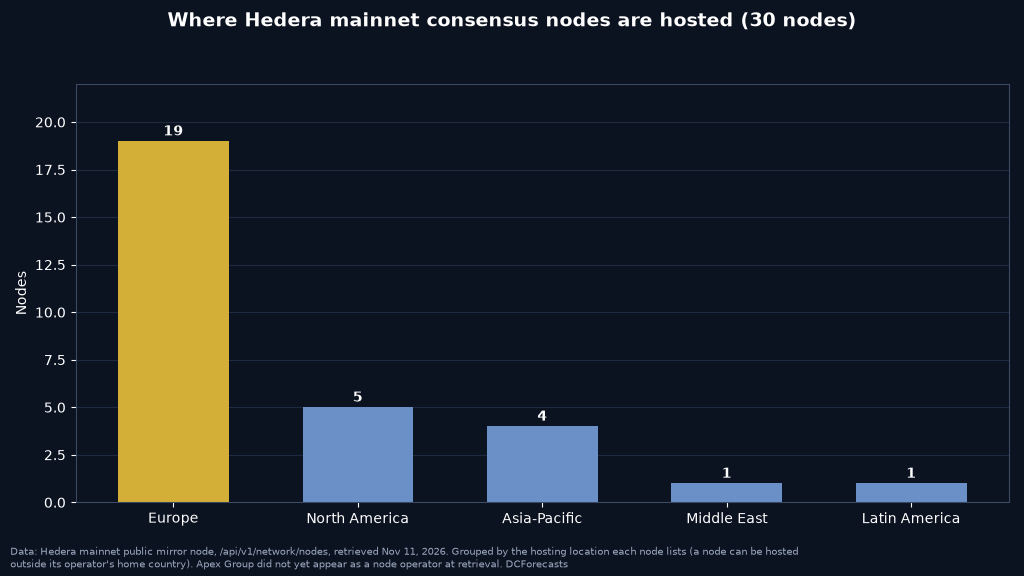
Nineteen of those nodes are hosted in Europe, five in North America and four in the Asia-Pacific region. One is hosted in the Middle East and one in Latin America.
The operators are a mix of global brands. They include Google, IBM, Deutsche Telekom, Dell, FedEx and Accenture, along with financial firms such as Nomura, Shinhan Bank, Standard Bank, Aberdeen Investments and BitGo. Accenture, McLaren Racing and FedEx are among the Council’s more recent additions, according to its website.
Apex did not yet appear as a node operator when DCForecasts pulled the data. Under the Council’s rules, operating a node is one of a member’s obligations, so its node would be expected to join the list later.
Why Fund Administrators Matter for Tokenization
Much of the tokenization debate focuses on blockchains and exchanges. In practice, the firms that administer funds and maintain shareholder records decide how fast real assets move on-chain.
Apex’s decision to take a seat on a public network’s governing body shows that this group is moving from pilots to formal commitments. It comes in a busy week for institutional digital assets. Deutsche Bank’s digital asset custody service went live with Bitcoin and Ether, and Alta raised $47.5 million to bring stablecoin payments to banks.
For crypto markets more broadly, that trend is a positive one. The more traditional finance builds compliant on-chain rails, the easier it becomes for institutions to hold digital assets of every kind, from tokenized funds to Bitcoin itself.
The next step to watch is whether Apex moves from exploring Hedera to issuing or servicing client funds on it, and how quickly its node joins the network.
DC Forecasts is a leader in many crypto news categories, striving for the highest journalistic standards and abiding by a strict set of editorial policies. If you are interested to offer your expertise or contribute to our news website, feel free to contact us at [email protected]












Discussion about this post