



Western Europe’s crypto economy did something most of the world did not manage during the 2025-26 downturn: it grew, and a new report suggests the MiCA crypto rulebook may be part of the reason.
Blockchain analytics firm Chainalysis put the region’s activity at $2.08 trillion between July 2025 and June 2026, up 1.2%, in a Nov. 9 chapter of its 2026 Geography of Cryptocurrency Report.
That growth came while the total crypto market cap fell 50% over the same window, according to the report.
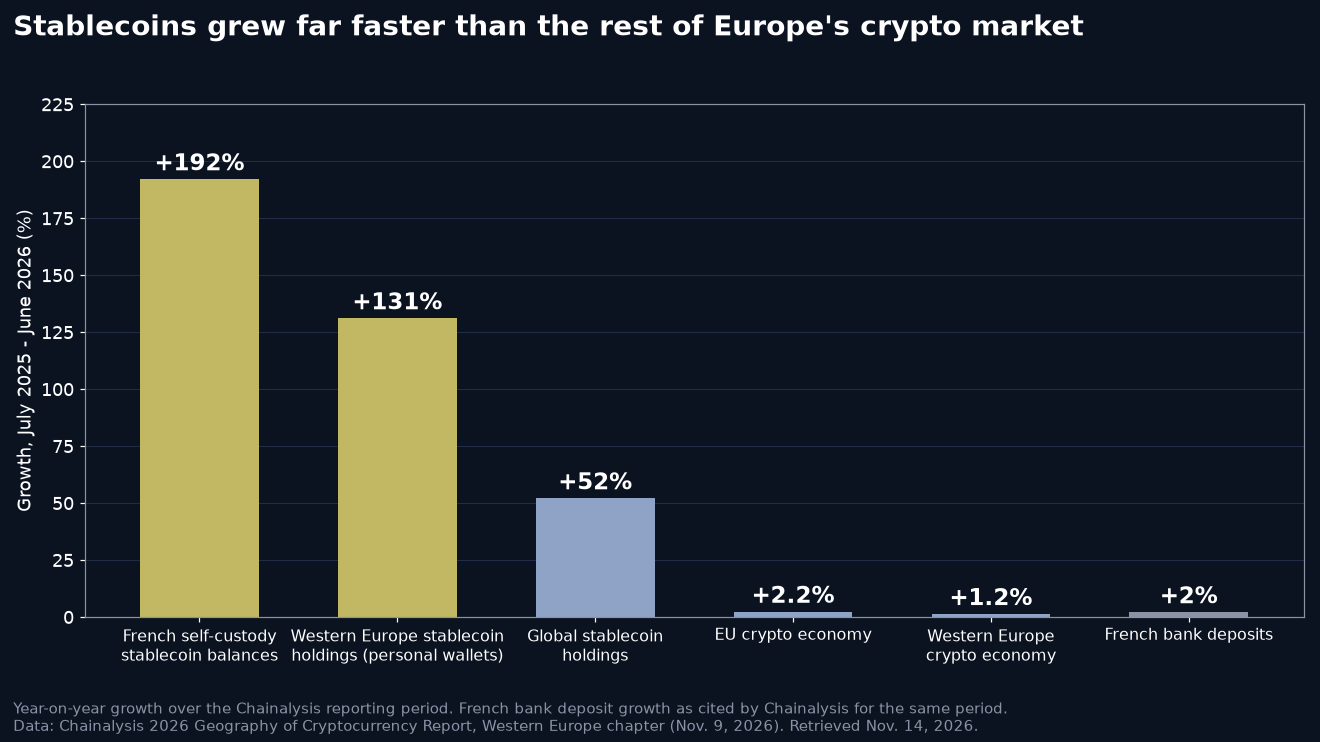
The real surprise sits underneath the headline number. Stablecoin holdings in personal wallets across the region jumped 131%, while the United Kingdom, still the largest market, shrank 8%.
The bigger question now is what Europeans are doing with that money, and what it says about demand for assets that sit outside the traditional banking system.
Six Countries Carry Two-Thirds of the Region
Western Europe now ranks as the world’s second-largest regional crypto economy.
It was one of only three regions to post positive growth in the period, alongside Sub-Saharan Africa and Latin America.
The UK led with $424.5 billion, about 20% of the regional total. Germany followed at $288.8 billion, then France at $215.8 billion and the Netherlands at $207.8 billion.
Spain ($156.1 billion) and Switzerland ($132.8 billion) both grew, driven by more activity on centralized exchanges.

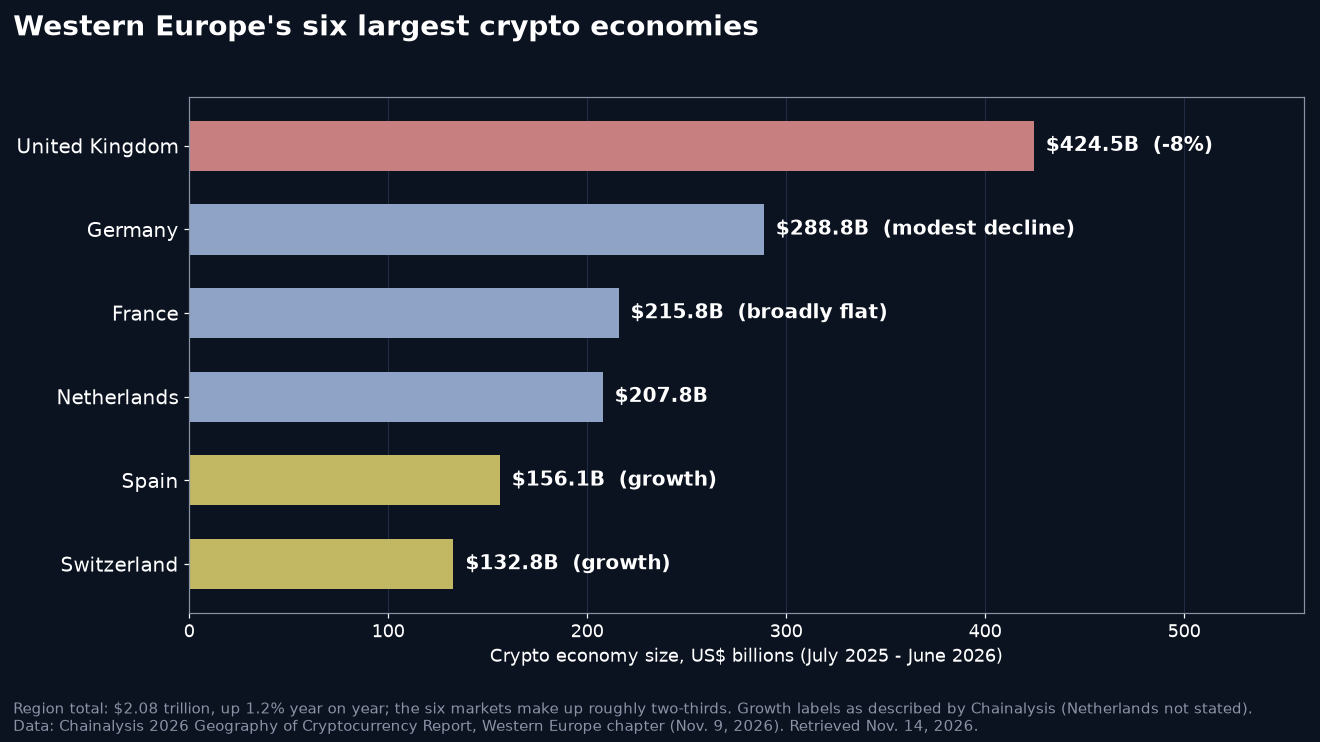
The weaker spots were concentrated in decentralized exchange trading. Chainalysis tied both the UK contraction and a modest German decline mainly to lower DEX activity, while France stayed broadly flat.
We read that as a rotation, not a retreat: speculative on-chain trading cooled while regulated venues kept expanding.
Why the EU Outgrew the UK Under MiCA Crypto Rules
The EU’s crypto economy grew 2.2% and the rest of Western Europe grew 3.8%, while the UK contracted 8%.
Chainalysis suggested the Markets in Crypto-Assets regulation may be part of the explanation. Early MiCA compliance costs may have slowed growth at first, but the July 2026 transition deadline appears to have pushed providers toward authorization, and licensed firms can then passport their services across the bloc.
The firm was careful to add that its data cannot prove MiCA caused the growth. Market dynamics also played a role.
The euro’s role is rising too. By the end of the period, euro-denominated trading made up 11.8% of crypto volume across 33 leading government currencies, closing in on a 14.5% benchmark Chainalysis derived from Bank for International Settlements foreign-exchange data.
The UK, by contrast, only opened its Financial Conduct Authority authorization gateway in September, which Chainalysis said may have encouraged a wait-and-see approach.
Institutional build-out is visible on both sides of the Channel. As we covered when Deutsche Bank switched on Bitcoin custody, large European lenders are now offering the plumbing directly.
Stablecoins Became Europe’s Fastest-Growing Habit
The 131% rise in regional stablecoin holdings compared with 52% globally, lifting Western Europe’s share of global stablecoin balances from 3.4% to 5.1%.
Holdings rose in every country Chainalysis measured, with Austria and France growing fastest.
The UK tells its own story. Domestic wallet-to-wallet stablecoin transfers climbed to $2.09 billion from $109 million a year earlier, accounting for 60% of the region’s domestic transfer value.
About 1.03% of eligible UK retail wallets moved at least 80% of their crypto into stablecoins, up from 0.66%. Those conversions peaked in July-September 2025, before Bitcoin’s October high, pointing to a gradual habit change rather than panic selling.
Banks want a share of that demand. Jan-Oliver Sell, chief executive of the bank-backed Qivalis consortium, described regulated euro stablecoins as a possible “on-chain cash leg for tokenised assets.”
France and Spain Show Two Very Different Paths
In France, self-custodied stablecoin balances rose 192%, against 2% growth in French bank deposits over the same period.
The number of French personal wallets holding stablecoins grew from 3,577 in June 2025 to 12,255 in June 2026. Stablecoins also accounted for 54.2% of French withdrawals from centralized exchanges, the highest share among the large markets studied.
Chainalysis linked the timing to bond-market stress, as French 10-year yields climbed above 5.14% in October, their highest level in over 20 years.
Spain is becoming a hub. Inflows from Western European users to Spanish-registered exchanges rose 79.1%, compared with 24.6% growth in Spain’s overall crypto economy, with flows from Italy up 329% and from Portugal up 751%.
What Euro Bond Yields Reveal About Bitcoin Demand
Using weekly data, Chainalysis found that when euro-area government bond yields rose relative to US yields, euro-denominated trading in Bitcoin and tokenized gold rose relative to dollar trading.
A rise of around 7 basis points coincided with euro trading about 12% higher. When the yield gap narrowed, euro trading was 8% to 10% lower.
The firm offered one interpretation: traders may add Bitcoin and tokenized gold to their portfolios when confidence in the euro area’s fiscal outlook comes under pressure. It also stressed the data cannot establish a direct link.
We believe that pattern matters more than any single month of price action. Bitcoin traded near $68,200, or roughly EUR 61,960, on Coinbase early on Nov. 14, well below its October 2025 peak.
Yet the demand signals in this report, from euro trading tied to sovereign-debt worries to rapid self-custody growth, are the kind that tend to build quietly during drawdowns. Our recent look at shrinking daily ETF exits tells a similar story on the US side.
Bitcoin’s fixed 21 million supply stands in sharp contrast to the fiscal strain Europe is grappling with. If euro-area debt worries return, the coming months will show whether Europeans keep reaching for hard, portable assets.
DC Forecasts is a leader in many crypto news categories, striving for the highest journalistic standards and abiding by a strict set of editorial policies. If you are interested to offer your expertise or contribute to our news website, feel free to contact us at [email protected]












Discussion about this post