



Bitcoin difficulty dropped 9.13% on Saturday, the deepest reset since June, after blocks spent the past two weeks arriving well behind schedule.
The adjustment landed at block 975,744 at 05:02 UTC on Nov. 14, according to mempool.space data. It took mining difficulty from 148.36 trillion down to 134.82 trillion.
The cut also came in larger than it looked earlier in the week. On Nov. 10, with three quarters of the epoch complete, the live estimate pointed to a reduction of about 6.8%. The final stretch then slowed sharply.
We believe this is one of Bitcoin’s most underrated features at work. Some hash power stepped back, and the network rebalanced itself on schedule, with no vote, no committee and no outside help.
Why the Final Cut Beat the Estimate
Bitcoin resets its difficulty every 2,016 blocks so that blocks keep arriving roughly every 10 minutes. When blocks come too slowly, the next adjustment makes mining easier by the same proportion.
Across the full epoch, which began at block 973,728 on Oct. 29, blocks averaged 11.01 minutes. That was 10% slower than the target, which is almost exactly what the 9.13% cut corrects.
The pace was not even. By our calculation from block timestamps, the first 1,522 blocks averaged about 10.7 minutes. The last 494 blocks, mined from Nov. 10 to Nov. 14, averaged about 11.9 minutes.
That late slowdown is what pushed the final number past earlier projections. The last batch of 144 blocks took 31.5 hours to mine, compared with the 24 hours the protocol aims for.
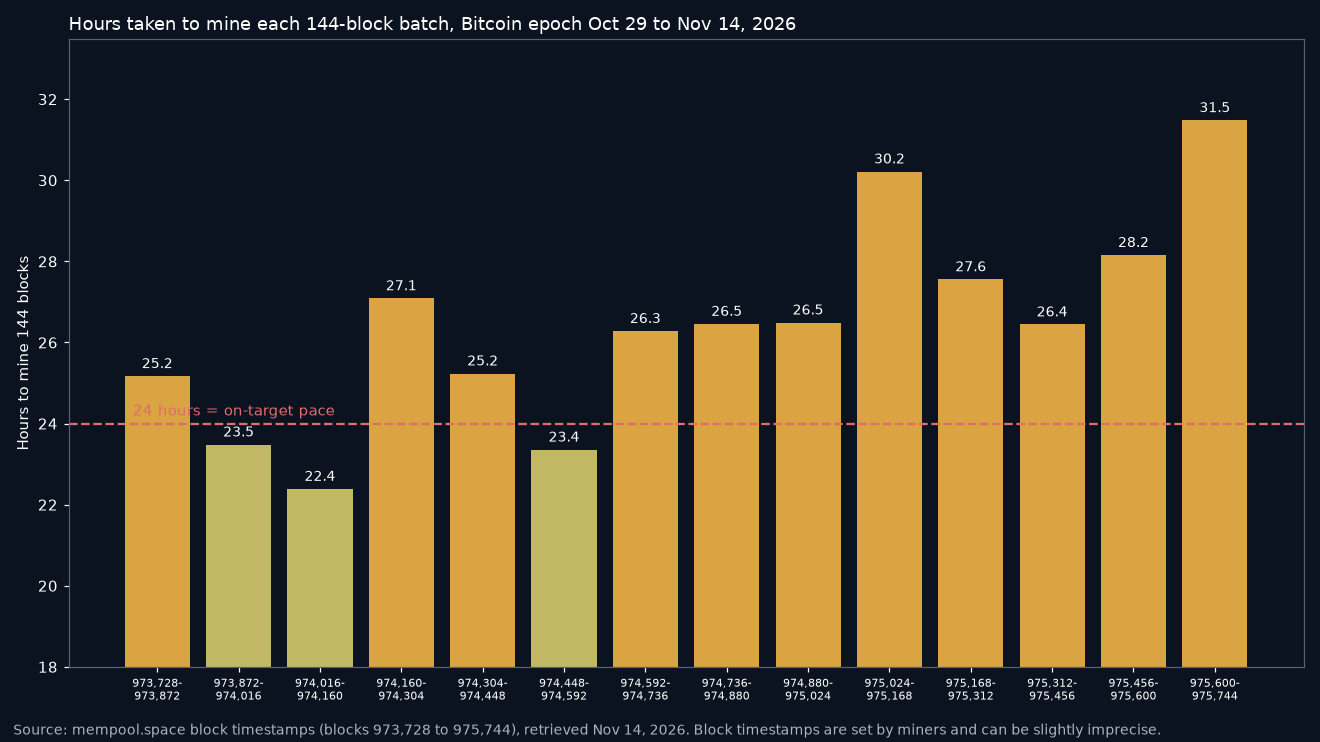
Only three of the 14 batches came in faster than 24 hours, and all three were in the first week. After that, every batch ran long.

How the Epoch Compares With the Past Year
An 11.01-minute average makes this the slowest epoch since the one that ended on June 14, which averaged 11.13 minutes. Over the last 26 epochs, only that period and the one ending Feb. 7, at 11.26 minutes, were slower.
The contrast with October is striking. The two epochs before this one averaged 9.44 and 9.48 minutes, as fresh hash power rushed in and lifted difficulty by more than 11% in under a month.
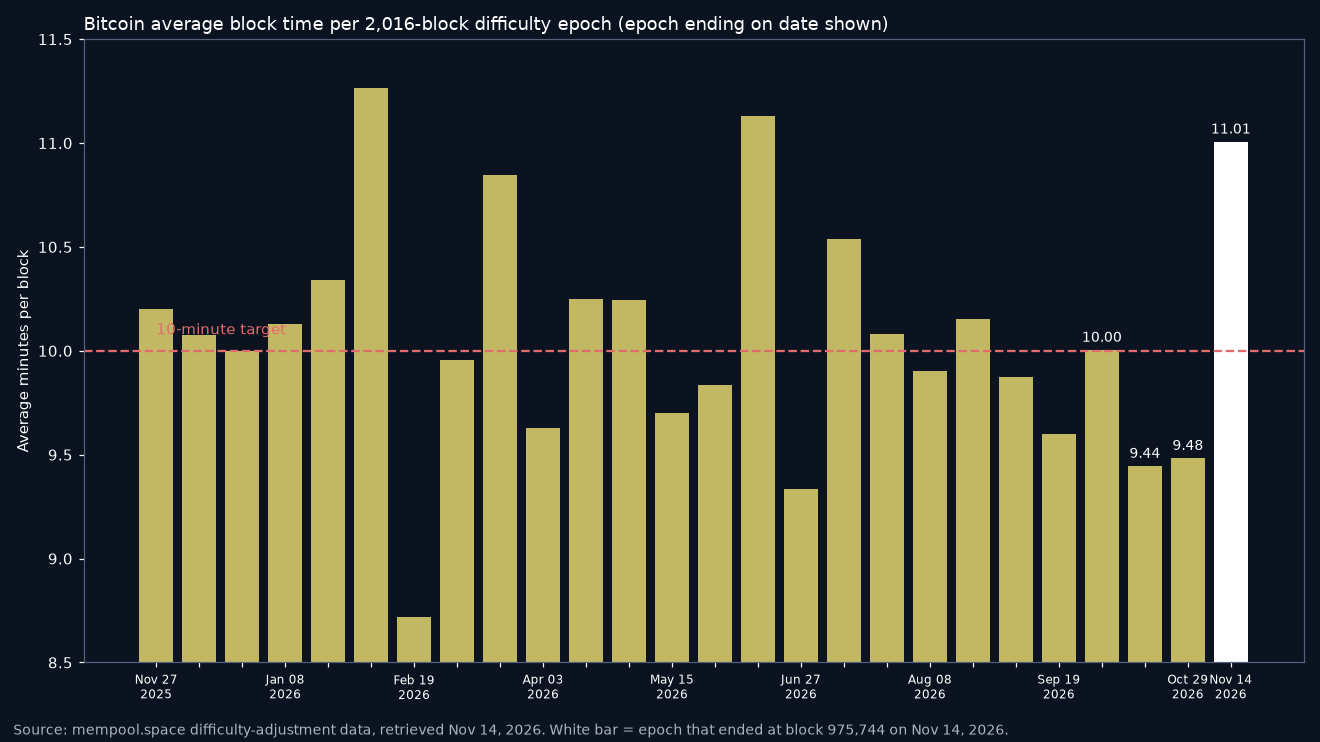
So far in 2026, 12 of the 23 adjustments have been cuts. Only two were deeper than Saturday’s: an 11.16% cut on Feb. 7 and a 10.09% cut on June 14. No cut since the start of 2022 has gone deeper than those two.
After the lower difficulty took effect, the network rebounded each time. The next adjustment brought a 14.73% rise in February and a 7.15% rise in late June, as miners returned once conditions improved. That history does not promise a repeat, but it shows how quickly hash power has come back before.
What the Bitcoin Difficulty Cut Means for Miners
For miners still running, the math is simple. With difficulty 9.13% lower, the same machines should find about 10% more blocks on average, at the same power cost.
That relief arrives at a useful time. Bitcoin traded near $65,283 on Saturday afternoon, down 4.8% in 24 hours on CoinGecko data, which squeezes revenue for every operator.
Fees are giving little extra help. Over the latest 144 blocks, miners collected about 454.3 BTC in total rewards, and only 4.27 BTC, or 0.94%, came from transaction fees. The 3.125 BTC block subsidy is still doing nearly all the work.
We covered the squeeze on miner revenue in our look at hashprice and the hash ribbons on Friday. A lower difficulty raises the bitcoin each unit of hash power can expect to earn, which directly supports that measure.
Is the Bitcoin Hashrate Already Recovering?
Early signs point the right way. The first 72 blocks after the adjustment arrived at an average of about 9.7 minutes each, a little faster than the target.
That sample covers less than 12 hours and less than 4% of the new epoch, so it says little about where the next adjustment will land. Block times can swing widely over short windows.
Daily bitcoin hashrate estimates are also noisy. That is why the epoch average, rather than any single day’s reading, remains the most reliable gauge of how much computing power is securing the network.
Difficulty now sits at its lowest level since the Oct. 3 adjustment, when it stood at 132.72 trillion. It is 13.6% below the record 155.97 trillion set on Oct. 29, 2025, according to mempool.space.
What to Watch Next
The next retarget is due at block 977,760. At the current pace, mempool.space estimates it around Nov. 29, though that date will move with block times.
The key question is whether miners who switched off machines in early November plug them back in now that each block is easier to win. Earlier in the week, our preview of this cut laid out how the adjustment works and why blocks were running slow.
We believe Saturday’s reset is a reminder of why Bitcoin keeps running through every market cycle. When conditions tighten, the protocol lowers the bar, keeps blocks flowing and leaves room for the miners who stay to earn more of every reward.
DC Forecasts is a leader in many crypto news categories, striving for the highest journalistic standards and abiding by a strict set of editorial policies. If you are interested to offer your expertise or contribute to our news website, feel free to contact us at [email protected]












Discussion about this post