



Bitcoin mining in the UK is being pitched as a fix for one of Britain’s fastest-growing energy bills. A new Bitcoin Policy Institute report argues that miners could soak up Scottish wind power the grid cannot move, and the timing is striking.
Official grid data shows Britain spent a record £606 million managing transmission bottlenecks in October 2026 alone. That is the highest monthly figure since the National Energy System Operator’s daily series began in April 2017.
For Bitcoin investors, this is a rare case where a policy paper meets a measurable problem. The question is whether flexible mining can win a place in Britain’s answer.
What the Bitcoin Policy Institute Is Proposing
The report, titled “Britain’s Biggest Opportunity,” was written by Bitcoin Policy Institute executive director Conner Brown and Joey Garcia, head of regulatory affairs at Xapo Bank.
Its focus is Scotland. Wind capacity there has grown faster than the transmission lines that carry power south to England, where demand is highest. When the wires are full, the grid operator pays Scottish wind farms to turn down and pays power stations further south, often gas plants, to turn up.
The authors put the annual cost of paying generators to switch off at more than £1 billion. Their idea is simple: if power cannot reach its customers, bring a customer to the power.
The report recommends that the Department for Energy Security and Net Zero and NESO assess whether mining sites could be placed behind transmission bottlenecks, especially along the Scotland-England boundary.
The Grid Bill Has Grown Six-Fold Since 2017
We checked the scale of the problem against NESO’s own constraint data. The operator publishes daily costs for managing thermal constraints, the cost of balancing the system when power lines hit their limits.
In the 2017/18 financial year, those costs totalled £309 million. By 2025/26, they reached £1.956 billion, more than six times higher.

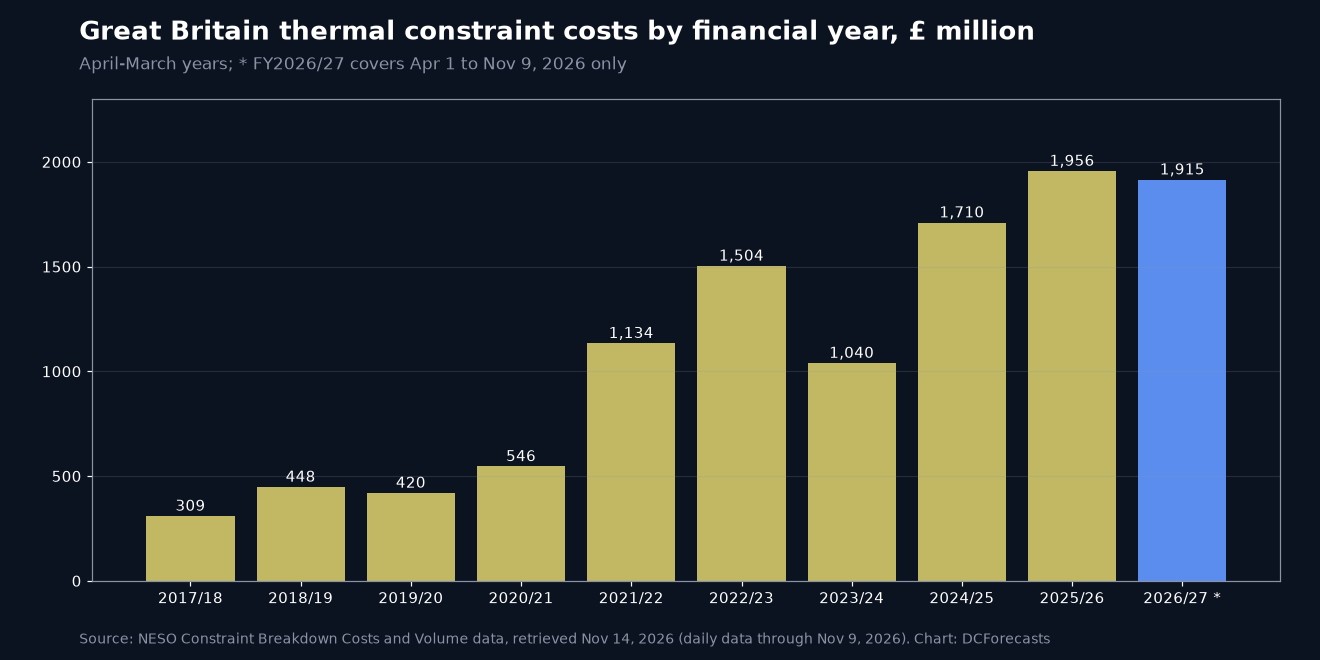
This year is running far ahead of that. From April 1 to Nov. 9, 2026, thermal constraint costs already add up to £1.915 billion. That is within about 2% of the entire previous financial year, with almost five months still to go.
Comparing like with like, April through October 2026 cost £1.893 billion. The same seven months in 2025 cost £980.5 million, so the bill has nearly doubled in a year.
September and October Broke the Monthly Record
The jump is concentrated in the past two months. September 2026 came in at £469 million, and October at £606 million.
Before this autumn, the highest month in the series was November 2021, at about £351 million. October beat that by roughly 73%.
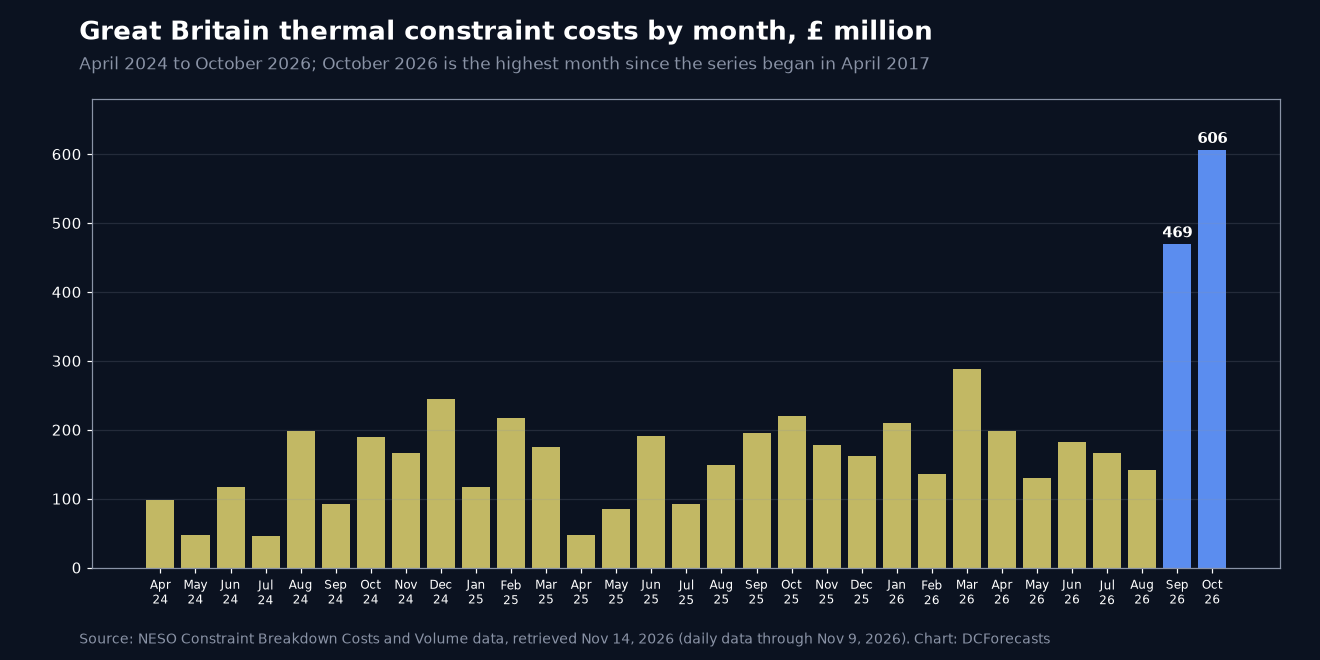
The single most expensive day this autumn was Oct. 27, at £52.1 million. The all-time daily high in the data remains July 20, 2022, at £62.1 million.
These figures cover the whole of Great Britain and include the cost of turning other plants up, not only payments to wind farms. Still, they show why the report’s authors see an opening.
Why Bitcoin Mining Fits Where Data Centers Struggle
The report’s central argument is flexibility. Traditional data centers need firm, uninterrupted power near city fiber hubs. They cannot shut down every time the wind drops or the grid gets congested.
Bitcoin miners can. According to the report, mining is modular, quick to deploy and relocatable, needing only power and an internet connection. It can switch off fully for long periods without disrupting any customer, and it can stay viable at partial use when power is cheap.
The authors cite research on ten mining companies that found facilities curtailed their electricity use between 5% and 31% of the time in response to grid conditions.
We believe this is Bitcoin mining’s strongest case: a buyer of last resort that turns stranded energy into revenue. It is the same logic behind Paraguay’s mining income from surplus hydropower.
The Hurdles Before Any Turbine Powers a Miner
The report is candid about its limits. It says the £1 billion-plus constraint bill is not the amount mining could save. Any real project would need modelling of consumer savings, emissions and infrastructure costs.
Economics matter too. Miners are already working with thin margins, as our look at hashprice near $29.52 per petahash showed. Cheap or curtailed power is exactly what would make UK sites competitive.
The authors also warn that banking restrictions and inconsistent investment and tax rules threaten Britain’s appeal as a mining location. They note, however, that Bitcoin already enjoys legal recognition as property in the UK.
In our view, transmission build-out will remain the long-term answer to Scotland’s bottleneck. But new lines take years, and the bill is growing now.
That gap is where Bitcoin mining’s flexibility could prove its value. If UK policymakers take up the report’s call for a study, Britain could become the next test of whether Bitcoin’s energy demand helps a grid rather than strains it.
DC Forecasts is a leader in many crypto news categories, striving for the highest journalistic standards and abiding by a strict set of editorial policies. If you are interested to offer your expertise or contribute to our news website, feel free to contact us at [email protected]












Discussion about this post