



Europe’s three most important financial authorities want the industry to write a common rulebook for asset tokenization, and they have set a tight deadline to get started.
The European Central Bank, the European Commission and the European Securities and Markets Authority (ESMA) have opened nominations for a new body called the European Tokenisation Standards Group (ETSG). Firms that want a seat have until Nov. 27, 2026 to apply.
The group is expected to begin work in January 2027. Its task is simple to describe and hard to deliver: make sure tokenized securities and the networks that carry them can actually talk to each other.
What the New Asset Tokenization Group Will Do
According to the group’s mandate, its core objective is “end-to-end interoperability” across Europe’s DLT-based financial markets.
In practice, that means agreeing on common market standards for settling and holding DLT financial instruments. Those standards must work between different blockchain-based infrastructures, and between those networks and the traditional systems banks use today.
The authorities also want a single rulebook. The ETSG is asked to build a framework for monitoring whether members actually use the agreed standards, and it may recommend steps EU authorities could take to encourage compliance.
One of the principles in the mandate is “not reinventing the wheel.” The group should build on established financial standards and existing DLT standards, as long as they are widely accepted and still suit the new market structures.
Industry Leads, Regulators Watch
The structure is unusual for an EU initiative. The ETSG will be chaired by industry participants, while the ECB, the Commission and ESMA sit in as observers.
Membership is open to a broad mix of players. The ESMA release lists EU associations, private entities, global institutions and fintech companies among the stakeholders that can take part.

The bar for nominees is practical. According to the call for nominations, each candidate must represent an entity with a European presence, bring relevant standards expertise, and be able to commit its organisation to acting on the group’s findings.
The three authorities will assess applications with balanced representation across geography and types of stakeholders in mind. The mandate adds that no single stakeholder group, defined by business model, technology or industry segment, should dominate. Progress will be reported back to the authorities periodically.
Why Europe Is Moving Now
The driver is fragmentation. Europe’s legacy market plumbing is already split across many national systems, and officials worry that a wave of separate blockchain networks could repeat the problem.
The mandate quotes a July 2026 Eurogroup statement warning that “without shared standards, the multiplication of DLT networks risks recreating and compounding the fragmentation” the EU has spent years trying to fix.
The ECB has heard the same message from the market. Feedback to its Appia public consultation in April 2026 showed that the risk of fragmentation in tokenization is significant and that action is “urgently needed,” the background document says.
Appia is the Eurosystem’s roadmap, published in March 2026, for bringing central bank money into tokenized wholesale markets. It has six building blocks, and the first one focuses on asset interoperability and standards. The ETSG is designed to feed directly into that work.
The Legal Track Behind It
There is also a legislative path. The EU’s DLT Pilot Regime, which lets market infrastructures test blockchain-based trading and settlement, has been in place since 2022.
In December 2025, the Commission proposed changes to that regime as part of its Market Integration and Supervision Package. The proposal would relax limits, add flexibility and require an industry group to set interoperability standards.
Those amendments still need approval from EU lawmakers. The ETSG lets work start early, and the mandate says that once the new standardisation mandate is adopted, the industry group required under the regime may carry out its work jointly with the ETSG.
What It Means for Europe’s Tokenized Markets
We believe this is a constructive step for digital assets in Europe. Shared standards are what turn isolated pilots into real markets, and the authorities are inviting the firms that will build those markets to set the terms.
The mandate is also explicit about its policy goals, including support for “the international role of the euro.” That ambition starts from a small base on-chain.
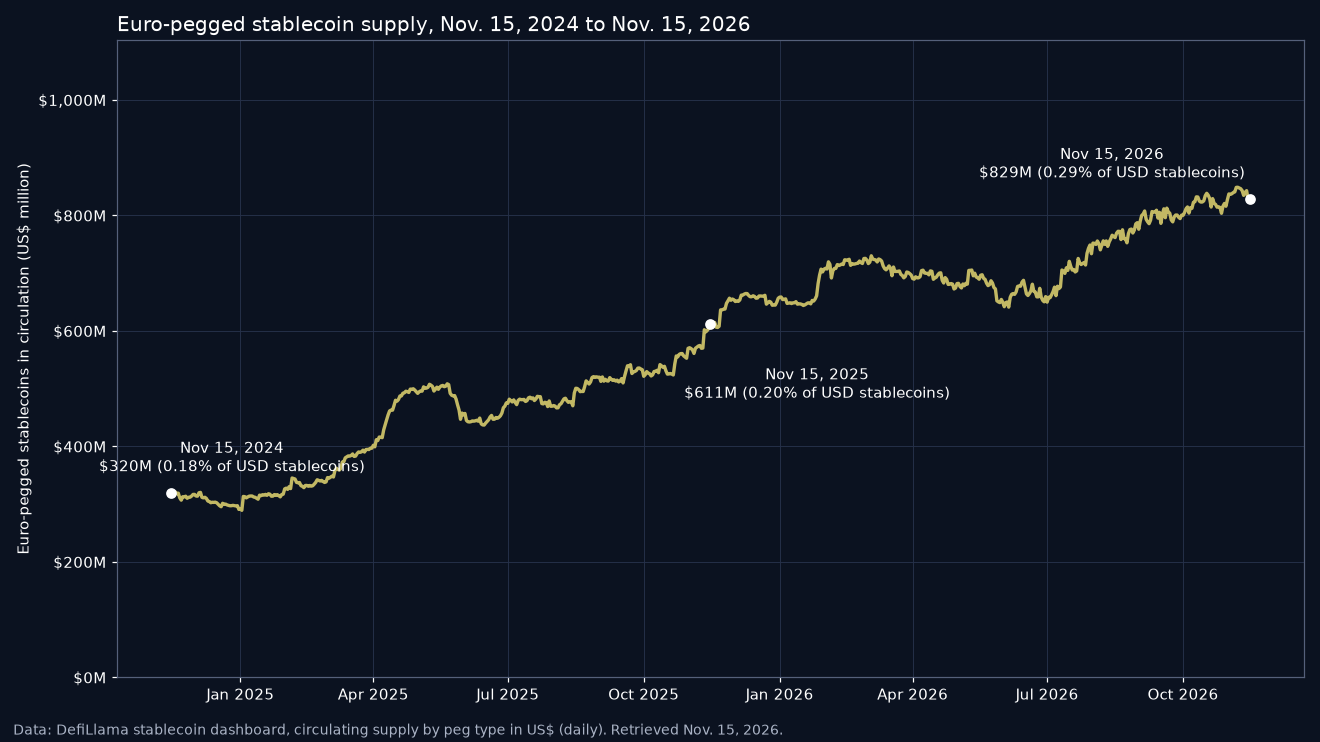
Euro-pegged stablecoins totalled about $829 million on Nov. 15, according to DefiLlama, against roughly $287 billion in dollar-pegged tokens. That is 0.29% of the dollar figure, up from 0.18% two years earlier. We looked at the euro’s catch-up effort in our analysis of the euro stablecoin gap.
Other regions are moving too. Hong Kong recently took its tokenized deposit pilot to 24/7 settlement in central bank money, and three central banks in the Asia-Pacific region have been testing ways to cut FX settlement risk.
The next milestone is close. Nominations close on Nov. 27, and the selected members are due to start in January. How quickly they agree on standards will help decide whether Europe’s tokenized assets can trade as one market rather than many.
DC Forecasts is a leader in many crypto news categories, striving for the highest journalistic standards and abiding by a strict set of editorial policies. If you are interested to offer your expertise or contribute to our news website, feel free to contact us at [email protected]












Discussion about this post