


A DeFi hack has emptied the KAVA pool at Kava Lend, the native money market of the Kava blockchain, and the door was a stablecoin market almost nobody was using.
In about 98 minutes early on November 14, an attacker borrowed roughly 55.2 million KAVA against collateral that existed mostly on paper. The tokens were worth about $3.76 million at the pre-attack price of $0.068.
KAVA has since roughly halved. Two days later, lenders in the drained pool still have no official loss figure, no root cause and no word on repayment.
How an Idle BUSD Market Became the Weak Point
The attack ran through Kava Lend’s market for BUSD, the Binance-branded stablecoin whose issuer, Paxos, stopped minting new tokens in 2023. The market had been close to empty for a long time.
Kava Lend calculates what suppliers earn by dividing interest paid by a market’s net supply. According to on-chain analysis by data firm Bitquery and DefiLlama’s hack database, the code guarded against a supply of exactly zero but not against a tiny positive number.
By shrinking that supply to a sliver, the attacker pushed the market’s supply interest index up roughly 243,000-fold in about three minutes. A modest BUSD deposit was suddenly counted as an enormous claim.
DefiLlama classifies the incident as a token and share accounting failure caused by an arithmetic error. In plain terms, the protocol believed a deposit was worth far more than it was.
127 Loans in 98 Minutes
Bitquery counted 127 KAVA loans between 04:04 and 05:42 UTC on November 14, spread across two wallets. Each loan was then liquidated in a way that closed the debt without recovering the borrowed KAVA.
The result, by Bitquery’s reading, was a pool that fell from about 55.3 million KAVA in cash to almost nothing. DefiLlama puts the stolen amount slightly lower, at about 53.9 million KAVA, or $3.7 million before the sell-off.

Roughly 49.2 million KAVA was then moved to BNB Chain. Starting just after 10:07 UTC, one wallet sold about 48.4 million of it over 35 minutes, raising around $2.09 million at the prices of the time.
Not every dollar got away. DefiLlama reports that about 612,416 USDT of the proceeds was blocked at the Relay bridge.
A 50% Drop in KAVA
The market reaction was swift. CoinGecko data shows KAVA trading near $0.068 for days before the attack, then collapsing as the stolen tokens hit the market.
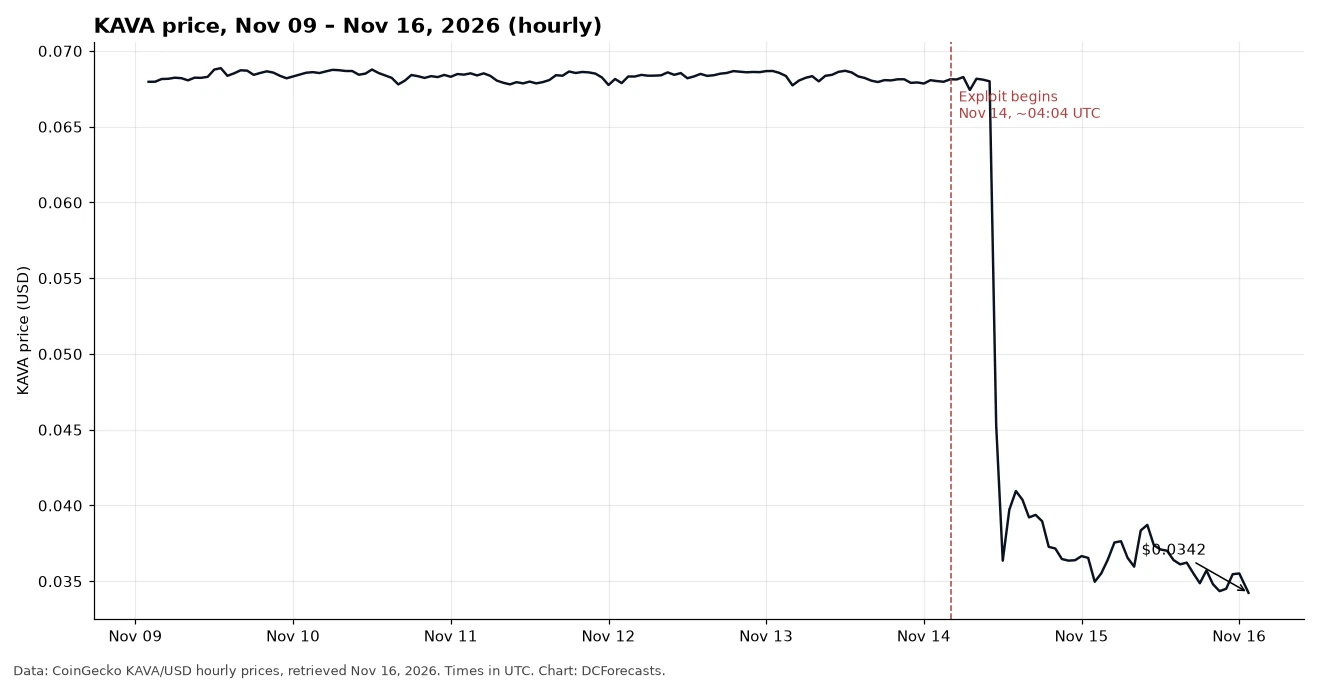
By early Monday, KAVA had slipped to about $0.034, roughly half its pre-attack level. Its market value stood near $37 million, according to CoinGecko.
For the wider Kava crypto community, the token’s size made the damage worse. With a market cap that small, dumping close to 50 million coins in under an hour was always going to overwhelm buyers.
Kava’s Response So Far
Kava acknowledged “unexpected behavior originating from a dApp within the Kava ecosystem” on November 14. It later stressed that “this is not an infinite mint” and that the event is “isolated and contained within Kava Lend.”
That distinction matters for holders. KAVA held in personal wallets or on exchanges was not taken; the loss sits with suppliers to the Kava Lend pool, while other holders absorbed the price hit.
Kava also paused its Axelar bridge and said a full incident report would follow once ready. It has not yet published a loss number, a technical post-mortem or any compensation plan.
Korean exchanges moved quickly. Bithumb suspended KAVA deposits and withdrawals from 19:35 Korea time on November 14, and Coinone followed five minutes later, with trading left open on both. Upbit also halted transfers.
What the Numbers Show for Kava Lend
DefiLlama’s data captures how the protocol has shrunk. Kava Lend’s total value locked stood at about $7.31 million on November 14 and dropped to roughly $5.34 million a day later.
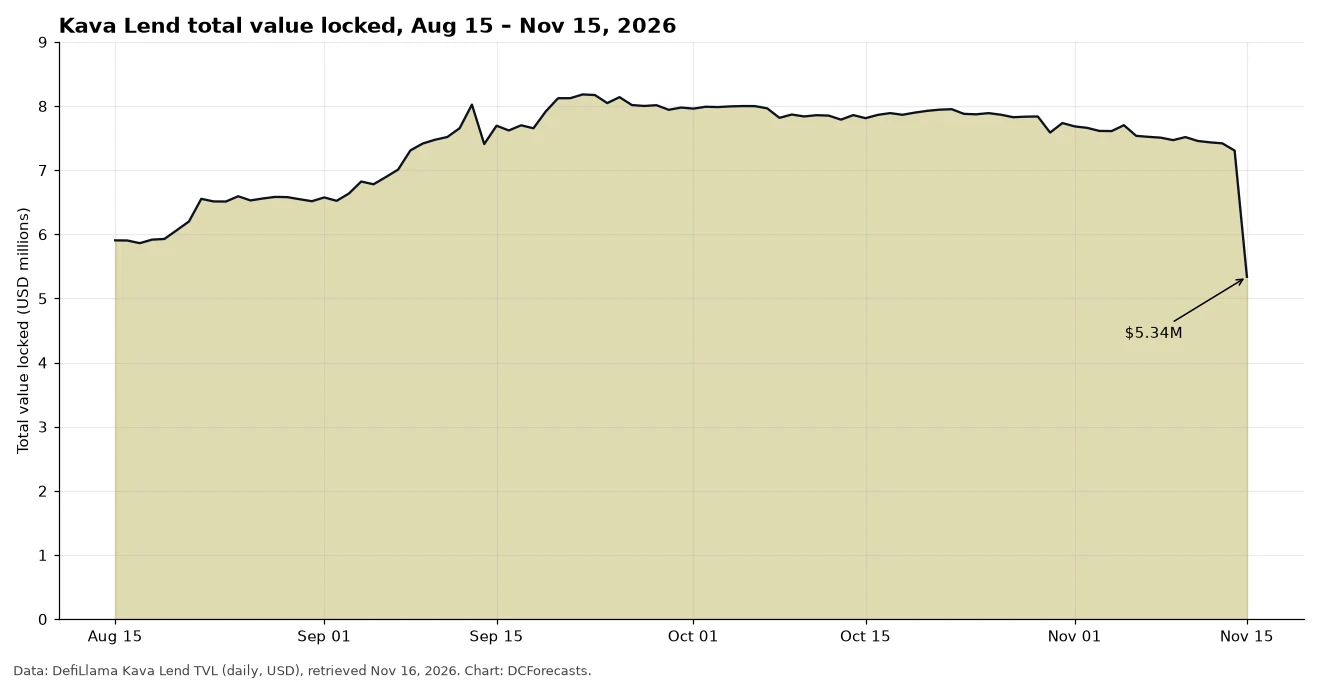
Part of that fall reflects KAVA’s lower price rather than withdrawals alone. Still, the protocol has given up all of its gains since mid-August, when TVL was near $5.9 million, and sits well below its September high of about $8.2 million.
It came on a busy weekend for security incidents. Separately, Bitcoin mining software maker Luxor pledged full compensation after a hashrate hijack, an operational attack that left the Bitcoin protocol itself untouched.
The Lesson From Dormant Markets
We believe the clearest takeaway is that idle code is still live code. A market that stopped mattering in 2023 still had access to a pool worth millions in 2026.
Lending protocols often add markets quickly and retire them slowly. Every forgotten pair is another set of math that has to stay correct under extreme inputs.
For users, the practical points are simple. Avoid depositing into Kava Lend until the incident report is out, use only Kava’s official channels for any refund news, and treat unsolicited “recovery” offers as scams.
The bigger question is whether Kava can make suppliers whole. Until it publishes the numbers, that DeFi hack will hang over a token that has already lost half its value in two days.
DC Forecasts is a leader in many crypto news categories, striving for the highest journalistic standards and abiding by a strict set of editorial policies. If you are interested to offer your expertise or contribute to our news website, feel free to contact us at [email protected]












Discussion about this post