



BTCS, the Nasdaq-listed company that holds Ether as its main treasury asset, has been selling ETH below what it paid to keep a $64.1 million loan on Aave safely collateralized.
The disclosure sits in the company’s quarterly report filed with the SEC on Nov. 12. It describes those sales as part of its “active management of collateral levels and health factors” on decentralized finance borrowings.
The timing matters. Ether has kept falling since the filing, and the gap between its price and the level where BTCS’s loan could be liquidated is now about 11%.
How Close BTCS Sits to Its Liquidation Line
As of Nov. 9, BTCS had about $64.1 million in Aave borrowings, including accrued interest, backed by roughly 46,676 ETH. At that day’s price of $2,127, the collateral was worth $99.3 million, or about 155% of the debt.
Aave lets a loan be liquidated when its health factor drops below 1.0. At that point, other market participants can repay part of the debt and take a matching amount of collateral, usually at a discount. BTCS said the liquidation threshold for ETH collateral is generally 80%, and its filing notes the company has no recourse against the protocol if a liquidation happens.
Applying that threshold to the Nov. 9 figures gives a health factor of about 1.24 and an estimated liquidation price near $1,717 per ETH, assuming the loan and collateral stay unchanged.
Ether traded near $1,941 on Coinbase on Friday. At that price, the same collateral is worth about $90.6 million, and the health factor falls to roughly 1.13.
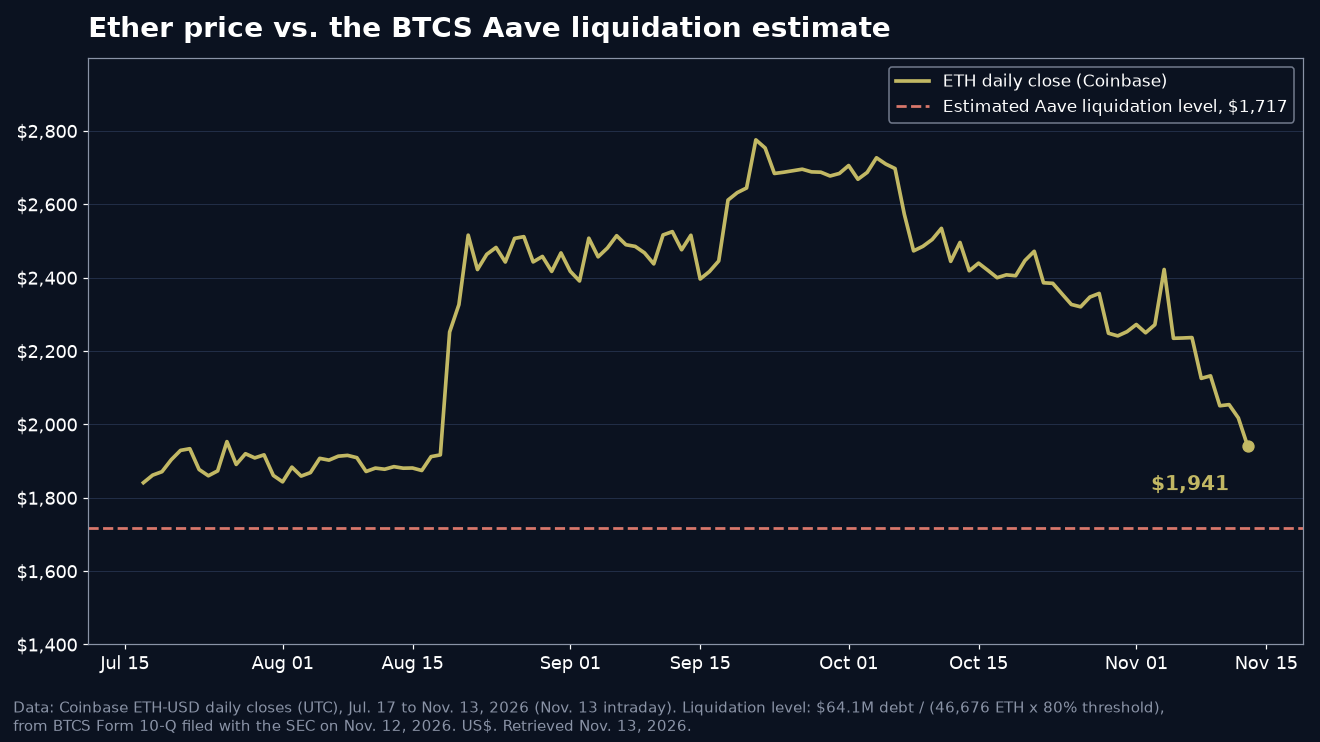
BTCS said it watches collateral and health factors continuously and can add collateral or cut borrowing when needed. It also said that, as of Sept. 30, it had not experienced any full or partial liquidation on these loans.
Selling Below Cost to Stay Ahead of the Protocol
The company did not say exactly how much ETH it sold to manage the loan. It did report $30.6 million in realized losses on digital asset transactions in the first nine months of 2026, up from $8.6 million a year earlier.

BTCS tied those losses to two things: selling ETH to manage collateral and repay DeFi borrowings, and moving ETH into liquidity pools at values below its carrying cost.
The balance sheet shows the effect. BTCS held 70,787 ETH as digital assets at the end of 2025. By Sept. 30, that figure was 49,571 ETH, with a fair value of $133.1 million against a cost of $136.4 million.
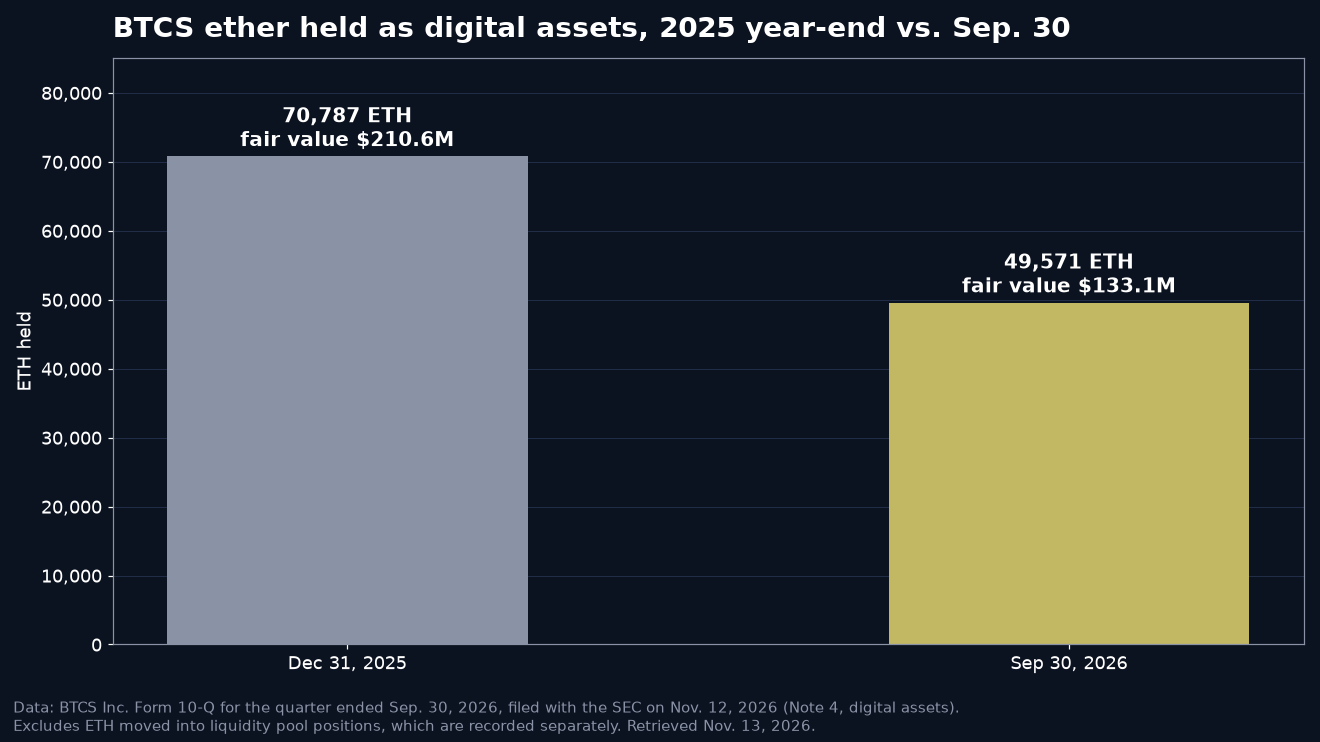
Part of that decline reflects ETH moved into liquidity pools rather than sold outright, since those positions are recorded separately. Still, the cost figure implies an average of about $2,752 per ETH for the coins held at the end of September, roughly 29% above Friday’s price.
The borrowing itself has grown slightly. BTCS started 2026 owing $61.5 million, borrowed another $28 million and repaid about $26.5 million of principal, ending September at $63 million.
Where the Money Comes From
BTCS has leaned heavily into decentralized finance to generate income from its ETH. DeFi made up about 69% of revenue in the first nine months, with liquidity pool strategies alone accounting for about 52%.
Cash on hand was thin at the end of the quarter, at about $0.5 million. By Nov. 9, the company reported about $142.6 million in cash, stablecoins and liquid digital assets, mostly ETH.
The liquidity pool strategy has its own accounting cost. BTCS booked an $11.2 million impairment loss on intangible digital assets in the first nine months, a category that includes those pool positions, on top of its realized losses.
That liquid pool is what gives BTCS room to top up collateral or pay down debt. But because most of it is Ether, it shrinks just as the loan needs more support.
Bitcoin Has Held Up Better
The pressure on BTCS comes from Ether’s slide relative to the wider market. ETH has fallen about 28% since Sept. 30, when it closed at $2,684. Bitcoin has dropped about 17.5% over the same stretch, from $83,556 to roughly $68,970.
That leaves one Ether worth about 0.0281 Bitcoin, close to the weak levels we covered when the ETH/BTC ratio hit its lowest since July.
Treasury companies built on Bitcoin face similar math, but the collateral has been more resilient. As our look at Nakamoto’s Kraken loan showed, its Bitcoin still covers its debt about 1.8 times.
What to Watch for BTCS Stock
The key number for BTCS stock is the gap between Ether and $1,717. If ETH keeps falling, the company will likely need to sell more, post more collateral or repay part of the loan.
A rebound would ease that pressure quickly. Every $100 move in ETH changes the value of its pledged collateral by about $4.7 million.
The company also has an at-the-market share sales program, with about $97.8 million still available under its shelf registration as of Nov. 11, according to the filing. That gives it another possible source of cash, though selling shares at depressed prices would dilute existing holders.
For now, BTCS has avoided liquidation by acting early and accepting losses. Whether that discipline is enough depends on where Ether goes next.
DC Forecasts is a leader in many crypto news categories, striving for the highest journalistic standards and abiding by a strict set of editorial policies. If you are interested to offer your expertise or contribute to our news website, feel free to contact us at [email protected]












Discussion about this post