



California voters have approved Proposition 42, a constitutional amendment that blocks any new California wealth tax on personal property, and its text names digital assets alongside stocks, retirement accounts and business interests.
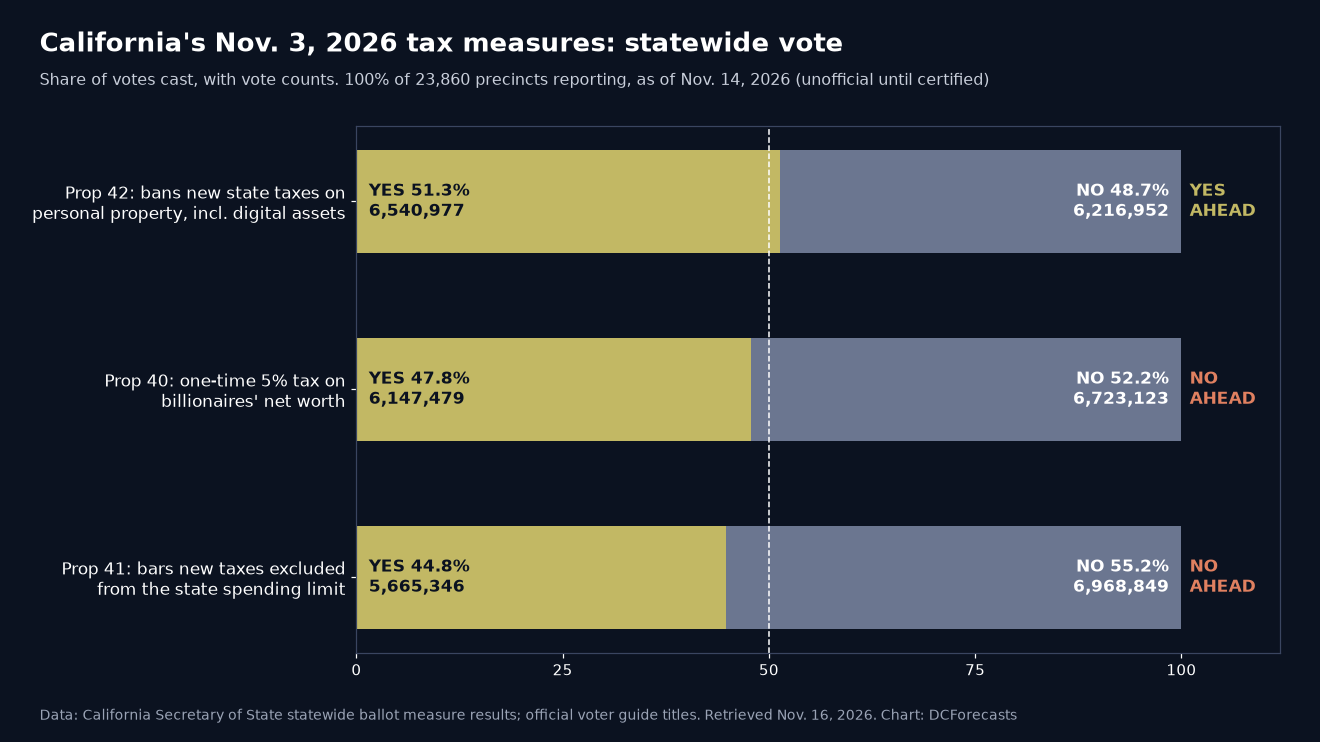
With all 23,860 precincts reporting, the Secretary of State’s count shows 6,540,977 votes in favor and 6,216,952 against. That is 51.3% to 48.7%, a margin of 324,025 votes.
On the same ballot, Proposition 40, a one-time 5% tax on billionaires’ net worth, fell short with 47.8% support.
For bitcoin holders in the largest U.S. state by population, the result writes a simple principle into the state constitution: owning an asset is not, by itself, a taxable event. The bigger question is how much room the measure leaves for future tax fights.
What Proposition 42 Actually Says
The measure adds two rules to the California Constitution.
The first bars any state law or constitutional provision enacted on or after Jan. 1, 2026, from imposing a tax on “the ownership or control of retirement holdings, individually owned assets, and other forms of personal savings.”
The definition is broad. According to the official text in the state voter guide, it covers pensions, 401(k) and individual retirement accounts, mutual funds, and all personal property, “including, but not limited to, financial assets, investment accounts, business interests, digital assets, intellectual property, personal belongings.”
The second rule limits retroactive taxes. A new tax cannot reach back to conduct, activities or a status that existed before it took effect, including a taxpayer’s residency on an earlier date.
There is a narrow exception. The Legislature can pass a tax reaching back up to 365 days, but only if the Governor has declared a disaster or fiscal emergency and the money is limited to that emergency.

Why This California Wealth Tax Fight Mattered for Crypto
Proposition 40 shows what was at stake.
According to the Attorney General’s official summary, it would have imposed a one-time tax of up to 5% on taxpayers with covered assets over $1 billion. Covered assets included businesses, securities, art, collectibles and intellectual property.
The Legislative Analyst’s Office said the tax would apply to billionaires who were California residents on Jan. 1, 2026, with payment due in 2027. It estimated revenue of “tens of billions of dollars” spread over several years.
That design relied on two features Proposition 42 now restricts: taxing the value of holdings rather than income, and fixing liability based on where someone lived before the vote.
For long-term bitcoin holders, the value-based approach was the real concern. A tax on holdings must be paid in cash every time, even when the investor has not sold a single coin.
How the Three Tax Measures Compare
Voters did not simply reject every tax question on the ballot.
Proposition 3, which extends an existing tax on high incomes to fund schools and health care, won 60.7%. Proposition 41, which would have barred new state taxes whose revenues sit outside the state spending limit, failed with 44.8%.
The split suggests Californians drew a line between taxing income and taxing ownership. Proposition 42 itself leaves alone any tax already in effect and first collected by Dec. 31, 2025, along with real property taxes.
The measure also had a built-in tiebreaker. Its text says a conflicting measure on the same ballot would be void if Proposition 42 received more yes votes. With Proposition 40 losing outright, that clause did not need to decide anything. Proposition 42 still drew 393,498 more yes votes than Proposition 40.
What Changes for Bitcoin Holders in California
In practical terms, very little changes for a California bitcoin holder’s tax bill this year.
Selling bitcoin at a gain still triggers state income tax, just as it did before. Federal rules are untouched, because a state constitution cannot change them.
What changes is the ceiling on future policy. A state-level annual tax on the market value of a bitcoin wallet, an exchange account or an ETF position is now off the table unless voters amend the constitution again.
We believe that matters for a holder base built around saving rather than trading. Bitcoin’s appeal as a long-term store of value depends on being able to hold it without a recurring bill on paper gains.
California has also been tightening consumer rules around crypto, as we covered in the state’s CoinFlip bitcoin ATM restitution order. Proposition 42 points in a different direction: protecting the people who hold digital assets rather than policing the firms that sell them.
What Comes Next
The count is not yet official. California’s Secretary of State still has to certify the result, and the measure takes effect at the earliest date allowed under the state constitution after that.
The Legislative Analyst’s Office warned that the amendment could make it “somewhat harder for the state to raise taxes” and could reduce future revenue, though it said the timing and size of any effect are unclear.
Legal challenges are possible. The measure anticipates them, requiring independent counsel to defend it if both the Governor and the Attorney General refuse.
Other states are moving in a friendlier direction too. In Texas, lawmakers have filed a bill that would let cities and counties buy up to $10 million in bitcoin.
For us, the key point is that the nation’s most populous state just put digital assets in its constitution as property worth protecting. That is a quiet but meaningful step toward treating bitcoin as a normal part of personal savings.
DC Forecasts is a leader in many crypto news categories, striving for the highest journalistic standards and abiding by a strict set of editorial policies. If you are interested to offer your expertise or contribute to our news website, feel free to contact us at [email protected]












Discussion about this post