



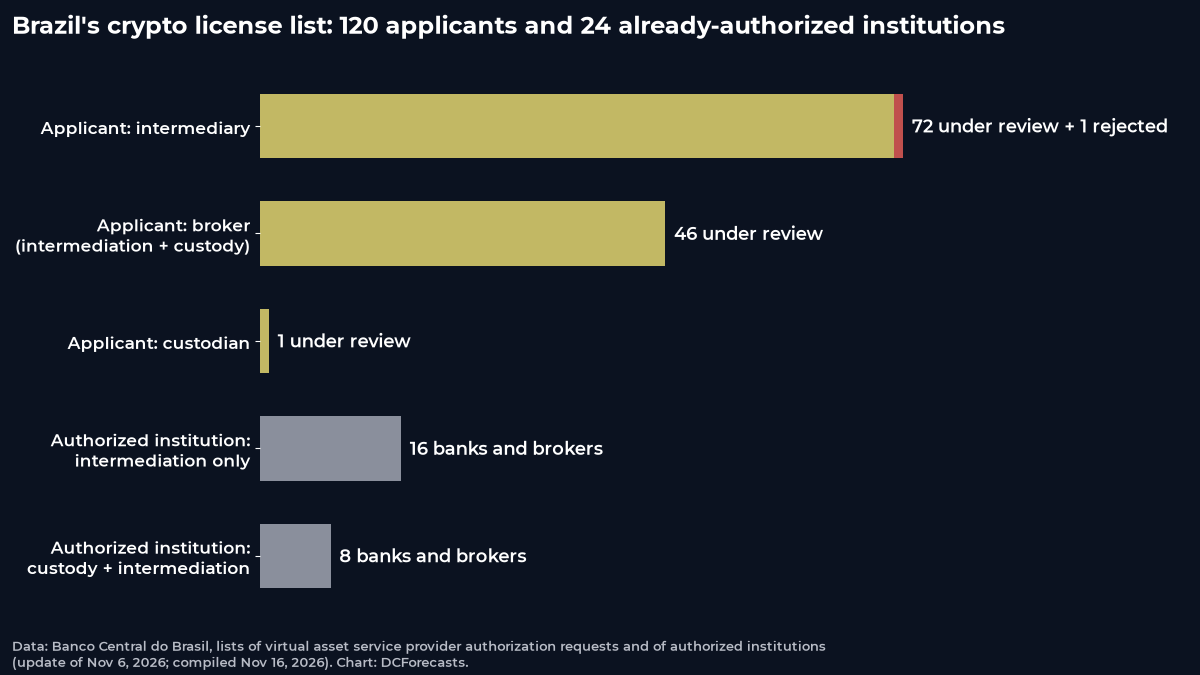
Brazil’s crypto license queue now has a clear shape. The Banco Central do Brasil lists 120 companies that asked for permission to keep serving crypto customers, and as of its Nov. 6 update, not one of them had been approved.
That is not a sign of trouble. It is how the new system was designed to work, with applicants allowed to keep operating while the central bank reviews each file.
Meanwhile, 24 banks and brokers that already hold central bank licenses, including Itaú Unibanco, Bradesco and Banco do Brasil, appear on a separate list of institutions cleared to offer crypto services.
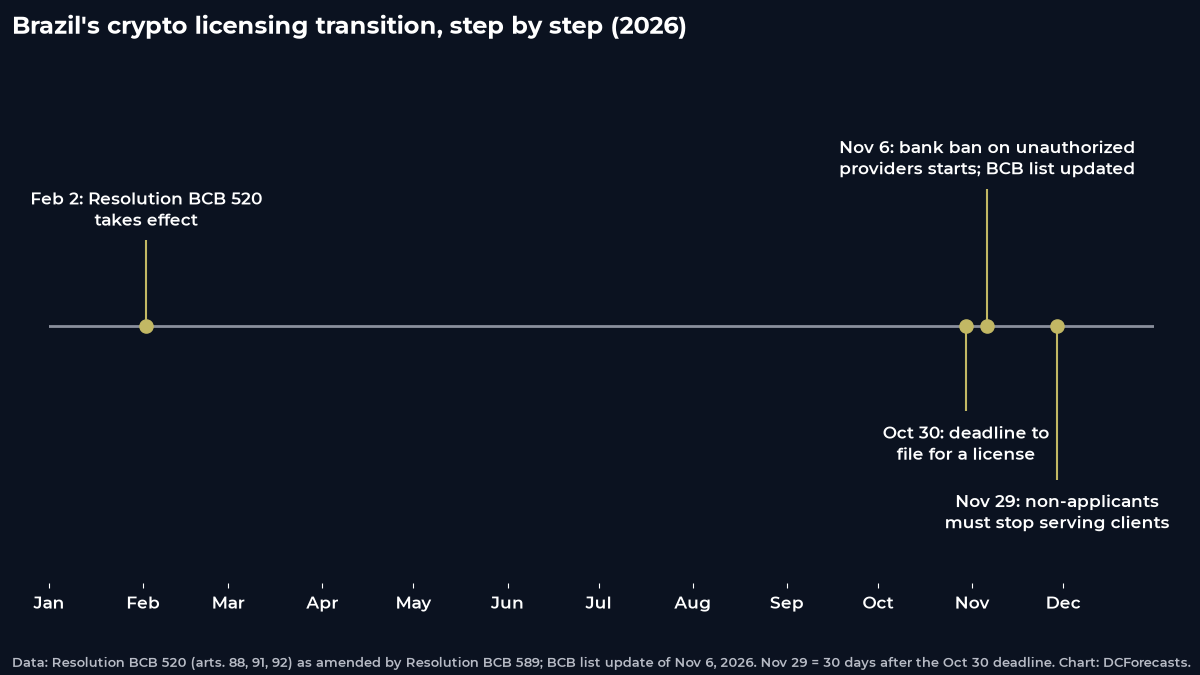
The next date to watch is Nov. 29. Under the rules, any provider that was operating but never applied must stop serving clients by then.
Who Is Waiting for a Brazil Crypto License
The list was published under Resolution BCB 520, the rulebook for virtual asset service providers that took effect on Feb. 2, 2026. It gave firms already active in Brazil 270 days to apply, a window that closed on Oct. 30.
The 120 requests fall into three license types. According to the central bank’s table, 73 firms asked to operate as intermediaries, 46 as brokers and just one as a custodian.
Brokers can both trade and safeguard client assets. Intermediaries handle buying, selling and swapping on behalf of clients, while custodians focus on holding the keys that control those assets.
The names show how broad the market has become. The broker requests include entities linked to stock exchange operator B3, Nubank’s crypto arm, Santander, Mercado Bitcoin, Foxbit, Bybit, OKX and Kraken’s parent company, Payward.
On the intermediary side, the list includes Brazilian entities of Coinbase and payments firm dLocal. Only one request, from an intermediary called Higherway Tech Soluções, was marked as rejected. The other 119 were listed as under review.

We see that mix as a strong vote of confidence. Global exchanges, local champions and traditional banks all chose to enter a regulated framework rather than leave one of Latin America’s largest crypto markets.
Why Big Banks Are Already in the Clear
The second list matters just as much. It names 24 institutions that were already authorized by the central bank and formally notified it that they would offer crypto services.
Eight of them are cleared for both custody and intermediation, including Itaú Unibanco, Bradesco, Banco do Brasil, BTG Pactual and Banco Safra. The other 16, among them Banco XP, PicPay Bank and Banco Genial, are listed for intermediation only.
For Bitcoin, this is a quiet but meaningful shift. Some of the largest banks in the country now sit inside a formal regime that covers holding and trading digital assets for clients.
In our view, that lowers the barrier for savers who would rather buy Bitcoin through an institution they already know. It also gives regulators a clear line of sight into how client assets are held.
Brazil’s banking sector is already in motion. Earlier this month, Nubank won a bank license in Brazil, another step in the merging of fintech and traditional finance.
The Nov. 29 Deadline and the Bank Ban
The rules carry real consequences for anyone left outside. Article 88 of Resolution BCB 520 says a provider that failed to apply on time must stop offering crypto services within 30 days of the deadline, which points to Nov. 29.
A second rule took effect on Nov. 6. From that date, banks, payment institutions and other supervised firms may not carry out or enable crypto transactions with providers that are not authorized to operate in Brazil.
That ban covers trading, custody, foreign exchange and payment accounts used to support those deals. It was originally set for Oct. 30 and pushed back a week by Resolution BCB 589.
One wrinkle is drawing attention from Brazilian lawyers. The earlier wording of the bank ban exempted firms that were “in the process of authorization,” and the amended text dropped that phrase.
The same resolution still lets on-time applicants keep operating until their review ends. Until the central bank clarifies the point, each bank may read the overlap through its own risk policy.
What the Review Process Requires
Filing was only the first hurdle. Applicants had to show risk management, cybersecurity and anti-money-laundering controls when they submitted their requests, and they must now report client data to the central bank.
Firms also have to send balances held for customers, the crypto they keep in custody and proof of reserves while the review runs. In plain terms, Brazilian users get a regulator checking that the coins on a platform’s books actually exist.
That focus on reserves matters after a year of exchange hacks and failures around the world. We believe it is exactly the kind of oversight that makes self-directed Bitcoin buyers and institutions more comfortable.
What It Means for Brazil’s Crypto Market
For customers, the central bank list works as a first check. A platform marked “under review” is operating legally under the transition rules, but it is not yet authorized, and the central bank stresses that being on the list is not approval.
Brazil now joins a wave of countries turning crypto rules into working license systems. Kenya, for example, opened its VASP license applications this month.
The open question is speed. With 119 files still in review, the pace of the first approvals will show how quickly Brazil’s regulated market can take shape.
We think the direction is clearly constructive. A market where the largest banks and the biggest exchanges compete under one rulebook is a market where Bitcoin is treated as a lasting part of the financial system.
DC Forecasts is a leader in many crypto news categories, striving for the highest journalistic standards and abiding by a strict set of editorial policies. If you are interested to offer your expertise or contribute to our news website, feel free to contact us at [email protected]












Discussion about this post