


The Hyperliquid Policy Center has asked the Commodity Futures Trading Commission to finish a job it started in October: write into federal rules that event contracts on sports, politics, culture and weather are swaps, and that sportsbook bets are not.
The advocacy group filed two comment letters dated November 16, one on each half of the CFTC’s plan. It backs both. Its main request is a one-line drafting change meant to make the two rules read as a single test. The deadline for public comments on both rules is Wednesday, November 18.
Two rules published on the same day
The CFTC put out both measures in the Federal Register on October 19. The first is a proposed rule that would add “event contracts, including those based on sports-, politics-, cultural, and weather-related events” to the regulatory definition of a swap. The second is an interim final rule, effective immediately, that sets out the agency’s view that casino-style gambling, including sportsbook wagers and casino games, falls outside that definition.
Taken together, the rules try to draw a federal line between markets the CFTC supervises and betting that states license. That line matters for CFTC prediction markets, the federally regulated exchanges that list contracts on game results and elections. It also matters for the CFTC’s own lawsuits against states, which now number 12.
What the Hyperliquid Policy Center wants changed
The letter on the proposal is signed by Chief Executive Jake Chervinsky and Senior Counsel Brad Bourque. It says the CFTC is right on the statute. In the group’s reading, Congress described event-based contingencies in the Commodity Exchange Act in 2000 and wrote them into the swap definition in 2010, long before today’s court fights.
The group’s main concern is the text. The proposal lists sports event contracts as swaps, while the interim rule excludes sports wagers. The preamble says the new paragraph won’t reach casino-style gambling, but “the rule text does not say so,” the letter states.
Its fix is to add a cross-reference. The new paragraph would cover event contracts “other than agreements, contracts, or transactions described in paragraph (7),” the place where the gambling exclusion sits. The group argues this would not pull any contract off a designated contract market. It would only confirm that a licensed bet placed outside a market is not an event contract under the rule.
It also asks the CFTC to define “event contract” in the statute’s own words. That would cover a contract whose payment depends on “the occurrence, extent of an occurrence, or contingency,” rather than on a change in a commodity’s price, rate, value or level.
A record of conflicting court rulings
The letter’s case for a written rule rests on how unevenly courts have handled the question. It cites a Washington state trial court that barred one exchange from event contracts in seven categories, including sports and elections, while still allowing contracts tied to economics and climate.

Federal appeals courts have also split, according to the letter. It says the Sixth and Ninth Circuits require an event to be “inherently” tied to an economic consequence, and the Ninth Circuit goes further by treating a game’s result as not an event at all. The Third Circuit, by contrast, held that the same contracts are swaps.
The group also warns that the states’ theory has no clear limit. If a state can treat a derivative as gambling because of what it is based on, the letter argues, the same reasoning could reach contracts on farm goods, energy, interest rates or currencies.
A quiet docket until the final days
Public interest in the proposal has been modest so far. By the morning of November 17, Regulations.gov showed 19 public comments posted on the proposal’s docket CFTC-2026-2213 and 12 on the docket for the gambling exclusion.
Most of that came late. Seven of the 19 comments on the proposal were posted on November 16 alone, including the Hyperliquid Policy Center’s. Underdog Sports Holdings filed on both dockets on November 12. The remaining comments are mostly from individuals and small companies.
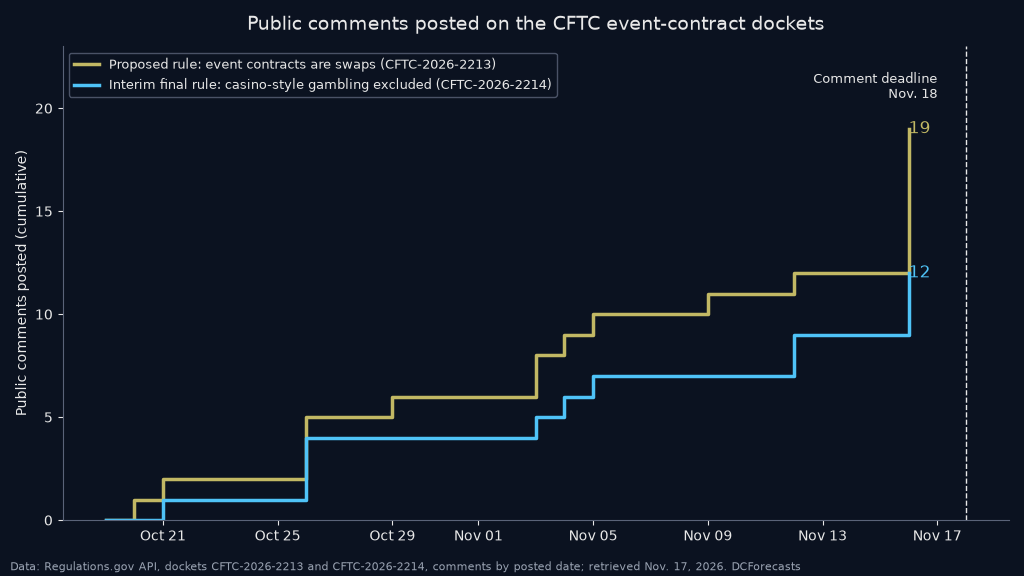
Comments often arrive in a rush near a deadline, so the totals could rise sharply by Wednesday. The CFTC must then weigh them before it finalizes the proposal. The gambling exclusion is already in force, but it can still be amended after review.
Why crypto groups care about this rulebook
The Hyperliquid Policy Center was set up to push for a regulated U.S. path to onchain markets, including those on Hyperliquid. In October it also wrote to the CFTC urging the agency to bring perpetual contracts on computing power to U.S. markets.
For the crypto industry, the event-contract fight tests whether one federal regulator can set a national standard for a new kind of market, or whether states can split it up one product at a time. The same question shapes how quickly onchain derivatives and prediction markets can reach American users.
The CFTC has already pushed in one direction. Earlier this month it gave exchanges 30 days to end state-by-state geoblocks, an order that a group of senators says clashes with court bans in several states.
A clear federal definition, written into the rule text rather than left to the preamble, would give those markets firmer legal footing. That is the outcome the letter asks for. Whether the CFTC adopts the suggested wording will become clear only when the final rule is published.
DC Forecasts is a leader in many crypto news categories, striving for the highest journalistic standards and abiding by a strict set of editorial policies. If you are interested to offer your expertise or contribute to our news website, feel free to contact us at [email protected]











Discussion about this post