


The fight over CFTC prediction markets rules has a new front, and this time it is on Capitol Hill. Nine Democratic senators wrote to Commodity Futures Trading Commission Chairman Michael Selig on Monday, Nov. 16, demanding that he reverse an order telling regulated exchanges to stop blocking users by state.
The letter, led by Sen. Adam Schiff of California, a member of the Senate Agriculture Committee, argues that the agency is pushing platforms to break active court orders.
“Your unilateral decision directly conflicts with active court orders, undermines state and tribal law, and must be reversed,” the senators wrote.
The CFTC has not withdrawn anything. But the letter adds political pressure to a dispute that already spans a dozen federal lawsuits and several appeals courts.
What the CFTC Ordered on Nov. 5
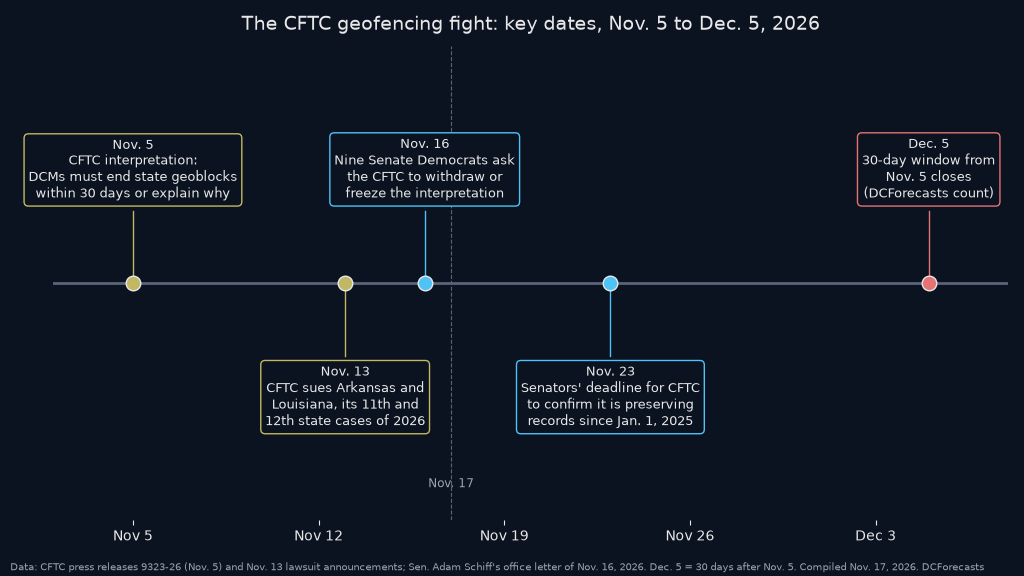
The trigger was an interpretation the CFTC issued on Nov. 5 under Regulation 38.151(b), the rule requiring designated contract markets (DCMs) to offer “competitive, open, fair, and impartial access.”
According to the CFTC’s announcement, DCMs must stop domestic geographic restrictions that breach that rule within 30 days, or explain to the Division of Market Oversight why they cannot. They must also make sure intermediaries routing orders to them are not imposing blocks of their own.
“Derivatives markets must operate on a uniform basis at a national scale in order to achieve the purposes set out in the Commodity Exchange Act,” Selig said at the time.
In practice, that targets geofencing, the location checks that platforms such as Kalshi use to keep sports contracts away from users in states where courts have restricted them. We covered the order itself when it was issued, in our report on the 30-day deadline for state geoblocks.
What the Senators Want Instead
The senators’ main demand is blunt. “The Commission must withdraw the interpretation or freeze all efforts to implement until litigation is resolved,” they wrote.

They also set out a fallback. At minimum, they want the CFTC to state that three kinds of location limits do not breach Regulation 38.151(b):
- Restrictions imposed by a court order.
- Restrictions adopted to comply with the Indian Gaming Regulatory Act or tribal-state gaming compacts.
- Restrictions an exchange chooses to adopt voluntarily.
The third point is the broadest. It would let a platform keep a state block as a business decision, without having to defend it against the agency’s reading of impartial access.
The group includes Sens. Amy Klobuchar of Minnesota and Elissa Slotkin of Michigan, alongside Schiff.
Court Orders in Three States and on Two Tribal Lands
The core of the letter is a legal clash. According to the senators, courts have ordered platforms to stop offering certain prediction contracts in Michigan, Nevada and Washington, and on the land of two California tribes, and have imposed geofencing requirements to enforce that.
“Numerous courts have held that sports-related event contracts are not swaps and instead are indistinguishable from sports bets subject to state and tribal gaming laws,” the letter states.
The senators point to rulings from the Sixth and Ninth Circuit appeals courts that support state authority. They also cite a Ninth Circuit decision, at the preliminary-injunction stage, finding that sports-event contracts offered on tribal land amount to unauthorized Class III gaming.
From there, their charge is sharp. “The Commission now appears to be encouraging prediction markets to offer prohibited contracts in contempt of these court orders during active litigation,” they wrote.
They added that there is “no basis or precedent” in the impartial access rule for the agency’s position, and that the same argument has already been raised in active cases and rejected.
A Records Request With a Nov. 23 Deadline
The letter goes beyond policy. The senators asked the CFTC to preserve all records and communications tied to the issues it raises, going back to Jan. 1, 2025.
According to the text released by Schiff’s office, that request reaches personal email, mobile devices and encrypted or disappearing-message apps. The senators asked the agency to confirm by Nov. 23 that it is preserving those materials.
That deadline does not pause the CFTC’s order or change any court ruling. But a preservation request is often an early step toward a deeper congressional inquiry, and it signals that the agency’s handling of prediction markets will stay under scrutiny.
Why the CFTC Is Unlikely to Back Down Quickly
Selig has framed the issue as one of national market structure. The Nov. 5 interpretation argues that state-by-state access can strand traders who travel, fragment liquidity and widen spreads for everyone.
The agency has also been fighting states directly. On Nov. 13 it sued Arkansas and Louisiana, bringing its count of state lawsuits in 2026 to 12, as we reported in our story on the CFTC’s widening court fight.
Because appeals courts have reached different conclusions, the question of who regulates event contracts could ultimately land at the Supreme Court.
What It Means for Crypto and Event Contract Traders
For users, little changes overnight. Existing court-ordered blocks remain in force, and the 30-day window from the Nov. 5 order runs to about Dec. 5.
For crypto markets, the stakes are wider than sports bets. The CFTC is also writing rules for crypto asset trading, and the same question of federal versus state authority sits underneath that work.
We believe a clear answer, whichever way it lands, is better for the industry than a patchwork. Platforms, including those listing bitcoin price contracts, need to know which rulebook applies before they can scale with confidence.
The next markers are the CFTC’s response to the senators by Nov. 23 and how exchanges handle the early December deadline.
DC Forecasts is a leader in many crypto news categories, striving for the highest journalistic standards and abiding by a strict set of editorial policies. If you are interested to offer your expertise or contribute to our news website, feel free to contact us at [email protected]











Discussion about this post