



Why is Bitcoin down roughly 17% in November? Grayscale’s research team says there was no single trigger, and it argues the drop has opened an attractive entry point for patient investors.
In a note dated November 16, Grayscale Head of Research Zach Pandl wrote that Bitcoin fell about 17% to around $64,000 in the first two weeks of the month.
The firm’s market-cap weighted Crypto Sectors index slid roughly 18% over the same stretch.
For Bitcoin investors, the most useful part of the note is the diagnosis. Grayscale traces the slide to stablecoin exits and AI-stock stress rather than to any flaw in Bitcoin itself.
The bigger question now is whether those pressures fade before the macro backdrop gets tougher.
Why Is Bitcoin Down? Grayscale Names Two Forces
The first force is stablecoin off-ramping. Grayscale says investors moved money out of stablecoins and into fiat, possibly because of heightened worries about the safety of funds on exchanges.
Stablecoin outflows can signal reduced risk-taking, and that may have included selling Bitcoin and other large-cap tokens.
The second force is pressure on Nvidia and other AI-linked equities. Growth portfolios often hold digital assets next to tech stocks, so de-risking in one can spill into the other.
Grayscale also notes that AI and Bitcoin increasingly compete for the same megawatts, since many miners now sell compute to AI firms.

Large caps took the brunt. Bitcoin and Solana were the weakest of the top 20 assets on a volatility-adjusted basis, according to the note.
What the Stablecoin Data Shows
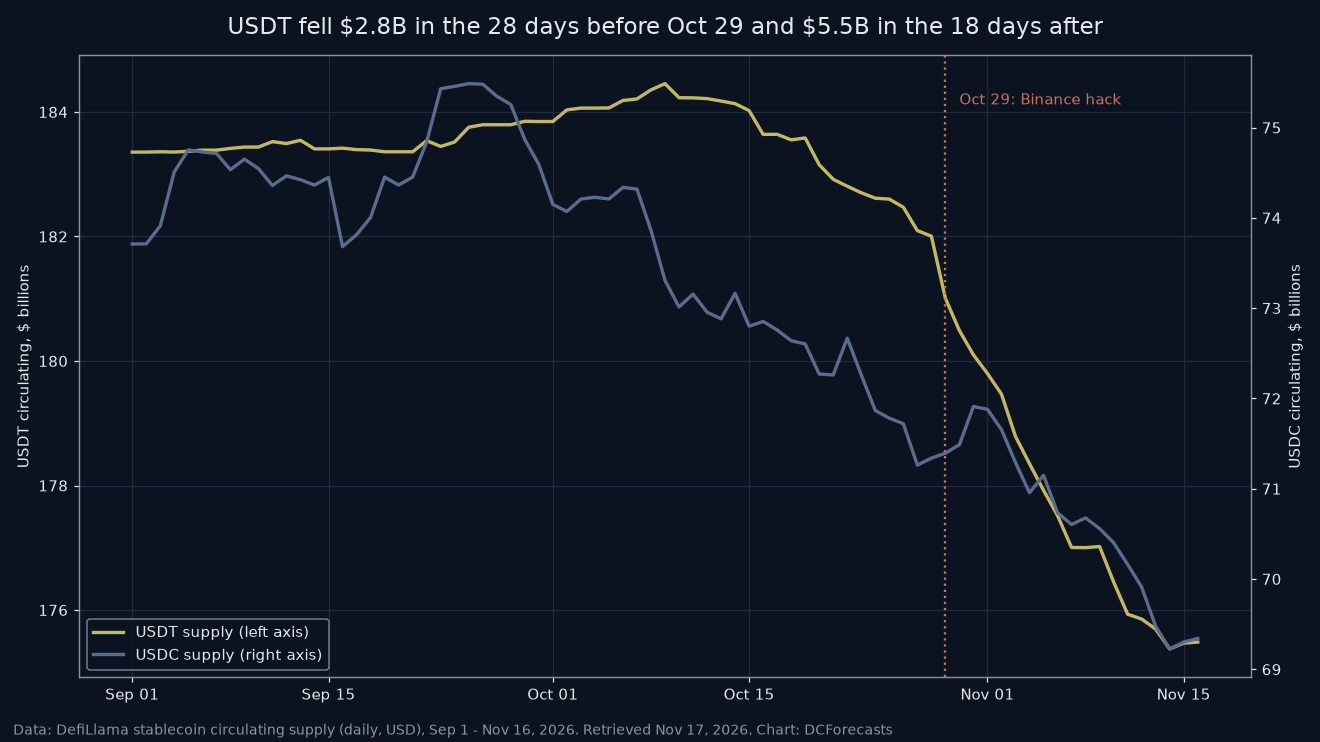
Grayscale says USDC supply started shrinking in early October, and USDT began trading below $1 shortly after. Supply then fell faster after the October 29 Binance hack.
Our own check of DefiLlama data supports that timeline.
USDT supply fell from $183.85 billion on October 1 to $181.01 billion on October 29, a drop of $2.8 billion in 28 days. By November 16 it was $175.48 billion, another $5.5 billion lower in just 18 days.
USDC went from $74.15 billion to $69.34 billion over the full period. Together, the two largest stablecoins shrank by about $13.2 billion since October 1.
That fits the broader drain we covered when stablecoins shed $16 billion in a month.
Grayscale draws a distinction here. It considers stablecoins that comply with the GENIUS Act, such as USDC, low risk, and reads the outflows as a temporary retreat to bank-based systems after high-profile security incidents.
The 200-Day Average Break and Weekend Selling
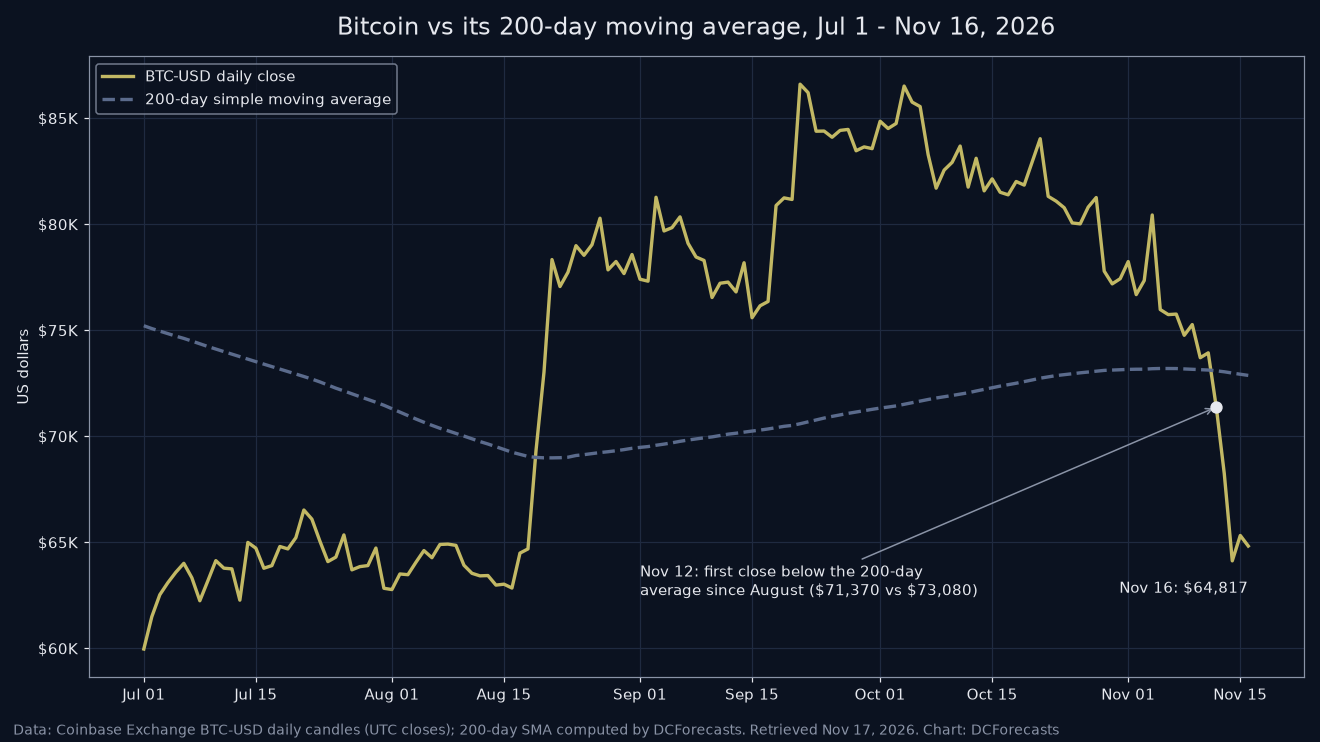
Technical factors made the move sharper. Grayscale points to November 12, when Bitcoin fell below its 200-day moving average, a level trend-following funds often treat as a sell signal.
Coinbase daily closes confirm the break. Bitcoin closed at $71,370 that day, under a 200-day average of $73,080, its first close below that line since August.
By November 16 the close was $64,817, about 16.3% below the October 31 close of $77,424.
Leverage added fuel. Falling prices triggered liquidations in perpetual futures, and much of the selling hit over the weekend, when order books are thinner.
ETP outflows, by contrast, “did not appear extreme,” the note says. That matters, because it suggests long-term fund holders were not the main sellers.
What Grayscale Rules Out
The note pushes back on two popular theories. Grayscale does not think the planned Anthropic IPO, which it calls well telegraphed, explains much of the pullback.
That contrasts with the view Tom Lee offered for ether’s slide.
It also dismisses pressure on Strategy, the largest digital asset treasury company. Strategy’s STRC variable-rate preferred stock “continues to trade near par,” Grayscale says.
We believe that is a meaningful signal. If stress were building inside the biggest corporate Bitcoin holder, its preferred paper would likely show it first.
Is This the Entry Point Grayscale Describes?
Grayscale is candid about the risks. It lists uncertainty over AI investment after the midterms, high inflation, the prospect of more Fed rate hikes and geopolitical conflict.
Even so, its proprietary indicators have swung “rapidly from overbought to oversold.”
The firm sees solid fundamentals underneath: institutional adoption of stablecoins and tokenized assets, plus ongoing deficit spending that creates persistent demand for alternative stores of value.
“For investors with medium- or long-term holding periods, we believe current valuations represent an attractive entry point,” Pandl wrote.
We agree that the causes look external rather than structural. The selling came from stablecoin exits, tech de-risking and leverage, not from any change to Bitcoin’s fixed supply or network.
Reclaiming the 200-day average, near $72,864 on November 16, would take a gain of about 12.4% from that day’s close. That level is the clearest marker to watch, alongside stablecoin supply and Nvidia’s results.
As we noted when Bitcoin slipped under its 200-week average, it has recovered every such break since 2019. If stablecoin outflows stabilize, the coming weeks will show whether this retreat becomes the entry point Grayscale expects.
DC Forecasts is a leader in many crypto news categories, striving for the highest journalistic standards and abiding by a strict set of editorial policies. If you are interested to offer your expertise or contribute to our news website, feel free to contact us at [email protected]












Discussion about this post