



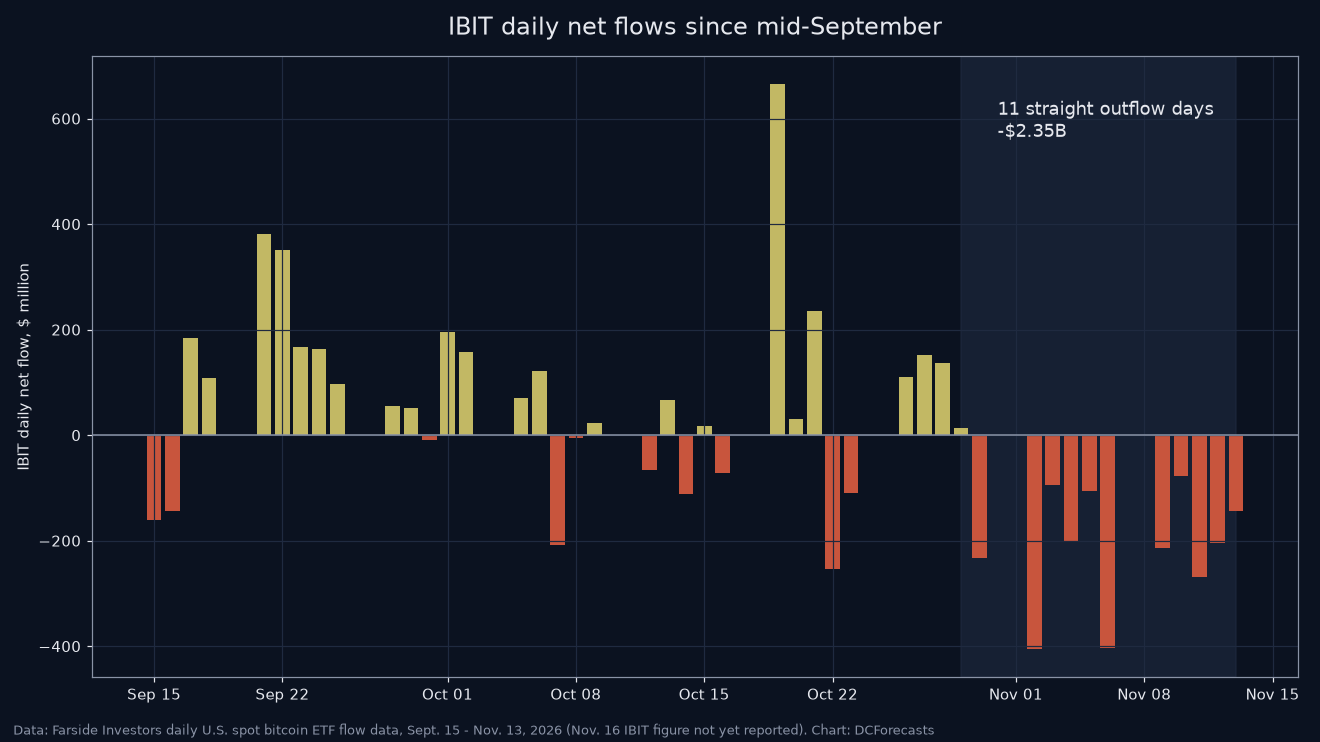
BlackRock’s iShares Bitcoin Trust (IBIT) has now recorded net outflows on 11 consecutive trading days, matching the second-longest losing run since the fund launched in January 2024. Between Oct. 30 and Nov. 13, investors pulled a combined $2.35 billion from the IBIT ETF as bitcoin slid from about $77,800 to the high $60,000s.
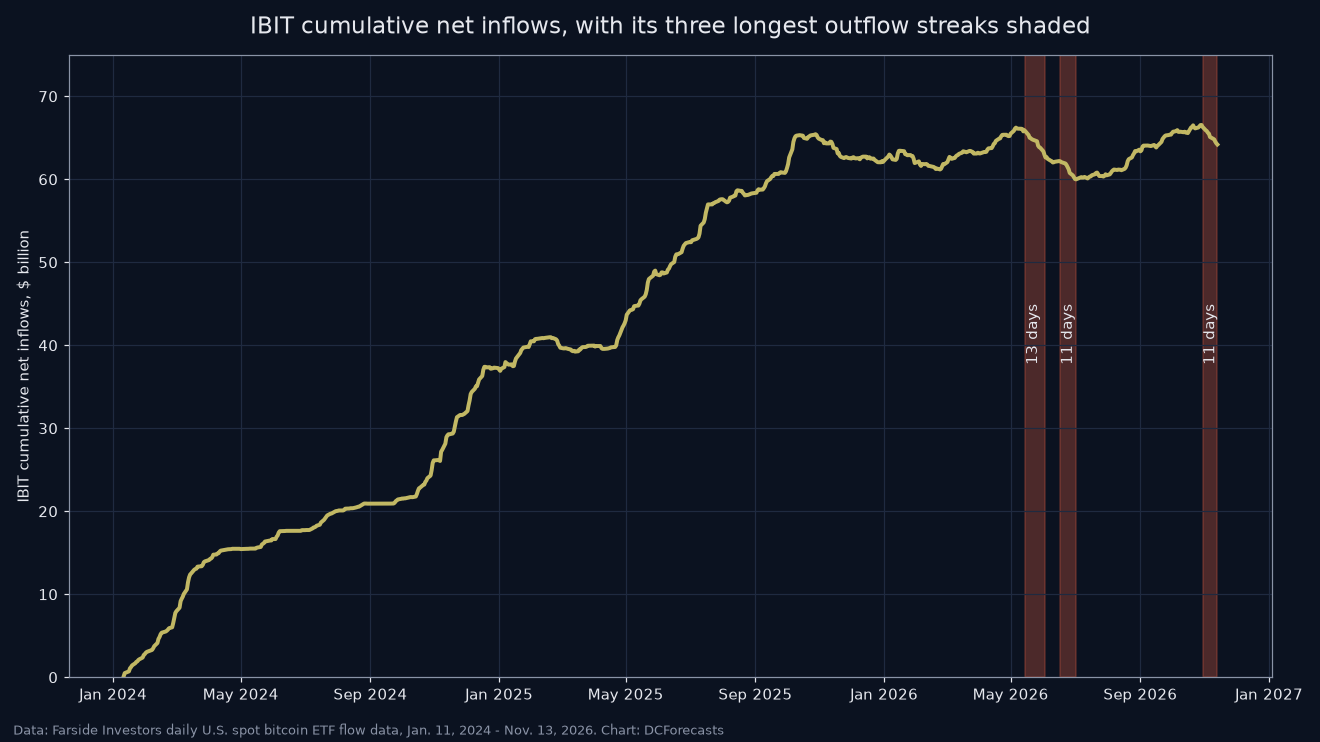
The number sounds large. Measured against what the fund has gathered, it is modest. Daily flow records compiled by Farside Investors show IBIT still holding $64.19 billion of cumulative net inflows, only 3.5% below the $66.54 billion peak it reached on Oct. 29.
An 11-Day Run, Day by Day
The streak started the day after IBIT’s inflow peak. Its biggest single withdrawals came on Nov. 2 and Nov. 6, at $405.3 million and $403.0 million. Most other sessions saw redemptions between $78 million and $270 million, the pattern of steady trimming rather than a single rush for the exit.
The wider ETF group has followed the same direction. The 12 U.S. spot bitcoin funds tracked by Farside lost a combined $1.07 billion in the week of Nov. 9 to Nov. 13, and the group has posted net outflows on eight straight days through Nov. 16. Even with IBIT’s Monday figure still unreported, the other funds shed $68.6 million that day.
Month to date, the funds are down $2.42 billion. Since January 2024 they still hold $54.63 billion of net inflows.
IBIT’s weight in that total is striking. On its own, the fund holds more net inflows than the whole group combined, because Grayscale’s older GBTC trust has lost a cumulative $28.18 billion since converting to an ETF. The other ten funds together hold about $18.6 billion of net inflows. When IBIT’s flows turn, the entire category’s numbers follow.
Only One Longer Streak on Record
IBIT has seen a longer run of outflows only once. Between May 15 and June 3, 2026, it posted 13 consecutive outflow days totaling $3.28 billion. A second, 11-day streak followed from June 17 to July 2, removing another $2.20 billion.
That double streak was the deepest drawdown in the fund’s history. It pulled IBIT’s cumulative inflows down to about $60 billion and coincided with bitcoin falling toward $61,000.
What Happened After the Summer Streaks
The end of that summer run turned out to mark a turning point for both flows and price. In the 30 days after the July 2 streak ended, IBIT took in a net $487 million. Over 60 days, that rose to $3.58 billion, and across July, August and September the fund gathered $5.12 billion in total.

Bitcoin followed. It traded near $61,490 on July 3, according to CoinGecko daily data, and reached about $83,580 by Oct. 1, a gain of roughly 36%. The buyers who returned in the summer did so near the same price levels bitcoin is testing now.
Price and flows tend to reinforce each other in both directions. Redemptions rise as bitcoin falls, and inflows return once the price stabilizes, and in July the end of IBIT’s outflow streak lined up with bitcoin’s summer low.
The record does not promise a repeat. The first summer streak, for example, was followed within two weeks by the second, so a run’s end is only visible in hindsight. But it shows that long redemption streaks in IBIT have so far been episodes inside a larger accumulation trend rather than a reversal of it.
Who Still Holds the Shares
Quarterly filings show that large institutions were adding to the fund through September. DCForecasts has reported that Bank of America’s IBIT holding grew to $685 million, that Mubadala’s $697 million IBIT stake became its biggest U.S. position after GlobalFoundries, and that the Abu Dhabi Investment Council kept every IBIT share while exiting 19 other stocks.
Those positions reflect Sept. 30, before the current selloff, so they do not show how these holders behaved in November. They do show that IBIT’s investor base now includes long-horizon owners such as sovereign funds and banks, which tend to move more slowly than short-term traders.
What to Watch for the IBIT ETF
The next data point is IBIT’s Nov. 16 figure, which will show whether the streak reaches 12 days. If it does, only the 13-day stretch from May and June will remain longer.
The funds that have already reported for Monday show modest withdrawals spread across several issuers. GBTC accounted for $34.6 million of the $68.6 million withdrawn from non-IBIT funds, Fidelity’s FBTC for $11.3 million, and the rest came in amounts under $7 million per fund.
The more important signal is the first inflow day. In July, the turn came quietly, with small daily inflows that built into billions over the following weeks. For now, 96.5% of the money that has flowed into IBIT since its launch is still there.
DC Forecasts is a leader in many crypto news categories, striving for the highest journalistic standards and abiding by a strict set of editorial policies. If you are interested to offer your expertise or contribute to our news website, feel free to contact us at [email protected]












Discussion about this post