



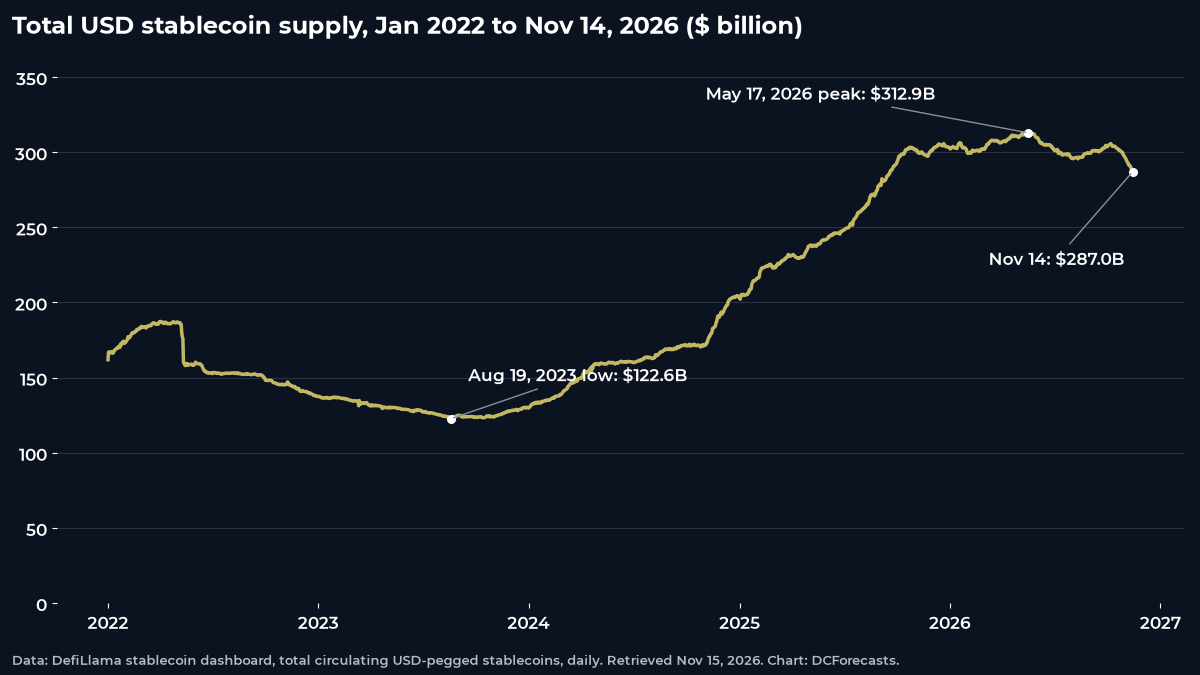
Roughly $16.3 billion worth of dollar-pegged tokens has left the crypto market in the past 30 days. According to DefiLlama data, total stablecoin supply stood at $287.04 billion on November 14, down from $303.38 billion a month earlier. That is a 5.4% contraction, and the largest 30-day decline in dollar terms since June 2022.
The figure matters because stablecoins are the cash that sits on exchanges and in on-chain wallets waiting to be deployed. When stablecoin supply grows, buyers have more ammunition. When it shrinks, some of that money is going back to banks. Even after this drain, though, the pool remains more than twice as large as it was at the bottom of the last bear market, and that is the part of the story Bitcoin holders should keep in view.
The steepest drain in more than four years
From January 2023 through September 2026, the worst 30-day drop in total stablecoin supply was about $8.5 billion, recorded in late June 2026. The current decline is nearly twice that size. To find a bigger one, you have to go back to June 10, 2022, when supply fell $16.88 billion in 30 days during the market stress of that spring.
The slide has also been steady rather than sudden. Weekly readings show supply peaking near $304.9 billion on October 4 and falling every week since: $303.9 billion on October 11, $302.5 billion on October 18, $300.5 billion on October 25, $296.4 billion on November 1, $291.5 billion on November 8 and $287.0 billion on November 14. That is six weekly declines in a row.
USDT and USDC account for most of the outflow
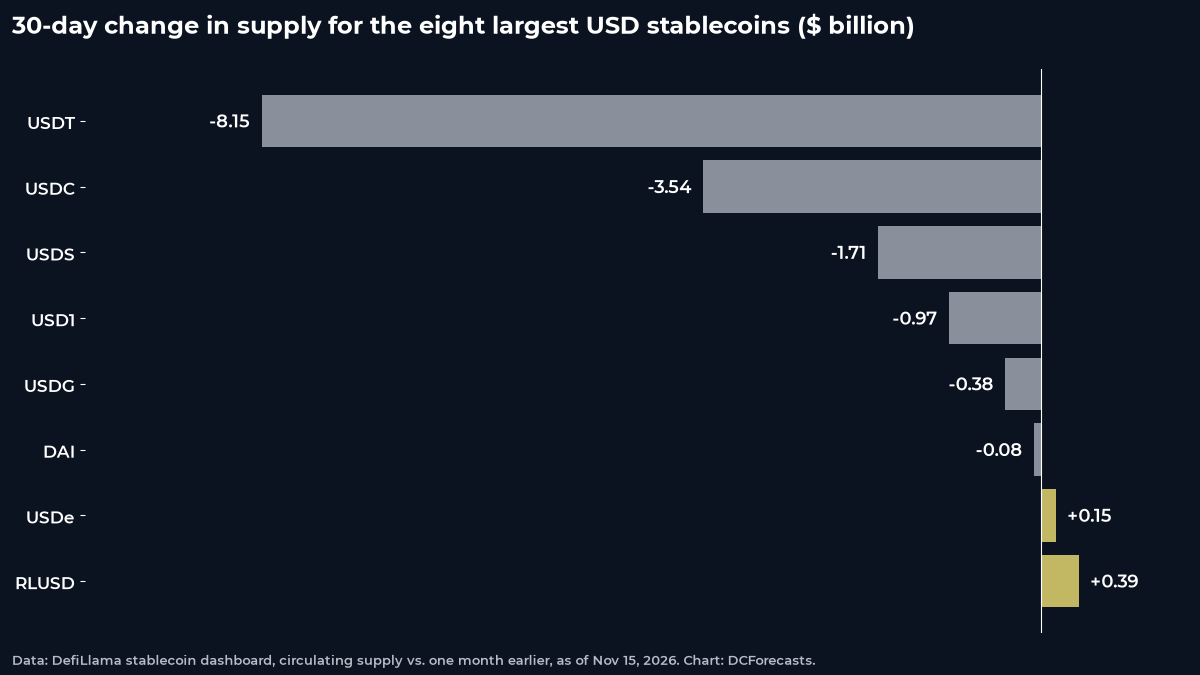
The two largest stablecoins did most of the shrinking. DefiLlama’s per-asset figures show USDT supply at about $175.4 billion, down $8.15 billion from a month earlier. USDC fell $3.54 billion to roughly $69.3 billion. Sky’s USDS lost $1.71 billion, and USD1 dropped by $0.97 billion.
Not every token is losing ground. Ethena’s USDe added around $0.15 billion over the same period, and Ripple’s RLUSD grew by about $0.39 billion to roughly $2.8 billion. Small gains, but they show demand for dollar tokens has slowed and shifted, not disappeared.
Why redemptions follow a falling market
Stablecoin supply usually tracks risk appetite. Issuers mint new tokens when traders and institutions send dollars in, and they burn tokens when holders cash out. A contraction of this size points to money leaving the crypto ecosystem rather than simply moving between exchanges.
The timing lines up with Bitcoin’s recent pullback. Coinbase daily closes show BTC at $82,131 on October 15 and $68,222 on November 14. The pressure has shown up elsewhere too: DCForecasts recently looked at a seven-day outflow streak in spot Bitcoin ETFs, and at how the price compares with Bitcoin’s realized price and MVRV ratio. The stablecoin data adds a third view: some traders have taken profits or cut risk and moved the proceeds back into fiat.
Still, a contraction is not a collapse. Supply is only 8.2% below its all-time high of $312.85 billion, set on May 17, 2026. More than $287 billion in dollar tokens remains in circulation.

The cushion is still far larger than in 2023
The long-run chart puts the drain in perspective. The last major stablecoin contraction ran from 2022 into the middle of 2023. Total supply bottomed at $122.63 billion on August 19, 2023, when Bitcoin closed near $26,096 on Coinbase.
What came next is the reason long-term holders watch this metric closely. Supply turned higher from that low, reaching $145.61 billion by March 13, 2024. On that day, Bitcoin closed at $73,135. The rebuilding of stablecoin balances and Bitcoin’s run to then-record highs moved together. One did not mechanically cause the other, but fresh dollar liquidity entering crypto is one of the clearest signs that new buyers are arriving.
Today’s starting point is far stronger. Even after a $16 billion drain, supply is 2.34 times its August 2023 low. The market is not starved of dollar liquidity. It is holding less than it did in October, with a large stock of capital still in place.
What to watch in the stablecoin market
The next few weeks should show whether this is a reset or the start of a longer squeeze. A few signals are worth tracking:
- Weekly supply direction. A first weekly increase after six straight declines would be the earliest sign that redemptions are running out.
- USDT and USDC net issuance. These two coins hold about 85% of the total. New minting from either would carry more weight than growth in smaller tokens.
- Regulated issuers. Coins such as RLUSD kept growing during the outflow, which suggests that compliant dollar tokens are still finding new users.
- Exchange flows into Bitcoin. Stablecoins are the main on-ramp for spot buying, so a renewed rise in supply would give Bitcoin’s next leg higher more fuel.
Liquidity is resting, not gone
A $16.3 billion monthly decline in stablecoin supply is a real signal, and the biggest of its kind since 2022. It reflects a market that has cooled since early October and holders who have chosen to step aside.
But the bigger picture favors Bitcoin. The stablecoin base is still near $287 billion, more than double the level from which the 2023 to 2024 rally began. History shows that when that pool starts to grow again, Bitcoin has tended to follow. For now, the cash is waiting, and the key number to watch is the first week that stablecoin supply turns back up.
DC Forecasts is a leader in many crypto news categories, striving for the highest journalistic standards and abiding by a strict set of editorial policies. If you are interested to offer your expertise or contribute to our news website, feel free to contact us at [email protected]












Discussion about this post