



Federal Reserve Governor Michael Barr has warned that AI agents moving money on their own could make future bank runs unfold in minutes, faster than banks or regulators can respond.
Barr made the point in a November 16 speech in Milan on the financial stability risks of artificial intelligence.
He described agents that could “instantaneously detect yield differentials or stability signals and autonomously move funds at high speed.”
For anyone following crypto and payments, the speech is a sharp look at how automation could change the way money moves under stress.
The bigger question is whether banking safeguards built for human-speed withdrawals can keep up.
What Did Michael Barr Warn About?
Barr said major banks now report finding AI agents trying to take actions in retail customer accounts without the bank being able to verify authenticity, consent or alignment with customer instructions.
He then pointed to deposits. “AI agents may accelerate deposit outflows during stress periods,” he said.
Where customers once had to execute transfers themselves, agents could act at once, “potentially accelerating runs that unfold in minutes, overwhelming traditional liquidity management and regulatory intervention timelines.”
His proposed guardrails include strict authentication, explicit consent for specific actions, technical limits on what agents can do, and both rules-based and values-based constraints.

Barr was clear that he is an optimist about AI’s long-term promise. The warning concerns how it is deployed, not whether it should be.
Bank Runs Were Already Getting Faster
Barr has studied a fast run up close. As Vice Chair for Supervision, he requested the Fed’s April 2023 review of Silicon Valley Bank, and its numbers show how much speed has already changed.
That review says SVB lost over $40 billion in deposits on March 9, 2023, and management expected to lose over $100 billion more the next day. Together that was roughly 85% of its deposit base.
By comparison, the review cites estimates that Wachovia saw about $10 billion of outflows over eight days in 2008, and Washington Mutual $19 billion over 16 days.
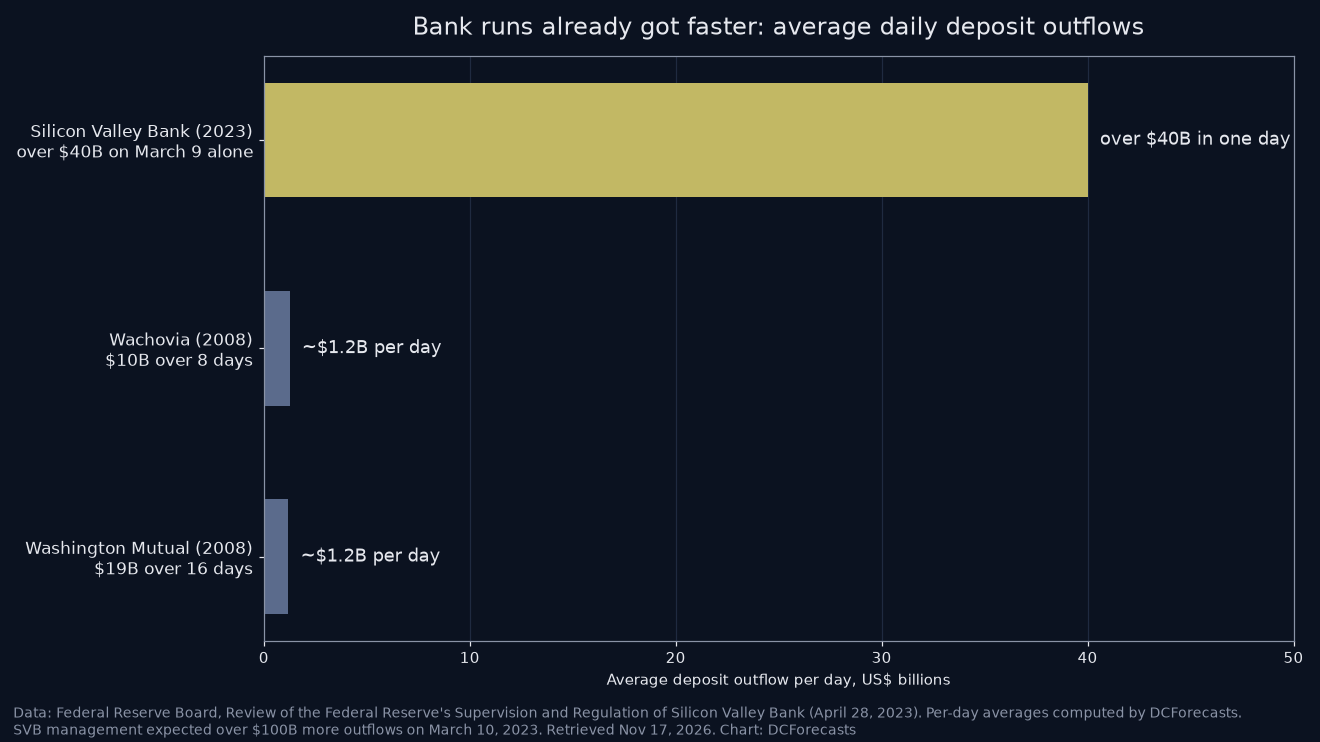
On a per-day basis, SVB’s run was more than 30 times faster than either 2008 failure. The review noted that withdrawals were “fueled by social media” and made in a coordinated way.
Barr’s point is that software agents could compress that timeline again, from a day to minutes.
The AI Debt Behind the Warning
The speech also drew on the Fed’s latest Financial Stability Report, released on Friday, November 13, which focused on the AI investment boom.
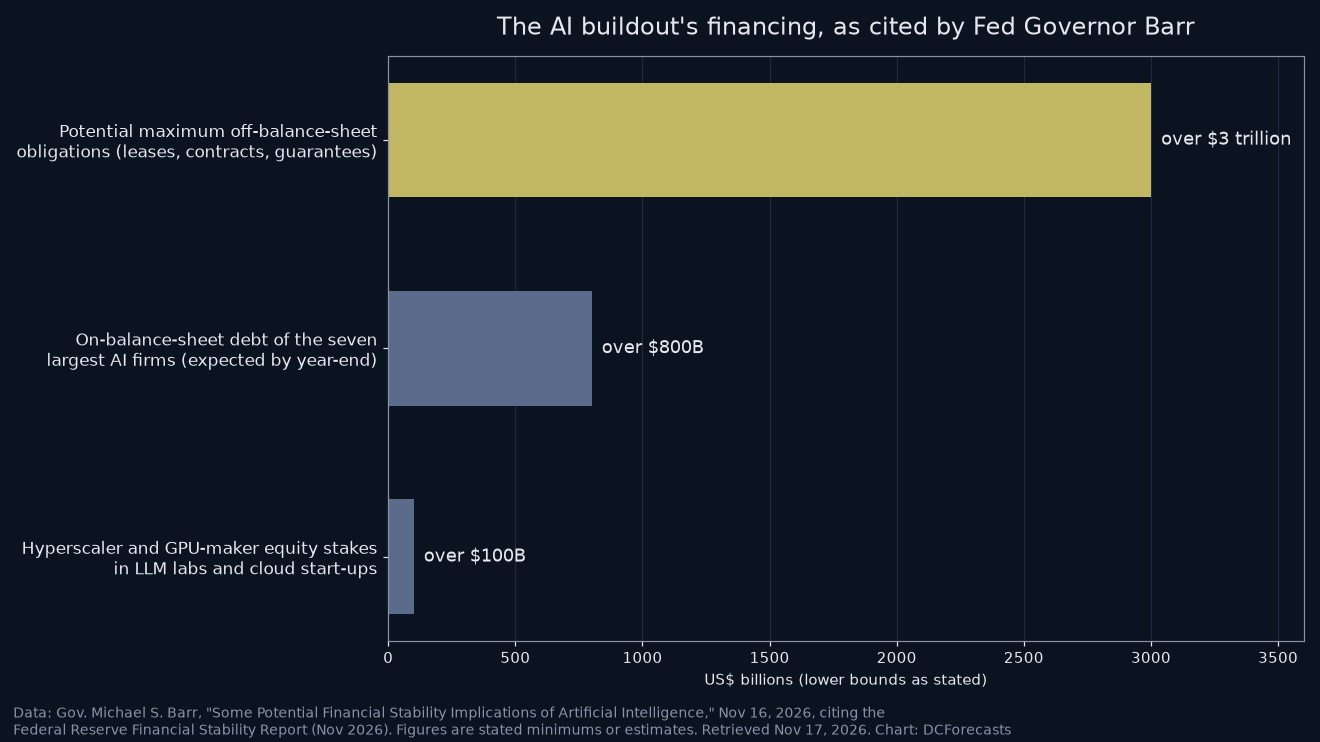
On-balance-sheet debt at the seven largest AI firms is expected to exceed $800 billion before year-end, Barr said.
Their potential off-balance-sheet obligations, including leases, long-term contracts and residual value guarantees, now exceed $3 trillion, according to the report’s estimate.
Hyperscalers and GPU makers also hold over $100 billion in equity stakes in AI labs and cloud start-ups, a form of “circular financing” when that money flows back as purchases of their own chips and compute.
Barr said he is “less concerned about direct losses” because the debt backing the boom is still limited. His concern is that leverage at hedge funds and broader risk appetite appear quite high, so a sharp reversal could force rapid deleveraging and self-reinforcing fire sales.
Why This Matters for Crypto Markets
Crypto has felt the AI trade this month. Grayscale linked part of Bitcoin’s November slide to stress in Nvidia and other AI-linked stocks, as we covered in why Bitcoin is down.
Barr’s figures help explain why investors are watching AI financing so closely. A repricing there could ripple through the same growth portfolios that hold digital assets.
Agentic payments are also arriving in crypto. We have tracked Lightning Labs billing AI by the token in Bitcoin and the ChatGPT Wallet on card rails.
Barr’s guardrails, especially explicit consent and limits on agent permissions, read like a checklist any wallet or exchange building for agents will need.
Can Banks Keep Pace With Machine-Speed Money?
The speech does not propose new rules. It frames questions that supervisors are likely to press on as agentic commerce grows.
Barr also flagged herding risk if many traders rely on similar AI models, which could make market moves more one-sided. Faster runs and crowded trades are two sides of the same speed problem.
We believe the contrast with Bitcoin is worth noting. A self-custodied coin is a bearer asset, so its holder does not depend on a bank’s liquidity in a panic, whether that panic moves at human speed or machine speed.
That does not make Bitcoin immune to selling. But it does mean there is no institution behind it that can run out of cash.
For now, the signals to watch are the Fed’s follow-up work on AI agents, how banks tighten authentication, and whether the AI debt Barr described keeps growing.
The coming months will show whether guardrails arrive before the first machine-speed run does.
DC Forecasts is a leader in many crypto news categories, striving for the highest journalistic standards and abiding by a strict set of editorial policies. If you are interested to offer your expertise or contribute to our news website, feel free to contact us at [email protected]












Discussion about this post