


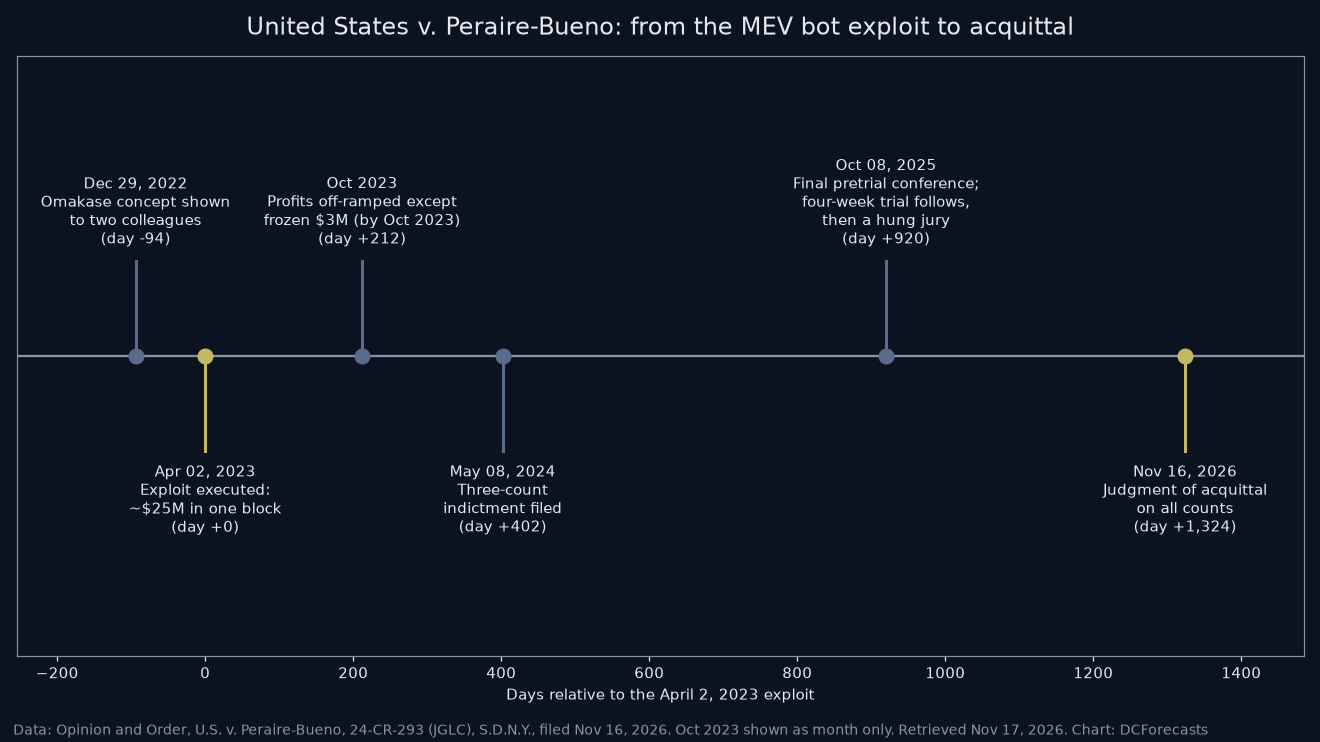
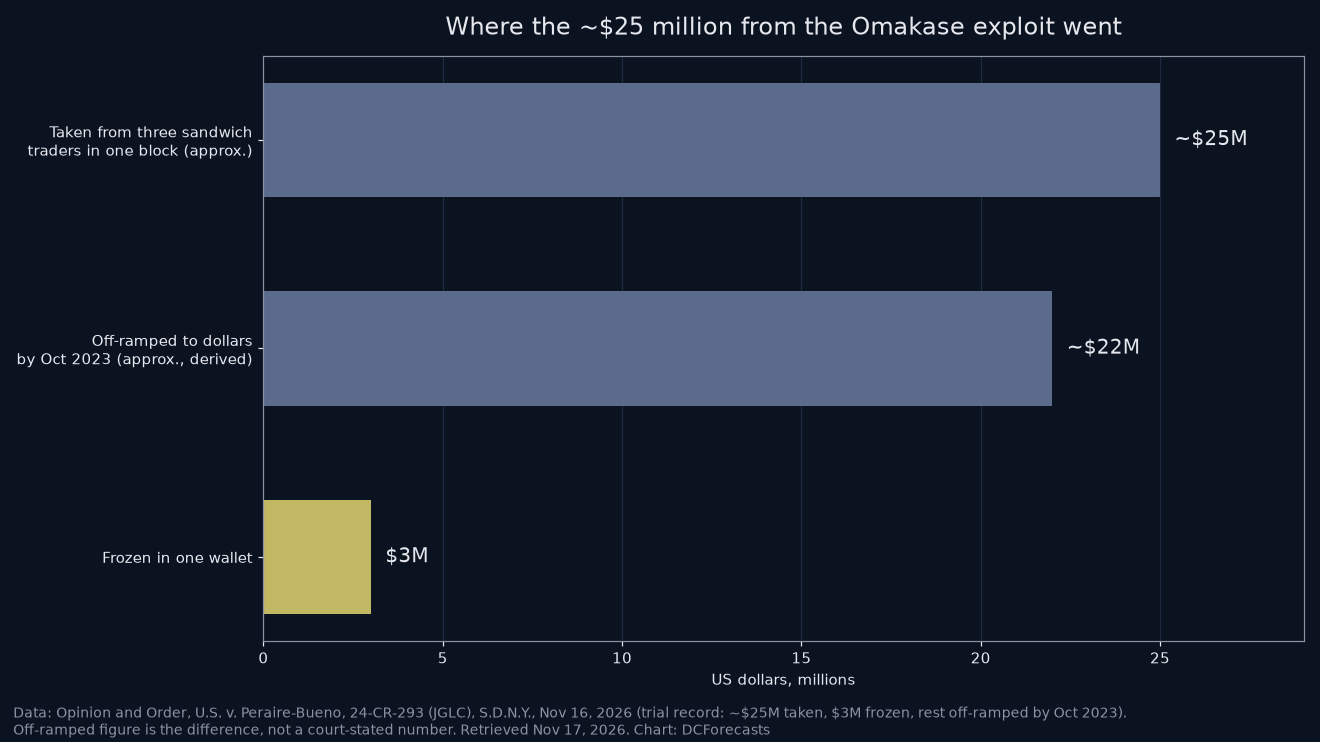
A federal judge in Manhattan has acquitted the two MIT-educated brothers who used a MEV bot trap to take about $25 million from Ethereum sandwich traders in a single block in April 2023.
U.S. District Judge Jessica G. L. Clarke granted Anton and James Peraire-Bueno’s motion for a judgment of acquittal on November 16, clearing them of wire fraud, conspiracy to commit wire fraud and conspiracy to commit money laundering.
The 46-page opinion closes the case. The Court directed the clerk to close it, so there will be no second trial after the first jury deadlocked.
For anyone who builds or trades on public blockchains, the reasoning matters more than the verdict itself.
The bigger question now is how prosecutors approach code-based exploits when the only “lie” they can point to is written in software.
What Did the Judge Actually Decide?
Wire fraud requires a material misrepresentation. Judge Clarke found the government never proved one.
“The question before the Court is not whether the Peraire-Buenos’ conduct was right or moral, or even whether it violated uncharged crimes,” she wrote.
It is only whether the trial evidence, read in the light most favourable to the government, could support a conviction. Her answer was no.
The money laundering count fell with it. That charge depended on the proceeds of wire fraud, and without fraud there was no unlawful activity to launder.

In a footnote, the judge declined to rule on whether the superseding indictment violated the brothers’ due process rights. She added, however, that “this prosecution raises serious due process concerns.”
How the $25 Million MEV Bot Trap Worked
The opinion lays out a scheme the brothers called “Omakase.” They first described it to two colleagues on December 29, 2022.
Its targets were sandwich traders, bots that place trades on both sides of another user’s transaction to profit from the price move they cause.
One trader testified that a single bot swapped $2.3 million of USDC for just $8.25 worth of SHIB, planning to sell it back at a small profit.
Omakase turned that habit against them. The team registered 16 validators and, according to trial testimony, ran 60 to 70 test transactions in the months before the attack.
On April 2, 2023, eight “lure” transactions hit the mempool just as one of their validators was due to propose a block. The bots bundled all eight.
The brothers’ validator then returned a deliberately invalid signed block header to a relay running MEV-Boost software, which caused the relay to reveal the block’s contents. They swapped the lures for their own transactions and proposed a valid replacement.
Three sandwich traders lost money. The validator was slashed for proposing two blocks in one slot, a penalty the opinion puts at 1 ETH.
Why “No Misrepresentation” Was the Deciding Factor
The government’s case leaned on several theories of deceit. Before trial it listed seven, from “posing as an honest MEV-Boost validator” to “submitting the doctored block.”
The judge noted that she had repeatedly asked prosecutors to pin down which statements were false. In its Rule 29 briefing the government offered six somewhat different theories.
None of them survived. Ethereum, the opinion stresses, is a “trustless, decentralized, and highly competitive environment,” governed by code, norms and financial incentives rather than terms of use.
In that setting, the judge reasoned, users assume validators act in their own self-interest. Behaviour that frustrates the spirit of a protocol is not the same as lying to someone.
We believe that distinction is healthy. Courts are drawing a line between exploiting open software and defrauding a person, and that line gives builders clearer rules.
What Happened to the Money?
The acquittal does not erase the trail of funds described in the trial record.
One wallet holding $3 million of the proceeds was frozen. By October 2023, the brothers had converted the rest into dollars through hundreds of transactions in their company’s exchange account.
Within 24 hours of the attack, Flashbots changed the MEV-Boost relay code so a relay checks whether a block header can produce a valid block before revealing its contents. Other relays followed.
That rapid patch is the quieter story here. The ecosystem fixed the weakness in a day, long before any courtroom weighed in.
What the Ruling Means for Crypto Developers
The opinion is a district court ruling, so it does not bind other judges. Still, it is the first full court analysis of a “first of its kind” MEV prosecution.
It joins a run of cases testing how old fraud statutes fit new markets, from the ex-Robinhood engineer who admitted trading Hyperliquid perps ahead of listings to fresh debates over smart-contract security after the Gnosis Safe role-key drain.
The lesson for traders is practical. Bots that risk millions on a predictable pattern can be gamed, and the law may not make them whole.
For Bitcoin holders, the episode is a reminder of why simple, conservative base-layer design matters. Fewer moving parts leave less room for the transaction-ordering games at the heart of this case.
Will Prosecutors Rethink Code-Based Cases?
Judge Clarke was careful to say she was not blessing the conduct. Her ruling turns on what the government charged, not on whether the scheme was fair.
That leaves room for other tools, such as civil claims or charges that do not require a lie. The opinion pointedly says it is not deciding whether the conduct “violated uncharged crimes.”
We believe the clearer outcome is that legal risk now tracks real deception rather than clever code. That clarity should help serious builders and institutions commit to open networks with more confidence.
The coming months will show whether prosecutors adapt their theories, or whether this ruling becomes the benchmark for MEV disputes.
DC Forecasts is a leader in many crypto news categories, striving for the highest journalistic standards and abiding by a strict set of editorial policies. If you are interested to offer your expertise or contribute to our news website, feel free to contact us at [email protected]












Discussion about this post