


The Commodity Futures Trading Commission has approved a blockchain-based derivatives exchange and clearinghouse, opening a regulated route for US traders to use the crypto-style perpetual futures that have mostly traded offshore.
In a statement dated Nov. 16, CFTC Chairman Michael Selig said the agency had approved applications to designate a designated contract market and register a derivatives clearing organization for “a firm utilizing blockchain-based architecture for execution and settlement of derivatives contracts.” Crypto exchange Backpack said the licenses are its own and that it plans to offer US users leveraged perpetual futures that trade around the clock.
What the CFTC Approved
The approval covers two separate roles. A designated contract market is a regulated exchange where futures and options are listed and traded. A derivatives clearing organization stands between buyers and sellers, collects margin and guarantees that trades settle. Holding both licenses lets one firm run the entire life of a trade, from order matching to final settlement.
Selig’s statement did not name the firm, but it made the regulatory point clearly. “These approvals mark an important milestone in the evolution of American financial markets and demonstrate that there is a regulated pathway for a new generation of market infrastructure built using blockchain technology,” he said.
He added that the Commodity Exchange Act sets core principles “without prescribing a particular technological architecture.” Firms using blockchain still have to meet the same standards as traditional venues, including:
- Anti-money laundering programs.
- Customer protection and segregation of client funds.
- Market surveillance.
- Financial resources and risk management policies.
- System safeguards.
The full statement is on the CFTC’s website.
What Backpack Says It Will Offer
According to Backpack, the US venue will offer leveraged crypto perpetual futures with 24/7 trading, cross-margining and collateral posted in either crypto or fiat, all on a single order book shared with its global users. Backpack has not given a launch date for US trading.
Perpetual futures, or perps, are contracts with no expiry date. Instead of rolling over each month, they use a periodic funding payment between longs and shorts to keep the contract price close to the spot price. They are the most traded product in crypto, but US customers have largely had to go offshore to use them. The approval adds another onshore option at a time when the CFTC is already being challenged over which perps it should allow, as seen in the fight over stock perpetual futures.
BP Token Jumps on the News
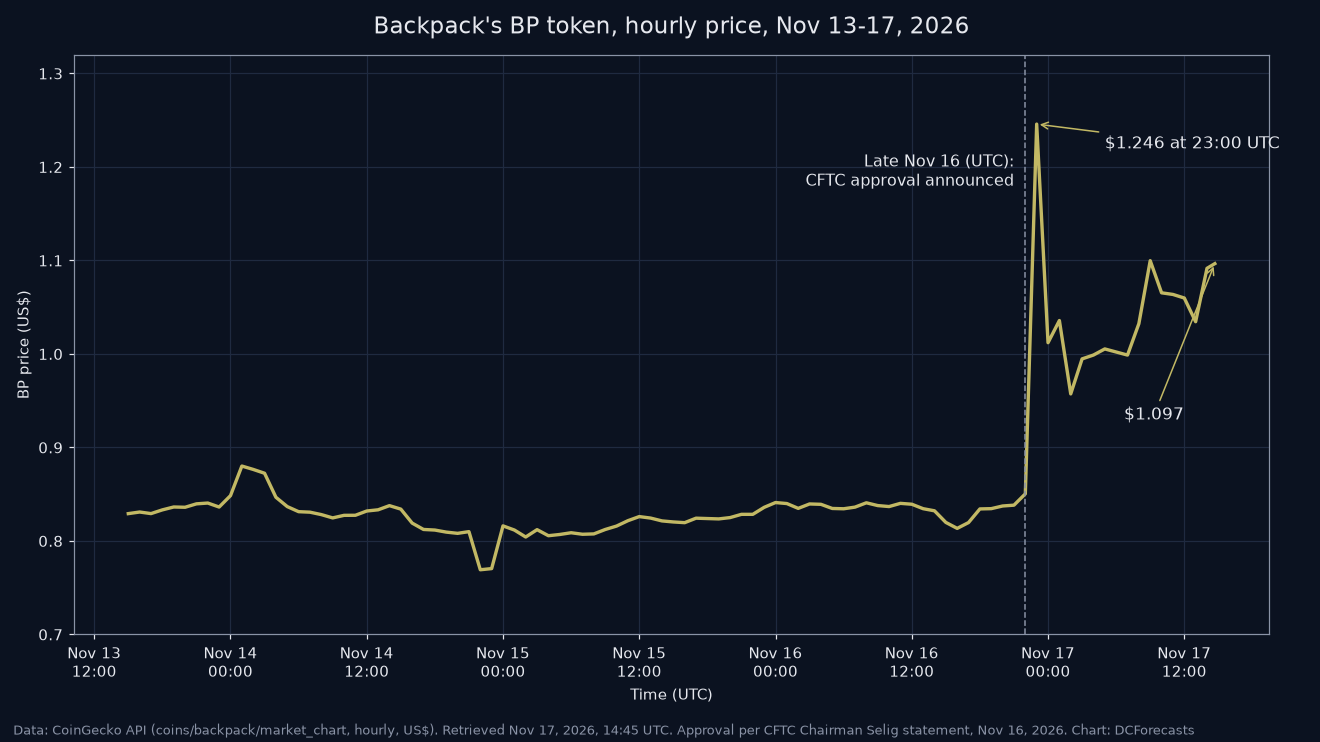
The market reacted quickly. CoinGecko hourly data shows Backpack’s BP token at about $0.850 at 22:00 UTC on Nov. 16. An hour later it was $1.246, a gain of roughly 46%. Part of the move faded overnight, and BP was trading near $1.097 by 14:40 UTC on Nov. 17, still about 29% above the pre-announcement level.

Why This Matters for Bitcoin
Bitcoin is usually the largest market on any crypto derivatives venue, so new regulated ways to trade it give US investors and institutions more choice without leaving the US system. A clearinghouse built on blockchain could also settle trades and margin calls on weekends and holidays, when traditional futures markets are closed but Bitcoin keeps trading.
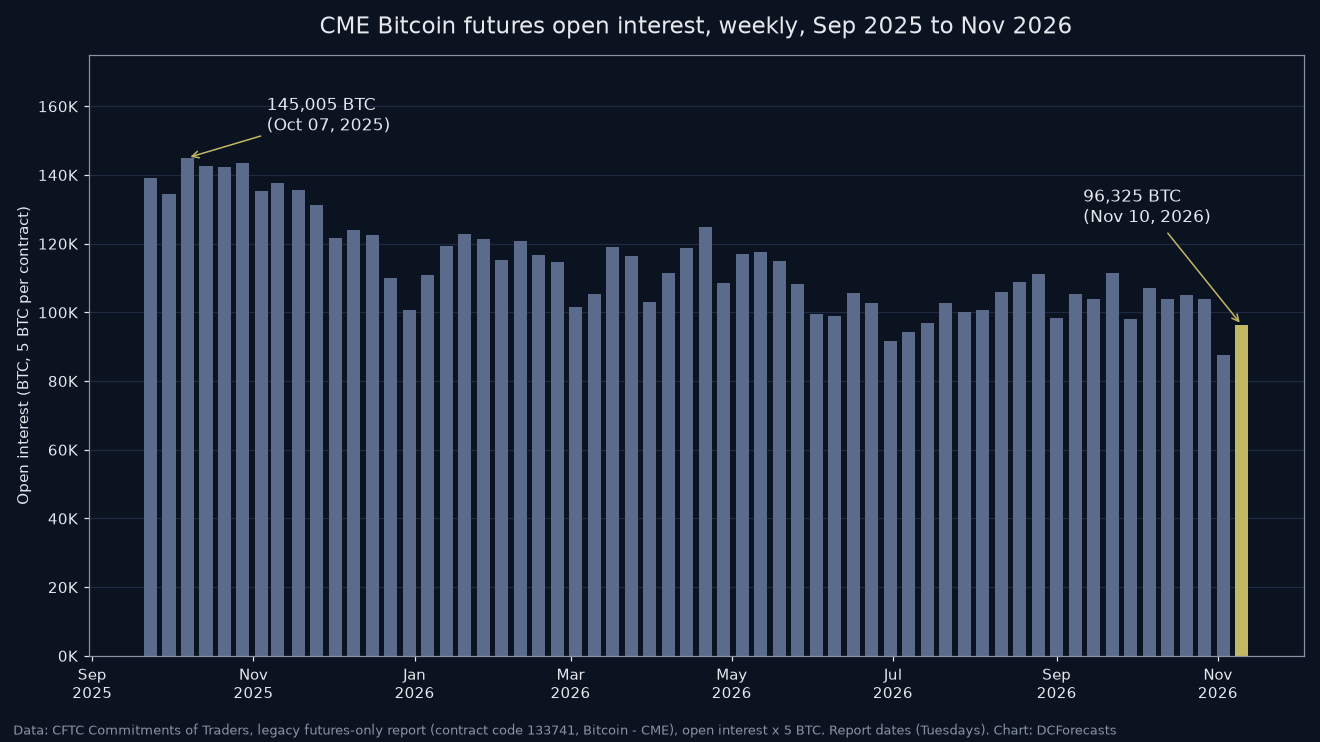
The CFTC’s own data shows there is room for that growth. Weekly Commitments of Traders reports put open interest in CME’s main Bitcoin futures contract at 19,265 contracts on Nov. 10, 2026. At 5 BTC per contract, that equals 96,325 BTC. That is down from a peak of 145,005 BTC on Oct. 7, 2025, in the 60 weeks of data reviewed. Lower open interest means fewer outstanding positions. It reflects the cooling since last year’s highs, not a lack of interest in regulated access.
A 24/7 venue with crypto collateral and a global order book is designed to bring back some of the trading that moved offshore. If US traders can get perpetual exposure to Bitcoin at home, more of that activity, and the liquidity that comes with it, could move into regulated markets.
Bitcoin was trading at about $65,035 on Coinbase on Nov. 17. Recent selling has pushed it to levels Grayscale recently called an attractive entry point. Better market plumbing does not set prices, but it widens access for the next wave of buyers.
A Busy Month at the CFTC
The approval comes during a very active stretch for the agency. In the past two weeks, the CFTC has sued several states that blocked event contracts listed on its regulated exchanges, issued guidance on trust companies in daily settlement, and received a request from an industry policy group to draw a clearer line between event contracts and gambling.
Selig tied the decision to keeping crypto business in the US. “Today’s approvals reinforce that the United States is open for business and that responsible innovation has a home in our regulated markets,” he said.
The next step is execution. Backpack still has to set a launch date, open accounts and build liquidity on its US venue. On the regulatory side, Selig’s statement makes clear that the path for blockchain-based derivatives infrastructure is now open.
DC Forecasts is a leader in many crypto news categories, striving for the highest journalistic standards and abiding by a strict set of editorial policies. If you are interested to offer your expertise or contribute to our news website, feel free to contact us at [email protected]












Discussion about this post