



An AI bubble burst is now one of the scenarios the Federal Reserve’s staff are formally modeling. Fed Chair Kevin Warsh laid out three possible paths for an economy reshaped by artificial intelligence on Nov. 16, and only one of them ends with falling stock valuations and a slowdown.
Warsh stressed that none of them is a forecast. Still, the timing is notable. Bitcoin has been trading in close step with technology stocks, so how the AI story plays out matters for crypto too.
Kevin Warsh puts “super intelligence” on the Fed’s agenda
Warsh spoke at the opening of the Productivity and Jobs Task Force conference, co-hosted by the Fed Board and the San Francisco Fed. It was his first visit to a Reserve Bank as chair.
He called the current period possibly “the most transformational period in my adult lifetime,” driven by what he termed “super intelligence,” or SI. In his view, SI could “supercharge idea generation,” and if that happens, growth “could be sustained at a level substantially higher than the long-run average.”
He also noted that U.S. productivity growth “in recent quarters” has been “reasonably strong,” but “hasn’t yet broken out definitively and structurally to the upside.”
According to the text of his remarks, the Board’s staff “has begun to evaluate various contingencies, applying stylized, model-based frameworks to generate scenarios.”
Three futures, from boom to AI bubble burst
Warsh described the range of outcomes in plain terms:
- Shared boom: productivity rises, gains are shared between workers and owners of capital, real GDP growth stays above its long-run average and the U.S. stays near full employment.
- Disruptive boom: growth still runs above average, but automation displaces jobs faster than workers adjust, pushing unemployment above full-employment levels.
- Disappointment: after heavy investment and stock gains, “expected returns could turn down and equity valuations could fall, leading to an economic slowdown and a more notable rise in unemployment.”
In that third case, he said, the economy “would recover, but without the productivity gains.” That is the closest the Fed has come to describing an AI bubble burst in its own words.
“These are illustrative scenarios, not forecasts,” Warsh said. He added that the Fed’s job “is to prepare for whatever comes next,” and that the technology will have “important implications for monetary policy down the road.” He did not signal any change to interest rates.

Why the Fed is watching AI financing so closely
The same day, Governor Michael Barr gave the financing side of the picture. In a speech on AI and financial stability, he cited the Fed’s November Financial Stability Report, which estimates that the potential maximum value of off-balance-sheet obligations linked to the AI buildout, such as long-term data center and compute leases, energy contracts and guarantees, “now exceeds $3 trillion.”
Barr warned that such complexity “can be opaque to unsophisticated investors” and can “exacerbate selloffs when investor sentiment shifts.” We covered his separate warning about AI agents speeding up bank runs on Nov. 17.
For now, the industry’s results point the other way. Nvidia reported revenue of $115.8 billion on Nov. 17, more than double a year earlier, and guided to $130 billion for the current quarter.
Bitcoin is trading in step with the Nasdaq
The reason this matters for crypto is visible in the data. Using Coinbase daily closes and the Nasdaq Composite from the St. Louis Fed’s FRED database, we measured the 30-trading-day correlation between their daily returns.
That reading stood at 0.68 on Nov. 16. It hit 0.76 on Nov. 5, its highest level this year, after falling as low as 0.12 in mid-May and hovering near 0.15 from late August into mid-September.
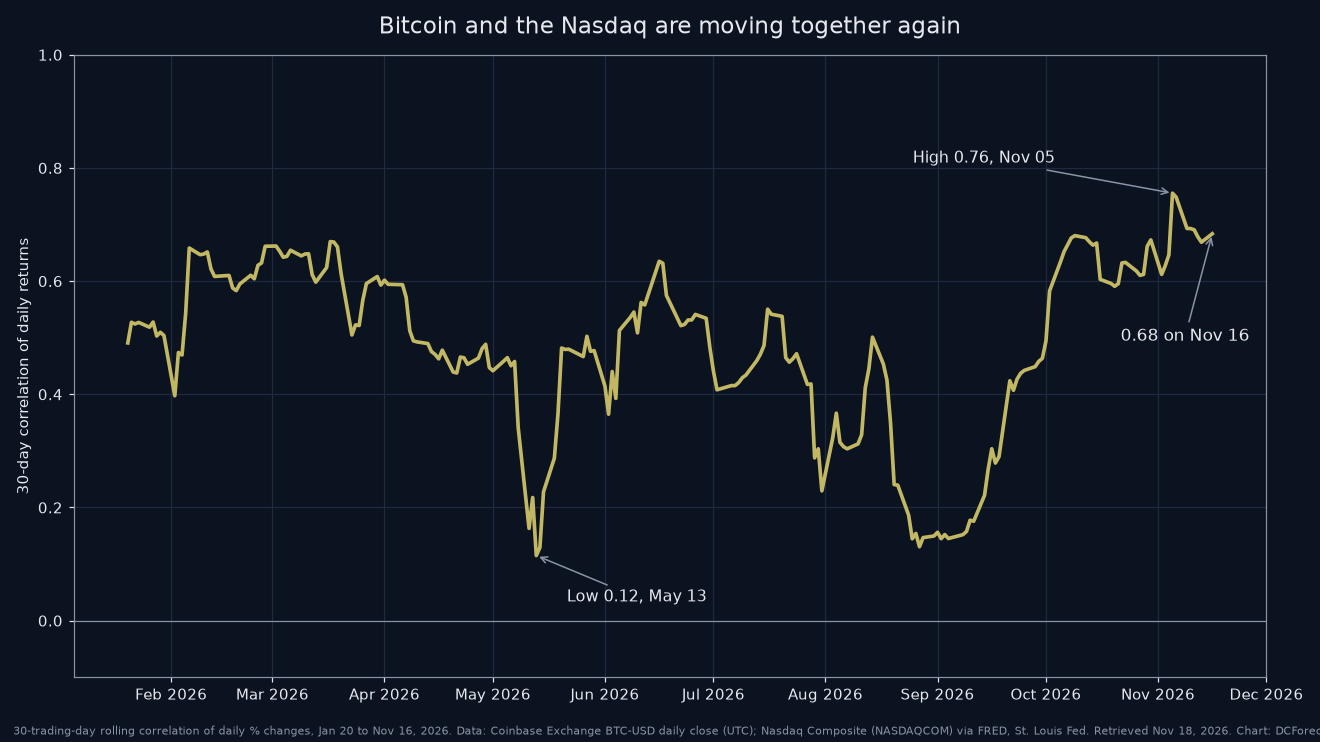
A correlation near 0.7 means the two tend to rise and fall on the same days, though not by the same amount. In practice, Bitcoin has been moving with tech sentiment more than with crypto-specific news.
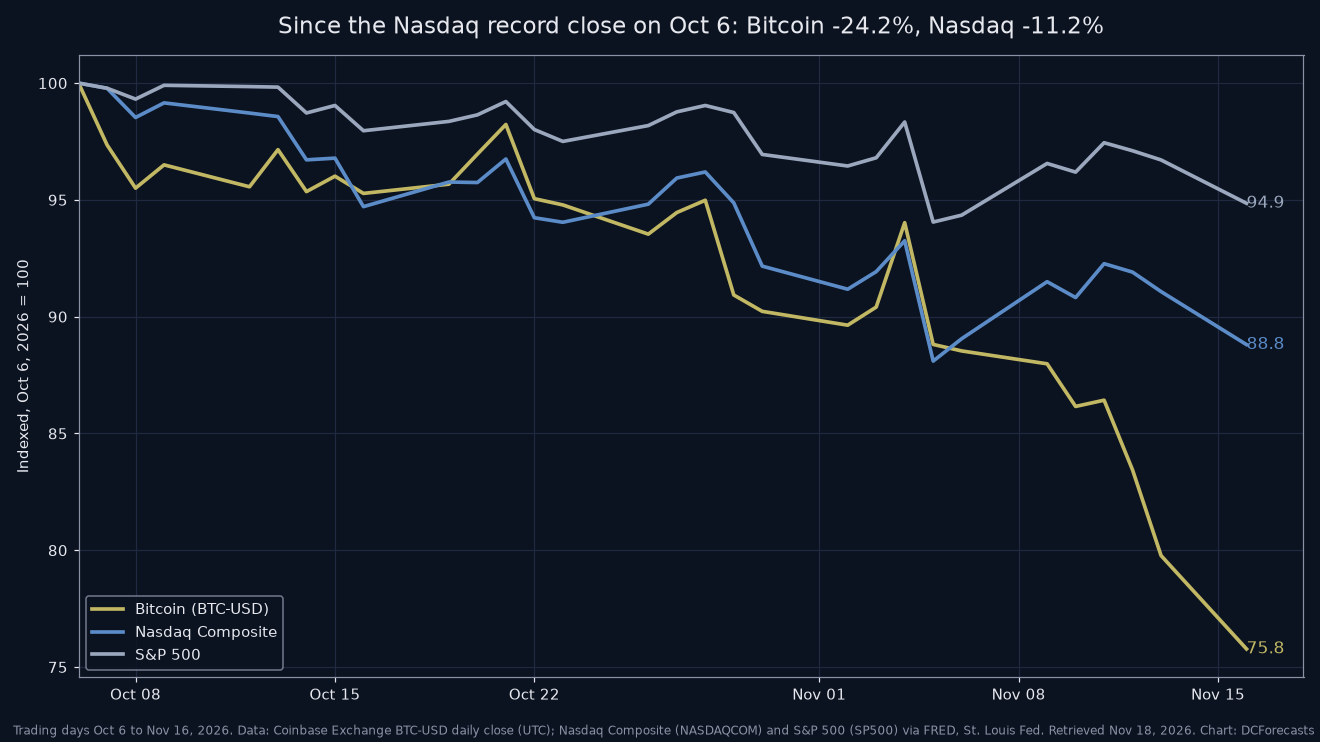
The size of the moves has differed sharply. Since the Nasdaq’s record close of 27,599.89 on Oct. 6, the index has fallen 11.2% through Nov. 16 and the S&P 500 has slipped about 5%. Bitcoin has dropped 24.2% over the same trading days.
What an AI bubble burst could mean for Bitcoin
The honest reading is that a sharp tech selloff would likely weigh on Bitcoin in the short run, as it has since October. Warsh’s third scenario explicitly includes falling equity valuations.
But Bitcoin has already absorbed much of that de-risking. It has fallen more than twice as far as the Nasdaq since Oct. 6 and recently slipped below its 200-week moving average, a level it has reclaimed after every break since 2019. Much of the fear is arguably already in the price.
Policy is the other lever. The Fed raised its target range to 3.75% to 4.00% at its September meeting. Warsh’s scenario describes a slowdown with “a more notable rise in unemployment,” the kind of backdrop in which central banks have historically turned to easier policy, which has tended to support scarce assets like Bitcoin.
The two growth scenarios are also constructive. Faster productivity growth and stronger GDP would support risk appetite broadly, and Bitcoin has historically benefited from expanding liquidity and investor confidence.
We believe the Fed’s willingness to plan openly for all three outcomes is healthy. It reduces the risk of a policy surprise, and it frames Bitcoin’s current weakness as part of a broader tech reset rather than a crypto-specific failure.
What to watch next
The next test comes at the Fed’s Dec. 8-9 meeting, which will include a fresh Summary of Economic Projections. Any mention of AI in the statement or projections would show how seriously policymakers weigh these scenarios.
Until then, the Bitcoin-Nasdaq correlation is worth tracking. If it starts to fall while AI stocks stay volatile, that would be an early sign that Bitcoin is trading on its own story again.
DC Forecasts is a leader in many crypto news categories, striving for the highest journalistic standards and abiding by a strict set of editorial policies. If you are interested to offer your expertise or contribute to our news website, feel free to contact us at [email protected]












Discussion about this post