



Bitcoin fees are about as low as they get, and that has made 2026 a rare window for one of the network’s most overlooked chores: merging small coins before they become costly to spend.
On Nov. 17, the mempool.space fee estimator showed 1 satoshi per virtual byte (sat/vB) for confirmation within an hour, and just 3 sat/vB for the next block. Data from the same source shows the median fee rate in mined blocks has averaged between 1.1 and 1.5 sat/vB in every month of 2026. In December 2023, the monthly figure was 153.6 sat/vB.
Why small Bitcoin withdrawals cost more later
Bitcoin wallets do not hold a single balance. They hold a collection of separate pieces of Bitcoin, called unspent transaction outputs, or UTXOs. Every withdrawal from an exchange, every payment received and every round of change creates a new one.
The fee for a transaction depends on its size in bytes, not on the amount sent. Each UTXO a wallet spends adds an input to the transaction. For a standard native SegWit address, each input adds about 68 virtual bytes.
That is how someone who buys $50 of Bitcoin every week, and withdraws each purchase, ends up with dozens of small UTXOs. Spending them all at once later means paying for dozens of inputs. When the network is busy, the fee to spend a tiny UTXO can be larger than the UTXO itself. That makes it uneconomic to move, a state often called “dust.”
Bitcoin fees have stayed near the floor all year
The fee market has changed a lot since the last two spikes. In late 2023, demand for inscriptions pushed the monthly median fee rate to 153.6 sat/vB in December. Around the April 2024 halving, the Runes launch lifted it to 87.4 sat/vB.
Since then, fees have fallen steadily. The monthly median has not been above 4 sat/vB since January 2025, and it fell below 2 sat/vB in August 2025. It has stayed close to the 1 sat/vB floor ever since. November 2026 has averaged 1.4 sat/vB so far, slightly above October’s 1.1 sat/vB, as the sell-off brought a burst of activity.
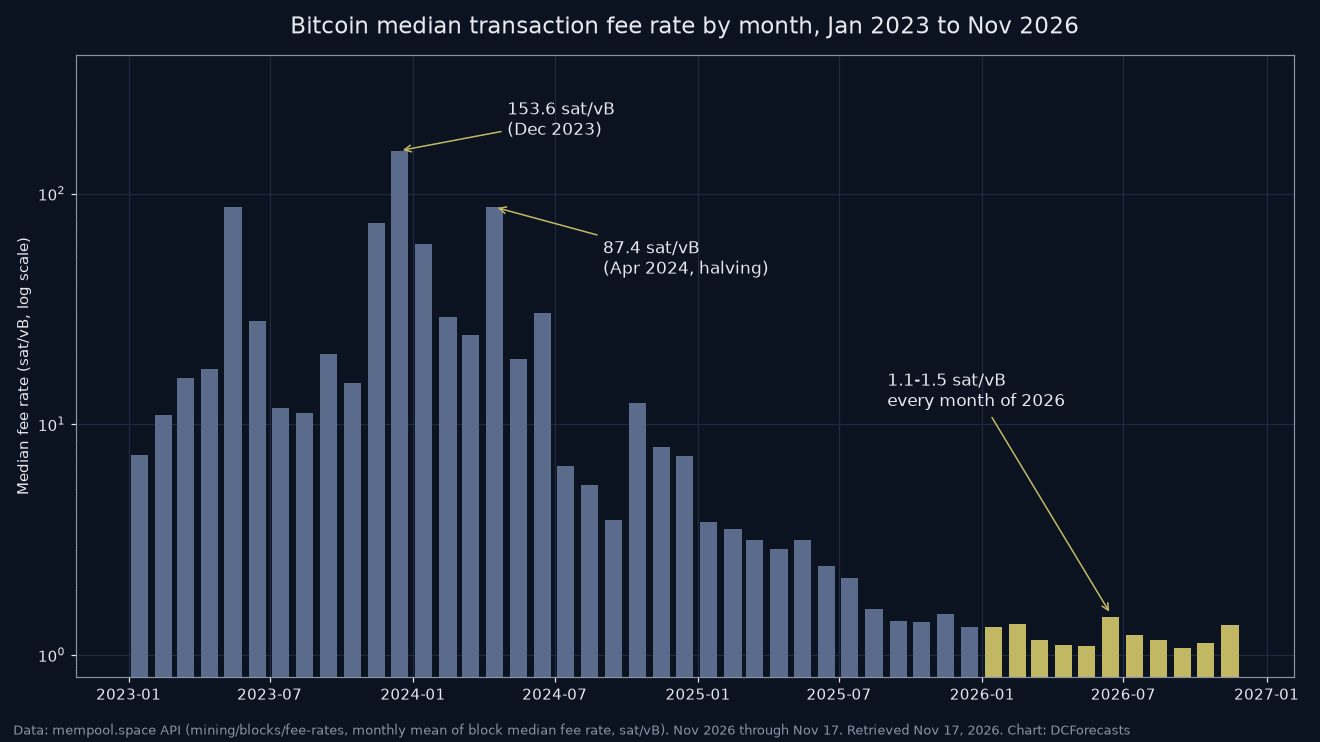
Low fees are not a sign of an idle network. As DCForecasts reported, Bitcoin processed a record of about 710,000 transactions a day in October. The network is handling more payments while charging users far less for block space. Wallets now batch payments, SegWit is widely used and block space is used more efficiently, so users get cheap settlement even at high volume.
What consolidating 50 small UTXOs costs now
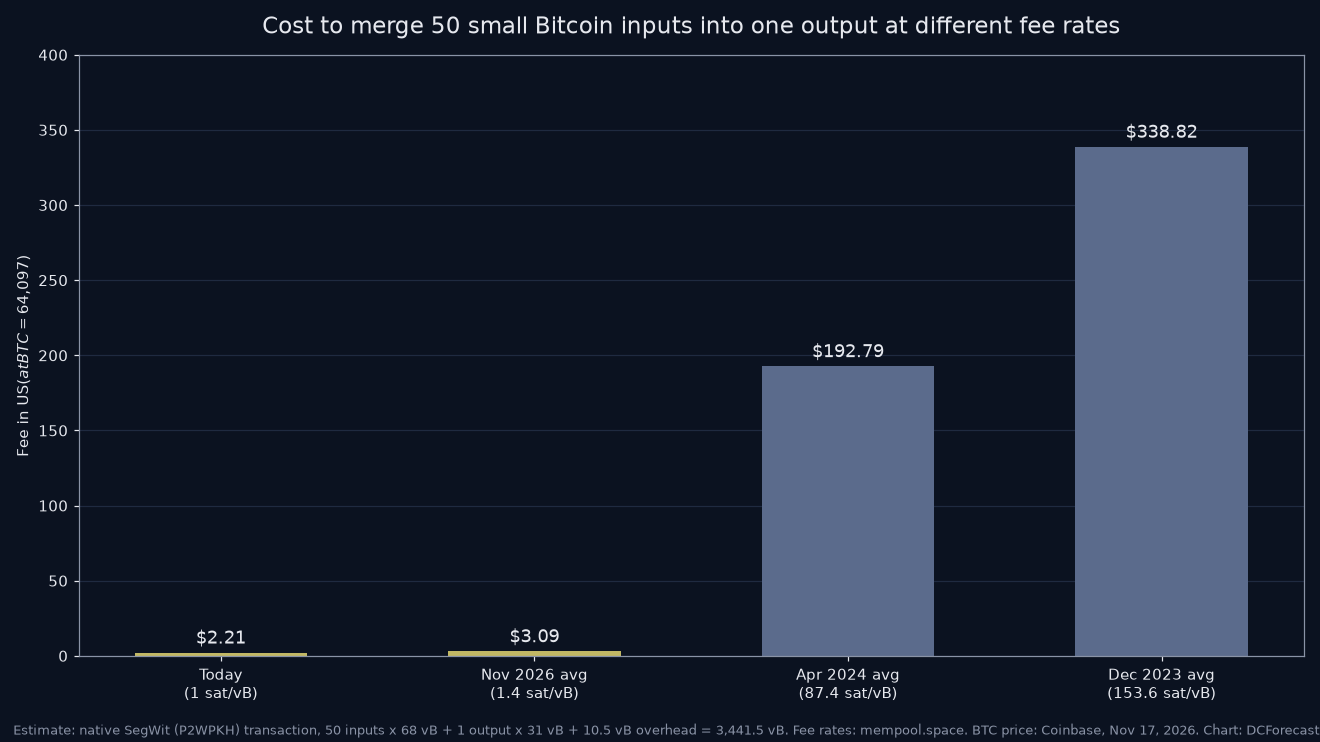
To show the difference, DCForecasts estimated the fee for one common clean-up. The example merges 50 small native SegWit UTXOs into a single output, using standard transaction sizes. That gives a transaction of about 3,441.5 virtual bytes.

At 1 sat/vB, the fee is 3,442 satoshis. With Bitcoin at about $64,097 on Coinbase on Nov. 17, that is roughly $2.21. At November’s average rate of 1.4 sat/vB, the cost is about $3.09.
Run the same transaction at April 2024’s average of 87.4 sat/vB and the fee jumps to about $192.79 at today’s price. At December 2023’s 153.6 sat/vB it is about $338.82. That is more than 150 times the current cost for the same clean-up.
How holders can use the quiet period
Most modern wallets let users choose which coins to spend through a feature usually called coin control. To consolidate, a holder sends many small UTXOs from the same wallet to a single new address they own, and sets a low fee rate.
At 1 sat/vB, a consolidation may wait a little longer for confirmation than a priority payment, but each input costs about 68 satoshis, or roughly four US cents at today’s price. Because the fee is set per byte, the savings scale with the number of coins being merged: a wallet with 200 small UTXOs saves four times as much as one with 50.
There is one trade-off. Merging coins links them together on the public blockchain, which can reveal that they belong to the same owner. Holders who care about privacy often keep coins from different sources separate rather than merging everything at once.
The other step is to cut down on new small UTXOs. Withdrawing from an exchange less often, in larger amounts, means fewer inputs to pay for later, whatever fees are doing at the time.
Cheap block space today, more demand tomorrow
Fees today make up a small share of what miners earn. Data from mempool.space shows blocks in November have carried about 0.022 BTC in fees on average, next to the 3.125 BTC block subsidy. Miners have still added capacity. DCForecasts tracked a 15% hashrate rebound after the latest difficulty cut.
History shows that demand for block space can come back quickly, as it did in 2023 and 2024. For long-term Bitcoin holders, the current low-fee period is a cheap time to tidy up a wallet before the next busy spell.
DC Forecasts is a leader in many crypto news categories, striving for the highest journalistic standards and abiding by a strict set of editorial policies. If you are interested to offer your expertise or contribute to our news website, feel free to contact us at [email protected]












Discussion about this post