



Solana rent, the deposit every account must hold to store data on the network, is about to get much cheaper.
At the Breakpoint conference on Nov. 17, Anza CEO Brennan Watt said the final three steps of a proposal called SIMD-0437 are next in line. Solana’s own conference recap a day later pointed to a window of roughly two weeks.
If all three cuts go live, the storage rate falls from 5,080 to 696 lamports per byte. That is a drop of about 86% from today’s level.
For a standard token account, the upfront deposit would shrink from about 0.00149 SOL to 0.00020 SOL.
The bigger question is whether cheaper storage brings a wave of new users and apps, and how carefully the network can absorb the extra data that follows.
What Solana Rent Actually Is
Despite the name, Solana rent is not a recurring fee. It is a refundable minimum balance.
Whoever creates an account, a wallet or an app, must lock enough SOL inside it to cover the data it stores. When the account is closed, that SOL goes back to a chosen address.
The formula is simple. Take the account’s data size, add 128 bytes of fixed overhead, and multiply by the current rate in lamports per byte. One SOL equals one billion lamports.
We checked the live number ourselves. On Nov. 18, Solana’s mainnet returned a minimum of 1,488,440 lamports for a 165-byte account, the size of a standard SPL token account. That equals exactly 293 bytes at 5,080 lamports each.

At a SOL price of $73.96 on CoinGecko, that deposit is worth about 11 cents.
Three Cuts Left in a Five-Step Plan
SIMD-0437 was written by Anza engineer Igor Durovic and created in December 2025. It replaced an earlier plan, SIMD-0436, that would have simply halved the rate.
Instead of one big jump, the proposal lays out five steps from the original 6,960 lamports per byte: 6,333, then 5,080, then 2,575, 1,322 and finally 696.
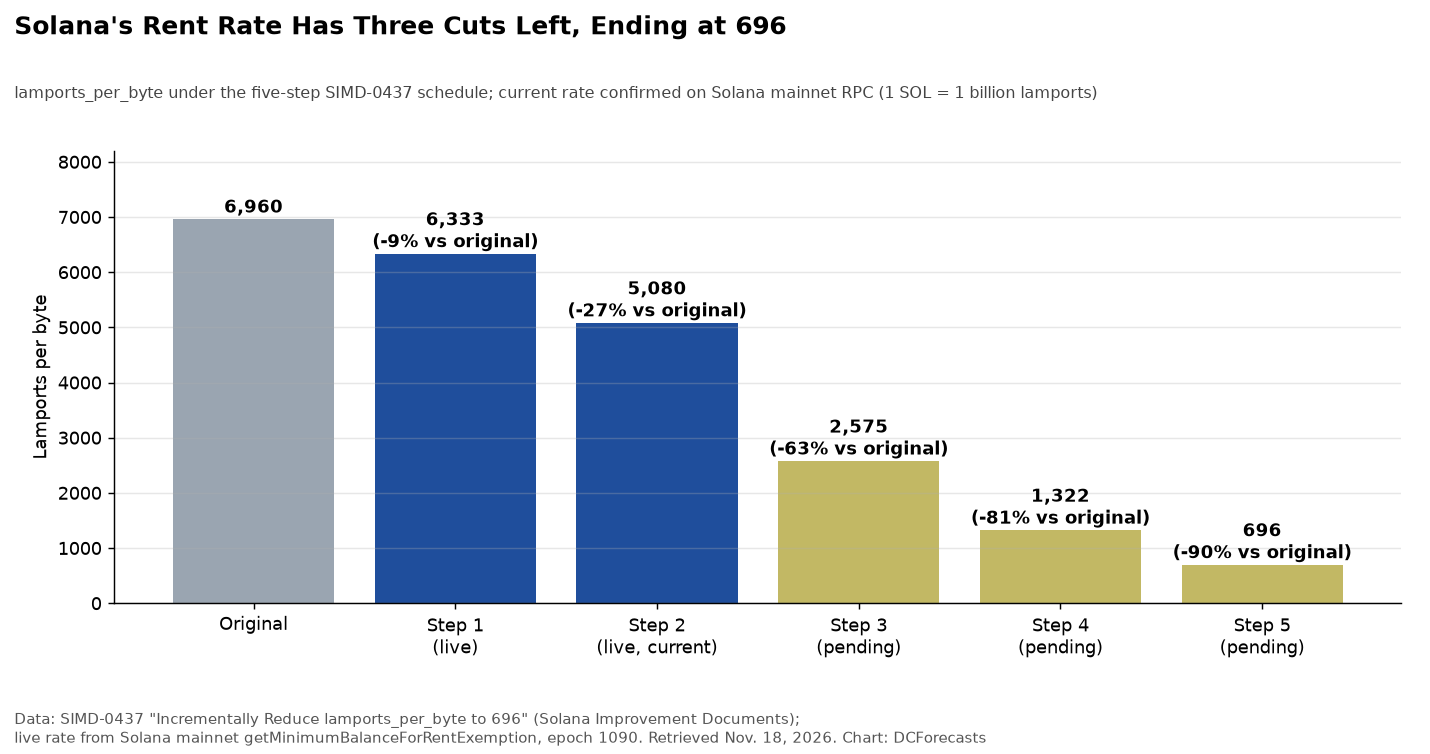
The first two steps are already live, which is why mainnet shows 5,080 today. Those cuts reduced the original rate by 27%.
The final three are the heavy lifting. Together they remove most of what is left, ending 90% below where Solana started.
Each step sits behind its own feature gate, so the network can switch them on one at a time.
Why Anza Wants Cheaper Storage
The proposal is blunt about the reason. It calls the rent rate “an arbitrary constant set years ago that has since increased significantly in real terms due to increases in the SOL price.”
In other words, the rate was fixed in SOL, so every rally made storage more expensive in dollars. The proposal argues this made state on Solana pricier than on rival networks, “with no compelling justification provided by real resource costs.”
The practical effect is easy to see in the numbers.
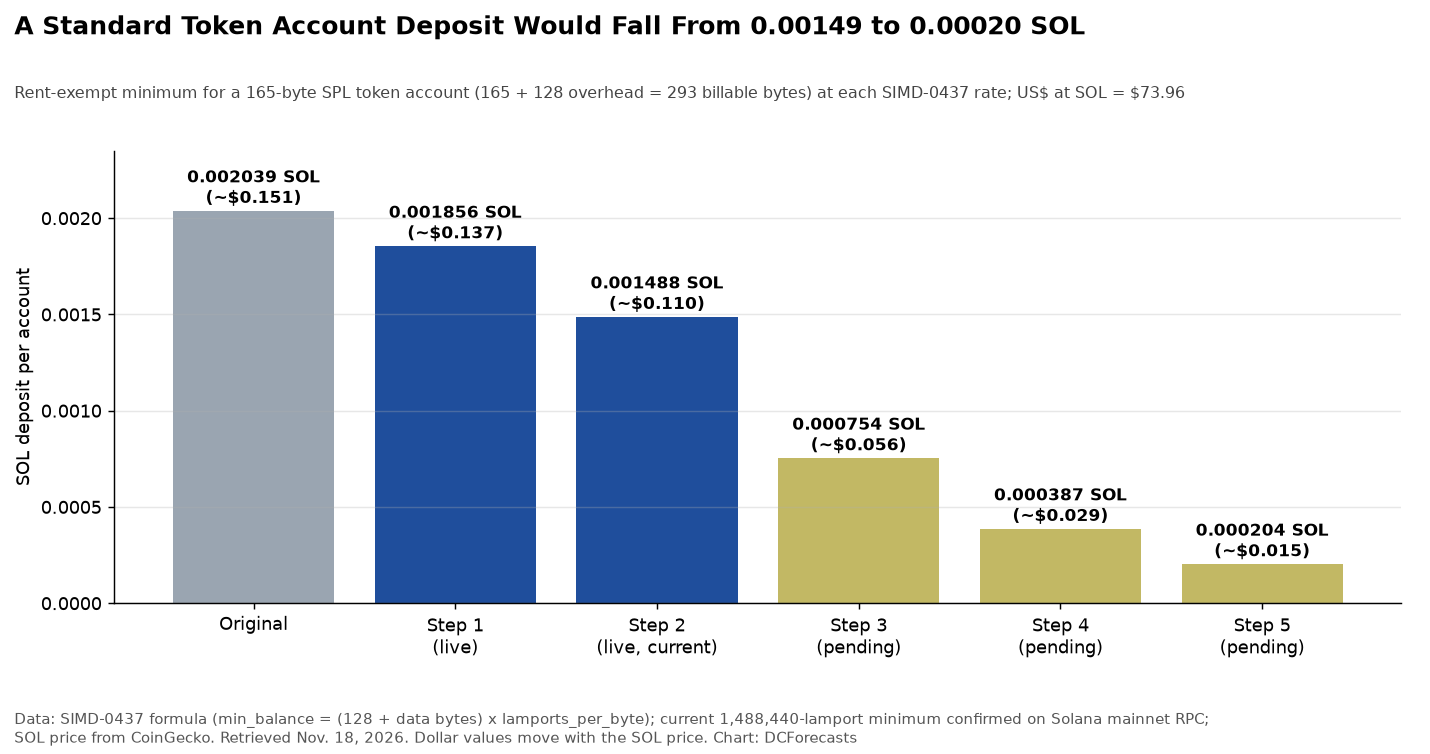
An app that opens 100,000 token accounts for new customers would need to lock about 148.8 SOL today. After the final cut, the same accounts would need about 20.4 SOL, freeing roughly 128 SOL, or close to $9,500 at current prices.
That matters for wallets, payment apps and games that pay to onboard users who have never held a given token. It is also the kind of change that fits Solana’s broader push toward everyday payments, such as Solflare’s MoneyGram cash-out link for USDC.
Existing accounts benefit too. The proposal says accounts created under the higher rate are allowed to reduce their balance to the new minimum, so locked SOL above that floor can be withdrawn.
The Safeguards Behind the Rollout
Cheaper storage has a cost elsewhere. Validators must keep every account in memory and on disk, so a lower deposit could speed up state growth.
SIMD-0437 treats that risk seriously. It says each step should go ahead only if a risk analysis, based on real data, shows it is safe, and it notes that risk “increases superlinearly” as the cuts deepen.
There is also a way back. Under the related SIMD-0392, rent can be raised again toward the legacy value without significant disruption to existing accounts, and the proposal points to SIMD-0389 as a way to do that automatically.
We believe this staged approach is the right one. It lets builders enjoy lower costs while giving the network a clear brake if storage growth runs too hot.
The exact activation dates for steps three, four and five have not been fixed in the proposal itself. Builders should avoid hardcoding today’s 0.00149 SOL figure and read the live rate from the network instead.
How Bitcoin Handles the Same Problem
Bitcoin takes a very different path. There is no refundable deposit. Users pay a one-time fee per virtual byte, and the network’s state is the set of unspent coins.
That design rewards keeping state lean, and this year it has been unusually cheap to do so. As we covered, Bitcoin fees have sat near 1 sat/vB for most of 2026, making it far cheaper to consolidate small coins than in 2023.
Both networks are attacking the same goal from opposite ends: making it affordable for ordinary users to hold and move value on-chain.
What to Watch Next
The key signal is the activation of step three, which would take the rate to 2,575 lamports per byte and roughly halve today’s deposit in one move.
After that, the data on account creation and state size will decide how quickly steps four and five follow.
Solana’s ecosystem has had a busy month, from Breakpoint to the Solana Foundation’s majority stake in CoinGecko. A 90% cheaper on-chain footprint could prove to be one of its most practical upgrades. The coming weeks will show how quickly builders put it to work.
DC Forecasts is a leader in many crypto news categories, striving for the highest journalistic standards and abiding by a strict set of editorial policies. If you are interested to offer your expertise or contribute to our news website, feel free to contact us at [email protected]












Discussion about this post