



Bitwise has filed a public registration statement for a Zcash ETF, and the venue it names on the cover is not New York. The prospectus says the fund’s shares are expected to list on the Texas Stock Exchange under the ticker “ZEC.”
The Form S-1 reached the SEC at 5:03 p.m. Eastern time on Nov. 17, according to the filing record on EDGAR. It follows a confidential draft submitted on Sept. 3 and an amended draft on Oct. 16.
The fee line is still blank, and the fund cannot sell shares until the registration becomes effective. But the document already sets out who will hold the coins, how prices will be set and which risks Bitwise wants investors to see.
The bigger question is whether a second spot Zcash product, on a newer exchange, can widen demand for a privacy coin that has had a turbulent year.
What the Bitwise Zcash ETF filing lays out
The trust will hold only ZEC and value it once a day using the CF Zcash-Dollar US Settlement Price, a benchmark from CF Benchmarks calculated at 4:00 p.m. ET.
Coinbase Custody Trust Company is named as custodian. BNY Mellon will act as administrator and transfer agent. Coinbase’s prime brokerage arm can execute trades, and Wintermute, Nonco and Virtu Financial Singapore are listed as approved trading counterparties as of Nov. 17.
Shares will be created and redeemed in blocks of 10,000, either in cash or in kind. The trust will not stake. Zcash is a proof-of-work network, so there is no staking yield to capture anyway.
The seed was symbolic. Bitwise Asset Management bought eight shares at $25 each on Oct. 15, for $200.
One detail to watch: a passage in the overview still refers to NYSE Arca, while the cover page and prospectus summary both name the Texas Stock Exchange. Later amendments should settle that.

Why the Texas Stock Exchange matters here
The Texas listing is the most unusual part of the filing. As we covered when the SEC approved generic listing standards for commodity trusts on the Texas Stock Exchange, the change lets that exchange list qualifying products without a separate rule filing for each one.
We read Bitwise’s choice as a sign that crypto issuers are now treating the venue as a real option rather than an experiment. More competition among exchanges usually means faster launches and lower costs for issuers, which can feed through to fees.
The ticker is also bold. Grayscale’s existing product trades as ZCSH. Bitwise has claimed the coin’s own symbol.
How Zcash has traded while the filing took shape
ZEC has been one of the most volatile large tokens of 2026. On Coinbase it closed at $197.30 on March 7, its low of the past year. It then ran to $1,652.43 on Sept. 26, about 8.4 times higher.
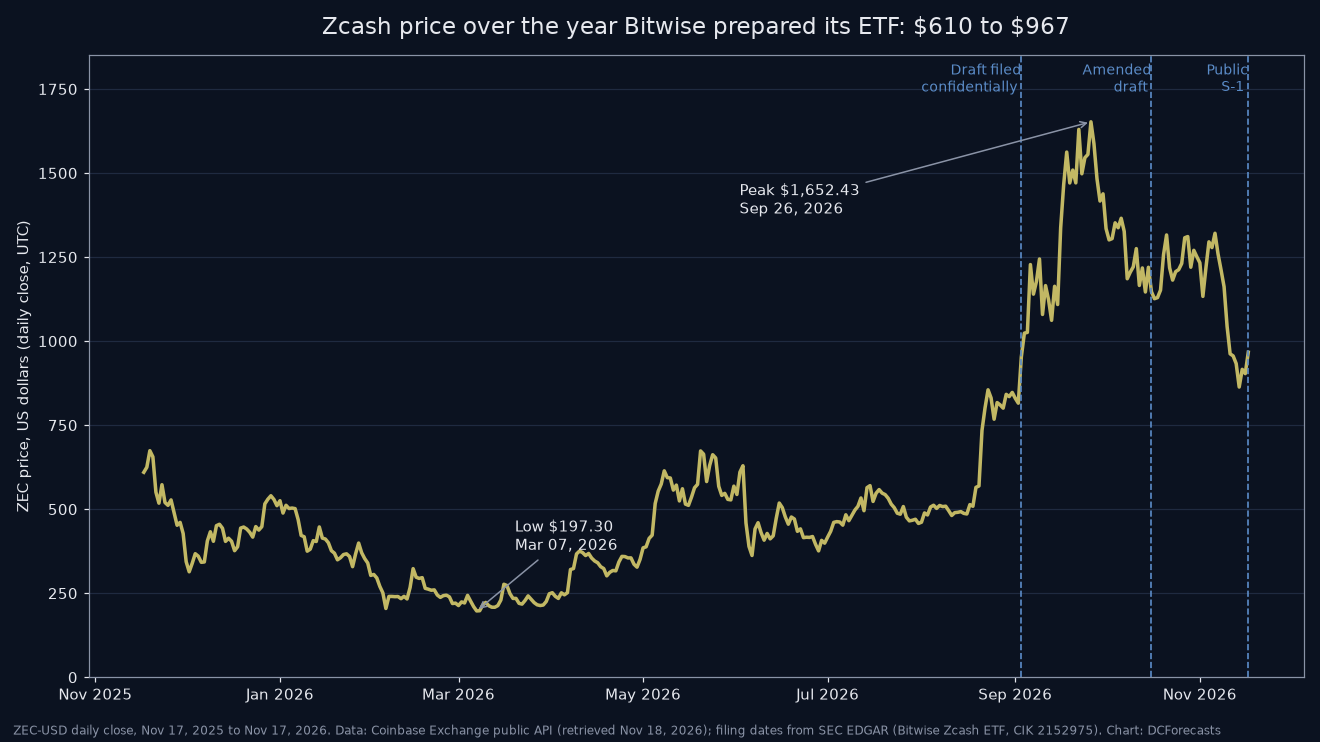
The drop since then has been sharp. ZEC closed at $966.88 on Nov. 17, about 41% below that peak. Measured over the full year, it was still up 59% from $609.74.
The Nov. 17 close was 7% above the prior day, but that move came before the filing was submitted, so we would not tie it to Bitwise. Early on Nov. 18, the token was trading near $952.
The filing itself adds sober context. It puts Zcash’s historical annualized volatility at 138.9% and its largest annual price decline at 93.1%. That is the price of admission for a smaller asset.
Zcash mining and privacy risks Bitwise flagged
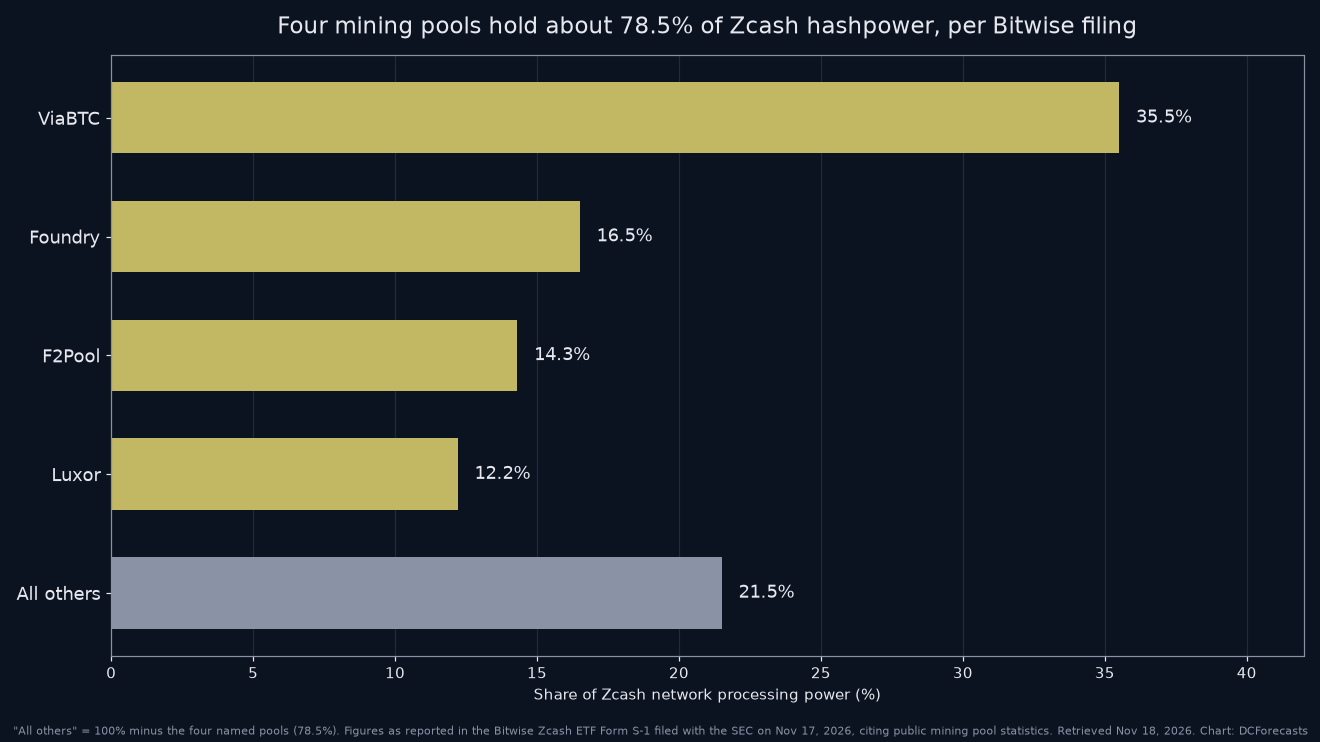
The prospectus is candid about where Zcash is still concentrated. Citing public pool statistics, it says ViaBTC, Foundry, F2Pool and Luxor together handled about 78.5% of Zcash network processing power.
It also notes that Nasdaq-listed Cypherpunk Technologies began mining ZEC in August, reporting about 14% of network hashpower as of Oct. 6. Cypherpunk held about 326,418 ZEC on Sept. 30, while Grayscale’s product reported about 608,229 ZEC on Oct. 5.
Then there is privacy. As of Oct. 5, roughly 29% of ZEC sat in shielded pools and 71% in transparent addresses. The filing warns that many platforms support only transparent deposits and withdrawals, and that compliance screening is harder for shielded flows. The trust says it will buy and sell on a transparent basis.
Governance is moving too. The filing describes the January exit of Electric Coin Company’s team to form ZODL, and holders are already debating treasury rules, as seen in the vote over the Zcash grants reserve.
What a second Zcash ETF could mean
Zcash borrows its monetary design from Bitcoin. Supply is capped at 21 million, issuance halves about every four years and about 16.9 million ZEC had been issued by Aug. 26, according to the filing.
The ETF template is borrowed from Bitcoin as well. The custody setup, daily benchmark and creation baskets are the same machinery that carried spot Bitcoin funds into mainstream portfolios.
We see that as the clearest takeaway. Bitcoin’s ETFs built the road, and issuers are now using it to reach smaller assets. Grayscale has already pledged its first year of Zcash ETF fees to the network. Bitwise would add fee competition.
For investors, the next steps are simple to track: the sponsor fee, the final exchange, and the date the SEC declares the registration effective. Until then, Bitcoin remains the anchor asset that made a filing like this possible.
DC Forecasts is a leader in many crypto news categories, striving for the highest journalistic standards and abiding by a strict set of editorial policies. If you are interested to offer your expertise or contribute to our news website, feel free to contact us at [email protected]












Discussion about this post