



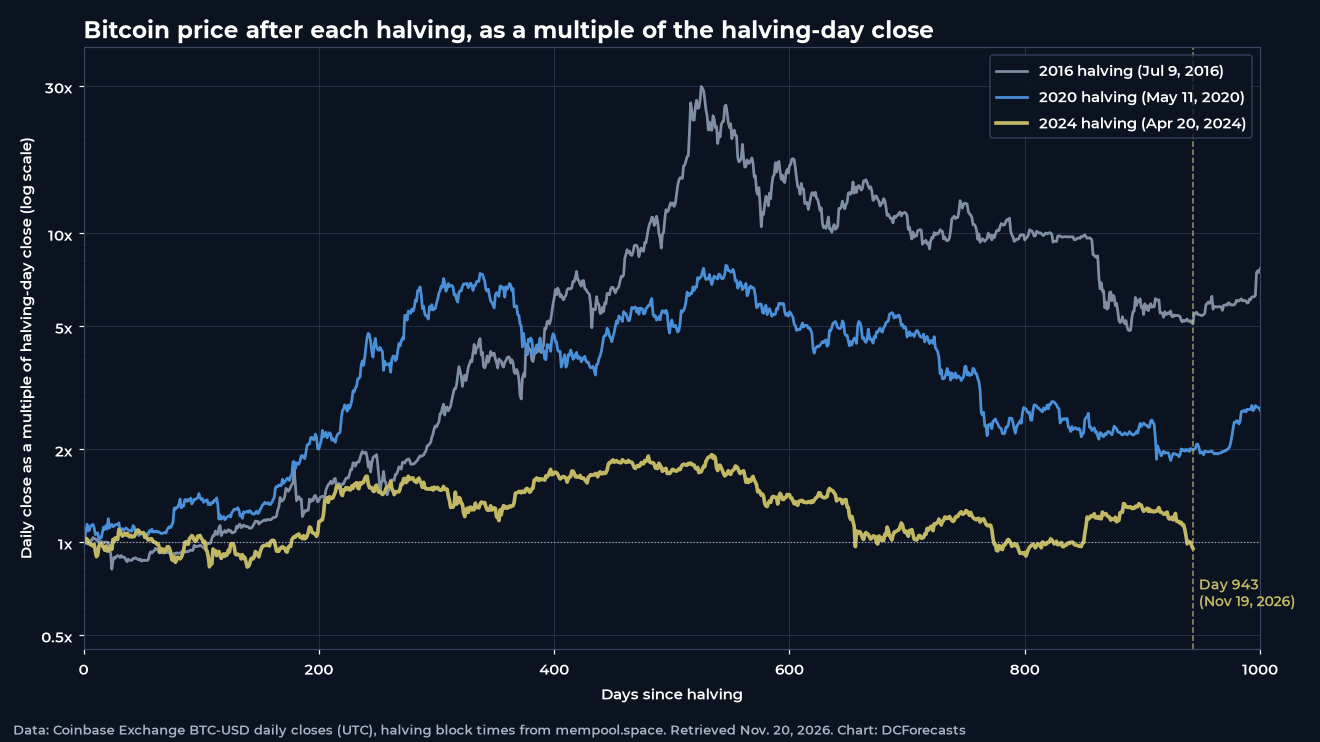
The bitcoin halving cycle hit day 943 on Nov. 19, and that count puts the market at a spot worth a careful look. In the last two cycles, Bitcoin had already logged its bear-market low by this point after the halving.
Bitcoin closed Nov. 19 at $61,913 on Coinbase. That is 943 days after the April 20, 2024 halving at block 840,000, and 4.7% below the $64,969 close on halving day.
We lined up every Coinbase daily close since 2015 against the three halvings it covers. The timing pattern is remarkably consistent, even though the size of the moves has changed.
For Bitcoin investors, the most useful finding is that this cycle topped right on the old schedule. The bigger question now is whether the low is also already behind us.
The Bitcoin Halving Cycle Peak Arrived Right on Schedule
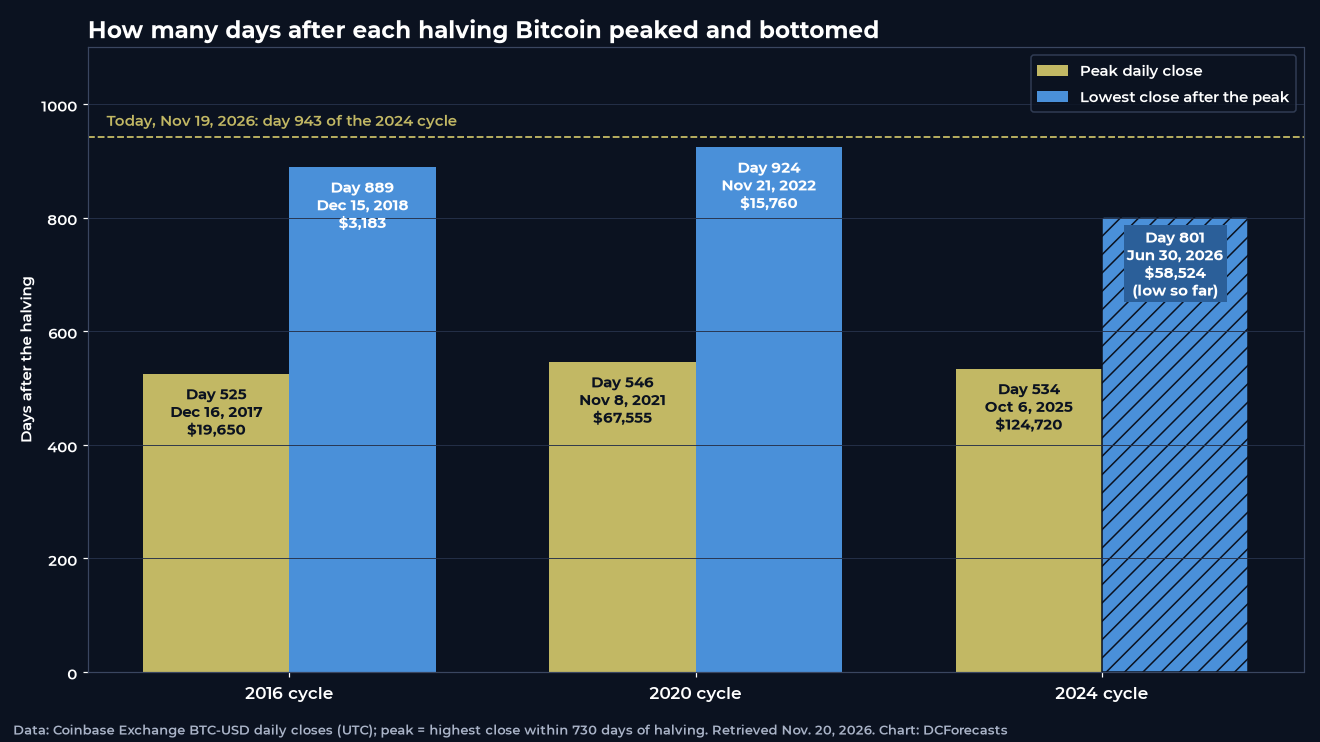
After the July 9, 2016 halving, Bitcoin peaked at a $19,650 close on Dec. 16, 2017. That was day 525.
After the May 11, 2020 halving, the cycle high was a $67,555 close on Nov. 8, 2021, on day 546.
This time, the record close of $124,720 came on Oct. 6, 2025. That was day 534, right between the two earlier tops.
Three peaks landing inside a 21-day window, years apart, is hard to dismiss as coincidence. We believe it shows how strongly the halving rhythm still shapes market psychology, even with spot ETFs and corporate treasuries now in the mix.
Where the Bitcoin Cycle Bottom Landed Before
The lows followed a similar rhythm. In the 2016 cycle, the lowest close after the peak was $3,183 on Dec. 15, 2018, on day 889.

In the 2020 cycle, Bitcoin bottomed at $15,760 on Nov. 21, 2022. That was day 924.
Both lows came roughly a year after their peaks, at 364 and 378 days. As we noted in our recent look at this November’s cycle position, today’s market is now about 409 days past its own top.
So far, the lowest close of this cycle is $58,524 on June 30, 2026, which was day 801. Bitcoin finished Nov. 19 about 5.8% above that level.
That leaves two readings. Either the June low was this cycle’s floor, arriving earlier than before, or the market is still working through its final stretch. The data alone cannot settle that, and we would not pretend otherwise.
The Honest Difference: Smaller Swings in Both Directions
Here is the part bulls should face squarely. At day 943 of the 2016 cycle, Bitcoin traded 411% above its halving-day price. At day 943 of the 2020 cycle, it was up 100%.
Today it sits 4.7% below. This is the first cycle in the Coinbase record where Bitcoin has spent this stage below the price it held on halving day.
The top was also far smaller. The 2016 cycle peak was 29.9 times the halving-day close, and the 2020 peak was 7.9 times. This cycle topped at 1.9 times.
But the damage has been smaller too. The 2018 low was 83.8% below its peak, and the 2022 low was 76.7% below. This cycle’s deepest close so far was 53.1% under the October 2025 record.
We believe that trade-off reflects a maturing asset. A market held by ETFs, asset managers and public companies tends to move less violently than one driven by retail leverage, and that cuts both ways.
What Followed Day 943 in Earlier Cycles?
History offers an encouraging, if limited, record. From day 943 of the 2016 cycle, Feb. 7, 2019, Bitcoin rose 192% over the following 365 days.
From day 943 of the 2020 cycle, Dec. 10, 2022, it gained 156% over the next year.
Those are two data points, not a forecast. They came with different macro backdrops, and neither guarantees anything about 2027.
What they do show is that this stage of the cycle has historically rewarded patience more than panic. In both cases, the hardest selling was already over by the time the halving clock reached this count.
Is the Bitcoin 4-Year Cycle Still Running?
The supply schedule certainly is. Since April 2024, each block pays 3.125 BTC, or about 450 new coins a day, and nothing about that can change through market sentiment.
The next halving is set for block 1,050,000. With the chain at block 976,702 on Nov. 20, that is roughly 73,300 blocks away, which at ten-minute blocks points to spring 2028. Our guide to the next Bitcoin halving covers the timing in detail.
In the last two cycles, the lows of this phase gave way to steady recoveries well before the following halving. From day 943 to the next halving, Bitcoin gained 155% in the 2016 cycle and 279% in the 2020 cycle.
For us, the key levels are clear. Holding above the $58,524 June close would keep that low intact as the cycle floor so far, while a return to the $64,969 halving-day price needs a gain of about 4.9% from the Nov. 19 close.
We would also watch spot ETF flows, the Nasdaq and Treasury yields as the main cross-market signals.
The halving clock is not a crystal ball. But a peak that arrived right on schedule, a drawdown far shallower than in past bear markets and a fixed supply schedule with ever-smaller issuance give long-term holders solid reasons for confidence. The coming weeks will show whether June already marked the turn.
DC Forecasts is a leader in many crypto news categories, striving for the highest journalistic standards and abiding by a strict set of editorial policies. If you are interested to offer your expertise or contribute to our news website, feel free to contact us at [email protected]












Discussion about this post