



VanEck is ending its custody relationship with Gemini across its three spot crypto ETFs, leaving Coinbase as the sole custodian named for the funds’ bitcoin, ether and SOL.
In filings with the Securities and Exchange Commission, the sponsor said it delivered written notice to Gemini Trust Company on Nov. 16 that the VanEck Bitcoin ETF (HODL), the VanEck Ethereum ETF (ETHV) and the VanEck Solana ETF will terminate their custody and clearing agreements with the firm.
The terminations take effect on or about Feb. 16, 2027. Until then, Gemini will keep providing services to all three funds.
What the Filings Say
The Form 8-K for the VanEck Bitcoin ETF, signed Nov. 19, covers two contracts. The first is a custodial services agreement dated Oct. 26, 2023, under which Gemini holds a custody account for the trust’s bitcoin and a fiat account for its cash. The second is a clearing agreement of the same date, which lets the trust settle digital asset trades with other Gemini customers.
“Coinbase Custody Trust Company, LLC will continue to serve as a custodian of the Trust’s bitcoin pursuant to the Coinbase Prime Broker Agreement,” the filing states.
The Ethereum ETF filing ends a Gemini custody agreement dated May 8, 2024, and a clearing agreement dated May 29, 2024. The Solana ETF filing ends a custody agreement from June 13, 2025, plus the same clearing agreement.
The Solana fund has one extra moving part. Gemini also facilitates staking of the trust’s SOL under a staking addendum, and that addendum ends together with the custody agreement. Coinbase Custody will continue as the fund’s SOL custodian under a separate agreement.
None of the three filings gives a reason for the change. They describe the step as the trusts’ election to terminate, made through the sponsor.
A Fund That Has Doubled Since Its First Quarter
HODL is the largest of the three VanEck products affected. It launched in January 2024 with the first wave of U.S. spot bitcoin ETFs.

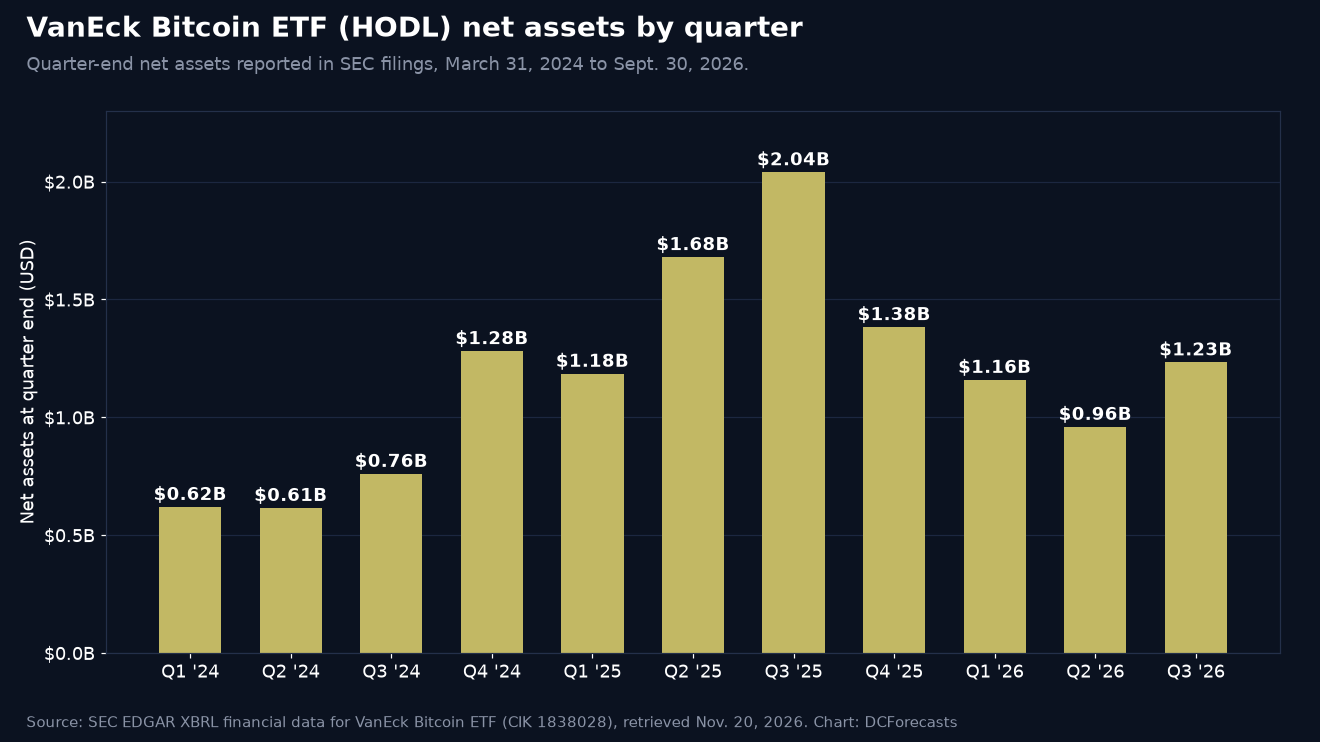
According to the trust’s financial data on file with the SEC, HODL held $619 million in net assets at the end of March 2024, its first full quarter. That figure peaked at $2.04 billion on Sept. 30, 2025.
Net assets fell over the next three quarters, to $959 million by the end of June 2026, as bitcoin’s price declined. They then recovered to $1.23 billion by Sept. 30, 2026, nearly double the fund’s first quarter-end balance.
Those figures move with both bitcoin’s price and investor flows. They show a fund that has kept a substantial base of assets through a volatile stretch for the market.
Almost all of that is bitcoin itself. The trust reported the fair value of its bitcoin at $1.233 billion on Sept. 30, 2026, slightly more than its net assets once small liabilities such as accrued fees are deducted. In other words, the coins held by its custodians are essentially the entire fund, which is why the question of who holds them gets disclosed in a formal SEC report.
Why Custody Choices Matter for ETF Investors
For a spot ETF, the custodian is the firm that actually holds the coins backing each share. Sponsors weigh cost, security practices, insurance, operational capacity and how well a custodian connects to trading and settlement.
Using more than one custodian spreads operational risk. Consolidating with one gives a sponsor simpler operations and a single point of integration. VanEck’s filings do not say whether it plans to add another custodian before February.
The move comes as other issuers reshuffle their own arrangements. Invesco Galaxy’s bitcoin fund recently brought in BNY as a second bitcoin custodian alongside Coinbase, showing that sponsors are still fine-tuning how they safeguard investor assets almost three years after launch.
Gemini, for its part, has been reshaping its business. In its latest quarter, its credit card brought in more revenue than its exchange, as we reported in our look at Gemini’s third-quarter results.
What Changes for HODL Shareholders
For investors who own HODL, ETHV or the Solana fund, the filings point to continuity rather than disruption.
The trusts’ bitcoin, ether and SOL will remain with a regulated custodian throughout. Gemini stays in place until mid-February, and Coinbase Custody already serves each fund. Nothing in the filings indicates a change to the funds’ investment objectives or to how shares are created and redeemed.
The bigger picture is a maturing market. Spot crypto ETFs are now treated like other exchange-traded products, with sponsors reviewing and renegotiating service providers as a routine part of running the funds.
That routine work is a sign of how far bitcoin has come since January 2024. A custody change at a $1.2 billion bitcoin fund is now a back-office story, disclosed in a standard SEC form, rather than a test of whether the asset belongs in mainstream portfolios at all.
Recent flows have been choppy, as our November ETF flow tracker shows. But the plumbing behind those products keeps getting more robust.
DC Forecasts is a leader in many crypto news categories, striving for the highest journalistic standards and abiding by a strict set of editorial policies. If you are interested to offer your expertise or contribute to our news website, feel free to contact us at [email protected]












Discussion about this post