


Wrapped Monero on Hyperliquid lost almost all of its value on Friday, Nov. 20, after the address that created the XMR1 token sent 5.2 million tokens to a freshly funded wallet that started selling straight away.
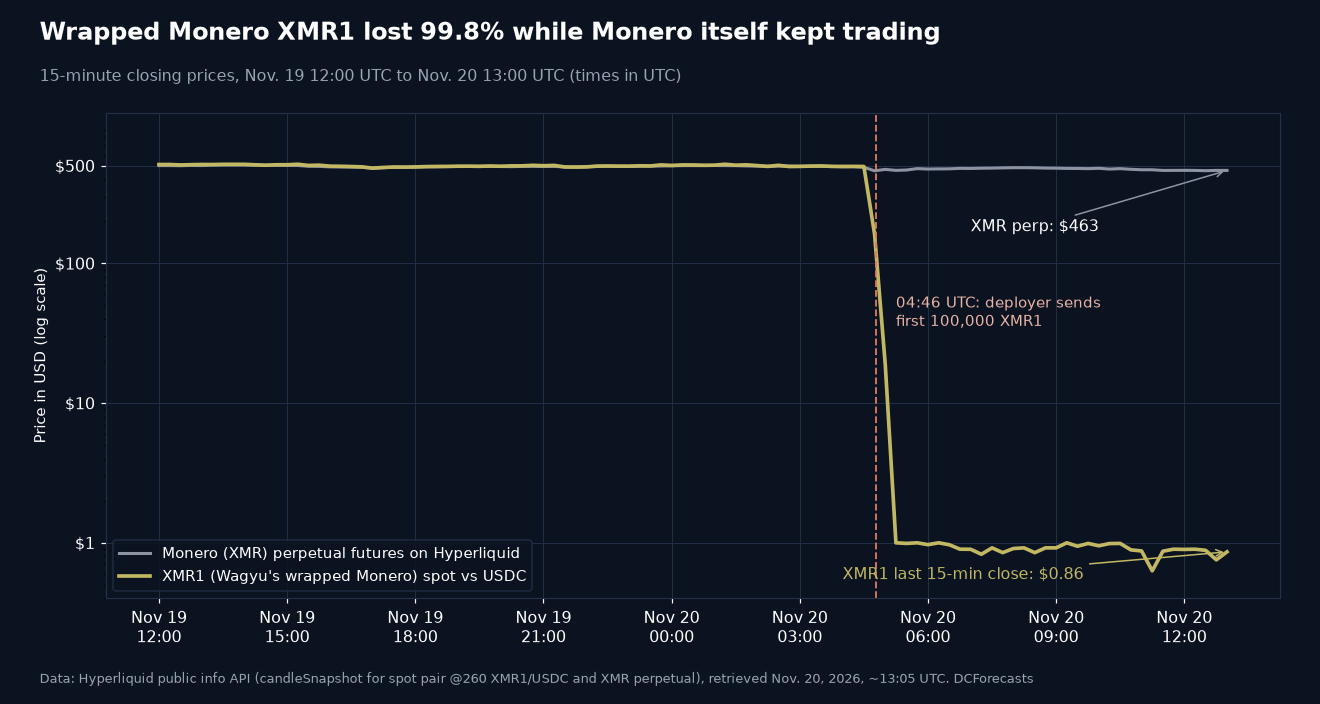
XMR1 traded near $494 before the dump. Within about half an hour it was changing hands at $1, and it sat at $0.86 by 13:00 UTC, according to Hyperliquid’s public market data.
Native Monero did not go with it. Hyperliquid’s XMR perpetual futures contract was still trading around $463 at the same time.
The gap between those two prices is the whole story. A wrapped token is only as good as the keys and the redemption promise behind it.
The bigger question now is whether the issuer, the swap service Wagyu, can make affected traders whole, and what happens to the 13.4 million XMR1 still sitting in the deployer address.
How the Wrapped Monero Token Unravelled
XMR1 is a Hyperliquid spot token listed as “XMR – Wagyu.xyz”. Wagyu lets users deposit native Monero and receive XMR1 for trading, or reverse the swap to get their XMR back.
Hyperliquid’s token records show XMR1 was deployed on Dec. 17, 2025, with a fixed 20 million supply. The entire genesis allocation went to a single deployer address, 0x2077…e06a.
On Friday, that address made three transfers to a new account, 0x1464…20bf. The ledger shows 100,000 XMR1 at 04:46 UTC, another 100,000 at 05:14 UTC and 5 million more at 05:16 UTC.
Its heavy selling began at 04:49 UTC.

The order book could not absorb it. Trade records show XMR1 sliding through $400 within two minutes, hitting $19 by 05:11 UTC and printing $1 by 05:21 UTC.
Where the $13.5 Million Went
We pulled the receiving account’s full fill history from Hyperliquid’s API. It sold 369,623 XMR1 across 4,576 fills for about $13.51 million in USDC.
It also forwarded 6,000 XMR1 in small batches to seven other addresses. Then it withdrew roughly $13.28 million of USDC from Hyperliquid in 11 tranches between 04:54 and 05:20 UTC.
On-chain analysts at Lookonchain and Bitquery reported that the proceeds were swapped on Arbitrum for about 7,467 ETH, worth around $13.22 million, before being bridged onward. Bitquery also counted 388 buyer accounts on the other side of the dump.
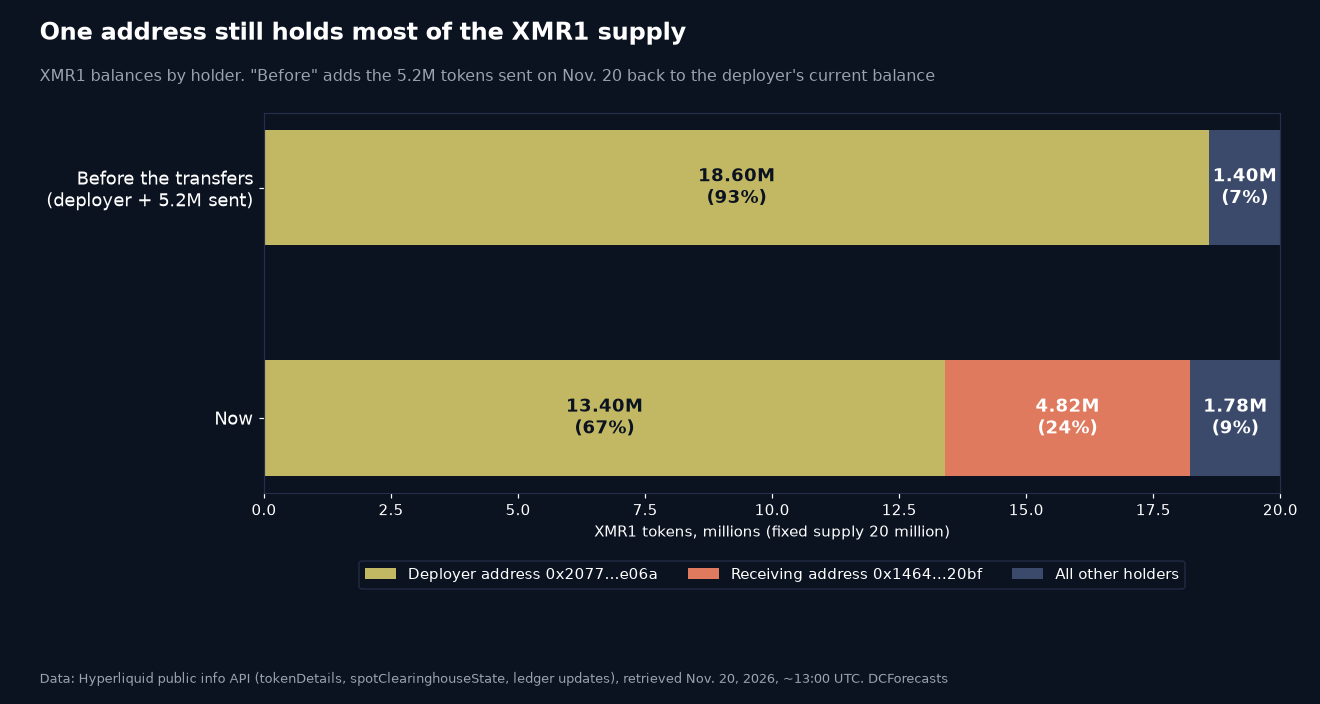
The selling wallet still holds about 4.82 million XMR1 and roughly $219,000 in USDC. At $0.86, those tokens are worth about $4 million.
Liquidity ran out long before the tokens did.
Hack or Insider? What Wagyu’s Developer Says
Hyperliquid token transfers like these need a signature from the account’s own key, so whoever moved the tokens controlled the deployer address. Whether that control was stolen is the open question.
The pseudonymous developer behind Wagyu, who posts on X as PerpetualCow, wrote at 09:36 UTC: “Not completely sure what happened yet, will investigate.” He added that market makers “got hit primarily” and that “Swappers were OK, suffered no loss there.”
Two hours later he promised: “Whoever was MMing XMR1 and lost money on it will be refunded fully obviously.”
In a later post-mortem, he said the hosting provider 1984.hosting had been breached and that the XMR1 deployer key sat on an old server he had deleted, but whose files were apparently retained. He said affected traders “will be refunded by me personally” and that Wagyu “will re-launch at a later stage.”
We could not independently verify the hosting breach or the refund timeline. Wagyu separately disclosed a data leak on Oct. 28, and no link between that incident and Friday’s transfers has been established.
We have seen this pattern before: a single key controlling too much, as in the Gnosis Safe role-key drain and the Gonka bridge exploit earlier this week.
One Address Still Controls Most of XMR1
The concentration did not end with the dump. Before the transfers, the deployer address held about 18.6 million XMR1, or 93% of supply. It still holds 13.4 million, or 67%.
The same deployer created ZEC1, Wagyu’s wrapped Zcash token on Hyperliquid. It still holds about 20.99 million of ZEC1’s 21 million supply, or 99.97%, according to Hyperliquid’s token data.
ZEC1 was still quoted near $835, on just $6,800 of 24-hour volume.
Hyperliquid’s own exchange was not breached. The XMR perpetual contract and other markets kept running, and the venue has faced closer regulatory attention lately, including a Hong Kong warning listing it as a suspicious platform.
Native Monero Price Held Up, With Caveats
The Monero price fell on Friday, but not because of XMR1. CoinGecko showed XMR at $463.15 at 13:07 UTC, down 7.6% over 24 hours, while Bitcoin was down 3.5% at $61,558.
Hyperliquid’s XMR perpetual ranged between about $460 and $502 on Friday. That move fits a broad risk-off day across crypto rather than a collapse in Monero itself.
Why Native Assets and Self-Custody Matter
We believe the lesson reaches well beyond one privacy coin. Every wrapped asset swaps the security of its native chain for the security of whoever holds the issuing keys.
That is also why Bitcoin’s design keeps winning the argument. Native BTC held in your own wallet carries no deployer key, no bridge operator and no issuer who can mint or move your coins.
Wrapped bitcoin on other chains can be useful, but readers should check who controls the minting keys, how reserves are proven and how concentrated the supply is.
The coming days will show whether Wagyu’s refund pledge holds, and whether the remaining XMR1 and ZEC1 supply stays put.
DC Forecasts is a leader in many crypto news categories, striving for the highest journalistic standards and abiding by a strict set of editorial policies. If you are interested to offer your expertise or contribute to our news website, feel free to contact us at [email protected]












Discussion about this post