


Gonka, a decentralized network that rents out GPU computing power for artificial intelligence, saw its Ethereum bridge emptied on Nov. 18 after an attacker replaced the cryptographic key that approves withdrawals.
On-chain records show the whole drain took 72 seconds. The new key was registered at 18:00:59 UTC. By 18:02:11 UTC, the attacker had pulled out every dollar of stablecoins the bridge held and minted 22 million unbacked Wrapped Gonka (WGNK) tokens.
Blockchain security firm Blockaid, which flagged the attack while it was still underway, put the realized loss at about $1.05 million across roughly five transactions.
A Swapped Key Unlocked the Bridge
Gonka’s bridge lets users move the network’s GNK token onto Ethereum as WGNK and back again. Withdrawals on the Ethereum side are approved with a BLS group signature, a single combined key that represents the Gonka validators for each epoch.
According to Blockaid, the attacker “rotated the Ethereum bridge’s epoch BLS group key” and then used the new key to approve its own withdrawals. In other words, the bridge was tricked into trusting a signer that the attacker controlled.
The bridge contract’s event logs back this up. The transaction that set the new key, sent from the exploit address in Ethereum block 26,443,607, registered a group key for epoch 462. The withdrawals that followed were all signed under that same epoch.
It is not yet clear how the attacker was able to submit a new key. Gonka had not published an incident report or any statement on its official X account at the time of writing. Its last post, on Nov. 17, was unrelated to the bridge.
72 Seconds From Key Change to Empty Reserves
Ethereum transfer logs show exactly what left the bridge and when:
- 18:00:59 UTC: a new BLS group key is registered on the bridge contract.
- 18:01:35 UTC: 884,150.87 USDT is withdrawn to the exploit address.
- 18:01:59 UTC: 647.74 USDC follows.
- 18:02:11 UTC: 22,000,000 WGNK is minted to the same address with no GNK locked behind it.
That brings the stablecoin haul to $884,798, which matches the roughly $884.8K that on-chain tracker Onchain Lens reported. The bridge contract now holds zero USDT and zero USDC.

The money did not sit still. The USDT moved into a swap contract at 18:02:59 UTC, less than 90 seconds after it arrived. On-chain analysts later reported that the stablecoins were converted to ETH and spread across other wallets.
What Happened to the 22 Million WGNK
The unbacked tokens were the second part of the attack. Before the exploit, 22 million WGNK would have been worth about $3.1 million at the token’s price of roughly $0.142. Blockaid and Onchain Lens valued what the attacker could actually realize from them at far less, about $172,000, because the market for WGNK is thin.
Transfer logs show the attacker sent 8.5 million WGNK to a single smart contract at 18:04:59 UTC. Less than a minute later, it burned 13 million WGNK through the bridge’s exit function, the step that normally moves tokens back to the Gonka network. The remaining 500,000 went to three other contracts, including Uniswap’s pool manager.
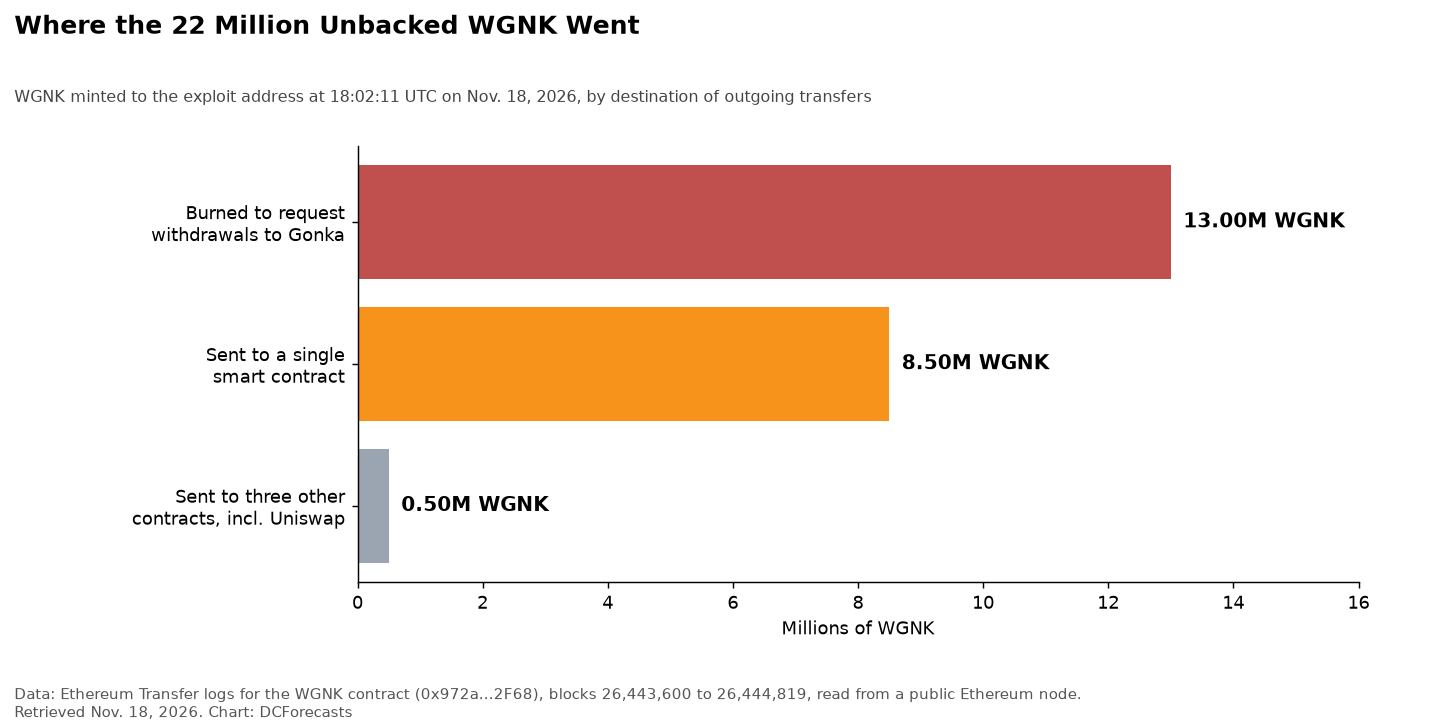
Whether that 13 million WGNK withdrawal can be completed on the Gonka side is now the key question. If the network’s validators refuse to honor it, the attacker’s haul could shrink to the stablecoins alone.
Holders Rushed for the Exit
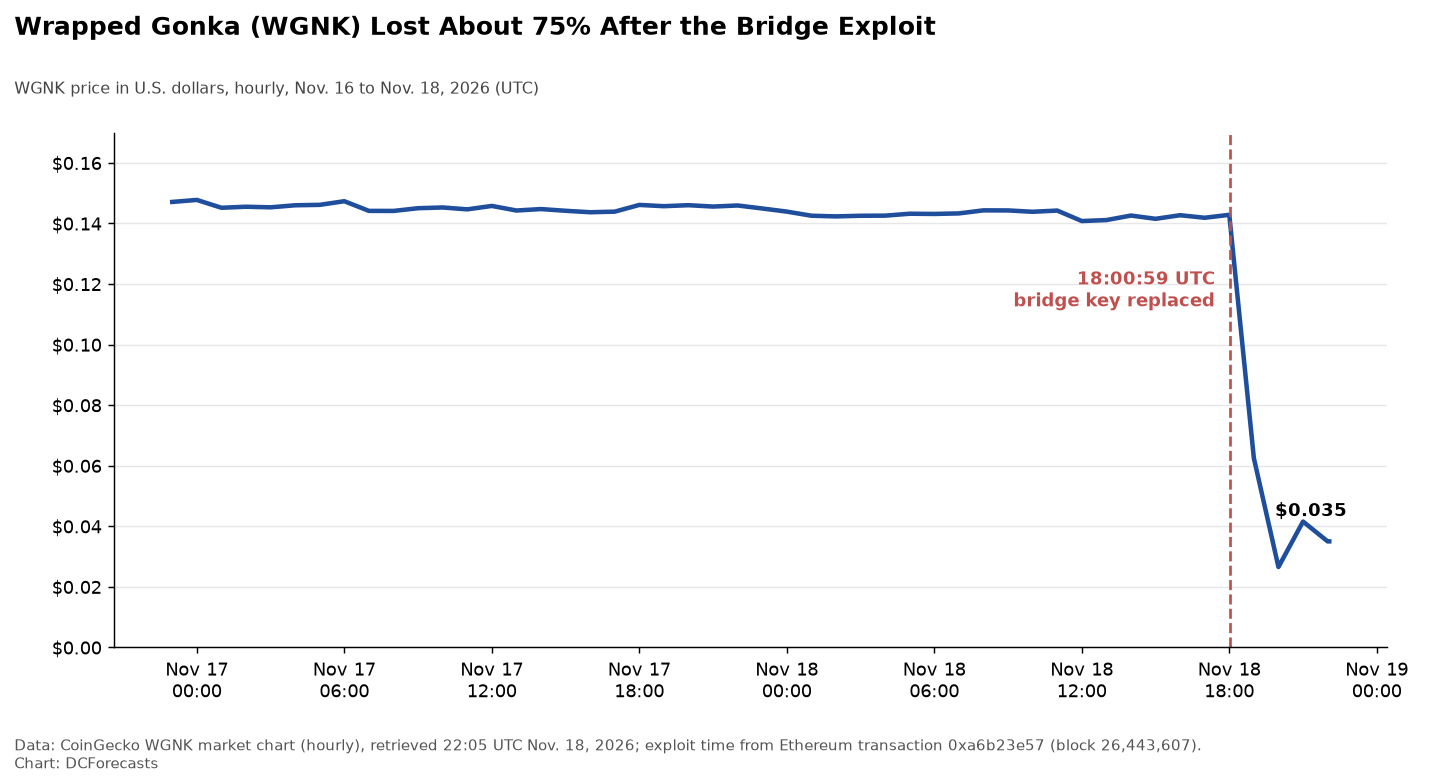
The damage to WGNK’s price was swift. CoinGecko’s hourly data shows the token trading near $0.142 through the afternoon of Nov. 18. Within hours of the exploit, it had fallen as low as $0.0265, and it stood at about $0.035 at 22:05 UTC, a drop of roughly 75%.
Other holders tried to get out too. Bridge logs show about 50 more burn requests from other wallets after the attack, totaling roughly 1.28 million WGNK by 21:01 UTC. Those users are trying to move their tokens back to the Gonka network, where native GNK traded near $0.11 on CoinGecko late on Nov. 18.
Security accounts on X urged users not to buy or bridge WGNK until Gonka issues an update and to ignore any direct messages offering “refunds,” a common follow-up scam after hacks.
Part of a Rough Day for Ethereum DeFi
The Gonka attack landed only hours after two other incidents on Nov. 18. DCForecasts reported earlier that K3 Capital’s sBOLD vault lost $3.43 million to a self-liquidation trick while the Reental platform was drained on Polygon. Etherscan and LOBSTR also reported intrusions into their customer support systems the same day.
Bridges remain one of the most exposed parts of crypto. Over the past month, users on X have tallied problems at several others, including the ILITY, Zilliqa, zkLink Nova and Initia bridges. The common thread is that a bridge is only as safe as the small set of keys that can approve withdrawals. When that key changes hands, the contract has no way to tell the difference.
Why Native Assets Hold Up Better
The incident is a fresh reminder of the strengths of holding assets on their native chain. Bitcoin held in your own wallet does not depend on a bridge committee, an epoch key or a wrapped token contract. There is no mint function that an attacker can call to create new coins.
That is one reason long-term holders keep favoring native Bitcoin self-custody over wrapped versions spread across other networks. Wrapped tokens can be useful, but every one of them adds a layer of trust that native coins do not need.
What to Watch Next
For Gonka users, the next steps depend on the project’s response. The main things to watch are whether Gonka pauses the bridge and explains how the group key was replaced, whether its validators block the 13 million WGNK withdrawal, and whether the project offers any plan to cover the lost stablecoin reserves.
Until then, holders should avoid sending new funds through the bridge and treat any unsolicited recovery offer as a likely scam.
DC Forecasts is a leader in many crypto news categories, striving for the highest journalistic standards and abiding by a strict set of editorial policies. If you are interested to offer your expertise or contribute to our news website, feel free to contact us at [email protected]












Discussion about this post