



Christine Lagarde used what she called her final keynote at the Frankfurt European Banking Congress to deliver one blunt lesson: Europe tends to act only after a slow-moving problem becomes impossible to ignore, and by then it is often too late.
Speaking on Friday, Nov. 20, the ECB President pointed to two areas where she believes the clock is already running: everyday card payments and the young market for tokenized assets.
That market was worth around €23 billion worldwide in March, she said, five times its size a year earlier.
For Bitcoin investors, the most interesting part is the reasoning behind it. Her case rests on not depending on payment rails that someone else can switch off.
The bigger question is how Europe’s answer will sit alongside an open network that already settles value without asking anyone’s permission.
What Christine Lagarde Told Frankfurt
Lagarde said this was her eighth speech at the congress as ECB President, and “sadly” the last.
She built it around a line from Machiavelli: some problems are “easy to cure but difficult to detect” early, and later become “easy to detect but difficult to cure.”
Europe, she argued, moves decisively when a crisis is obvious, as with the €800 billion pandemic recovery fund, but hesitates when costs build up quietly year after year.
She then described three places where the ECB chose to act before the need was obvious: retail payments, wholesale markets and the international role of the euro.

The full text is published by the ECB.
Why Card Payments Became a Sovereignty Issue
According to Lagarde, international card schemes handle more than 60% of euro area card payments. Fourteen of the 21 euro area countries have no domestic card scheme at all.
The speech’s footnotes add that this figure rose from 13 after a national scheme was discontinued.
ECB payments statistics show how much is now riding on those rails. Card payments made with euro area cards climbed from 27.2 billion in 2014 to 91.7 billion in 2025, worth about €3.53 trillion last year.
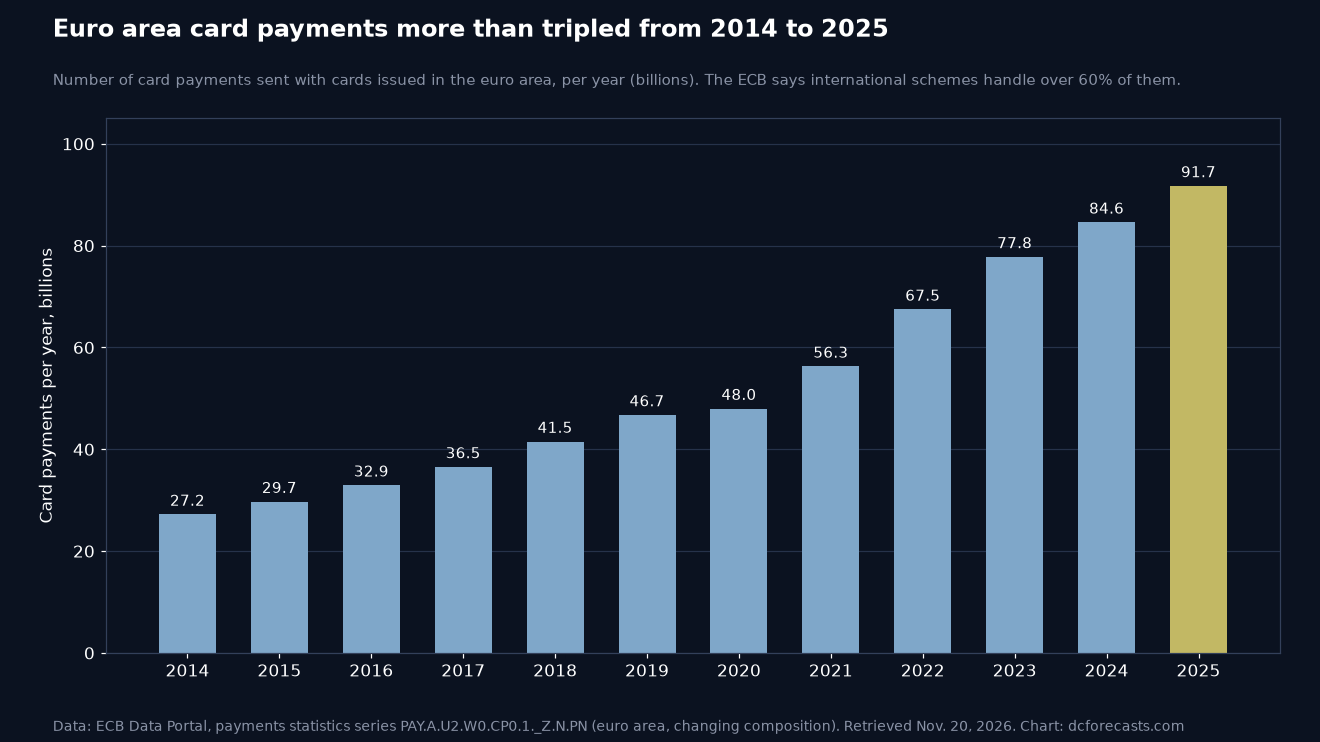
More than a third of day-to-day spending now happens online, Lagarde said.
She also cited a concrete risk. Judges of the International Criminal Court living in Europe, some of them European citizens, lost the use of their bank cards overnight.
The ECB’s answer is the digital euro. If legislation is adopted by the end of this year, the bank aims to be ready for a first issuance in 2029. We covered the earlier steps when the ECB set out its digital euro pilot plans.
A €23 Billion Market With a Short Window
On wholesale markets, Lagarde called tokenization “a huge opportunity” for building a single European market in digital assets.
But she warned that “the window for seizing it is limited.” If standards develop separately, platforms may end up unable to settle with one another.
To head that off, the ECB launched Pontes in September. It lets tokenized transactions settle in central bank money on Eurosystem infrastructure.
Earlier this month, the European Stability Mechanism settled a €1 billion digitally native bond on Pontes, according to the speech. A separate workstream, Appia, is working with market participants on common standards.
The €23 billion figure, footnoted to an August speech by ECB board member Piero Cipollone, covers tokenized traditional assets recorded on public blockchains. Other bodies measure the market differently, as our report on IOSCO’s tokenized asset count showed.
How Bitcoin Fits Into Lagarde’s Argument
Here is where the numbers become striking.
The tokenized market central banks are racing to shape is still small next to Bitcoin. At about €53,300 per coin, Bitcoin’s market value stood near €1.07 trillion on Friday evening, based on CoinGecko data. That is roughly 46 times the ECB’s €23 billion estimate.
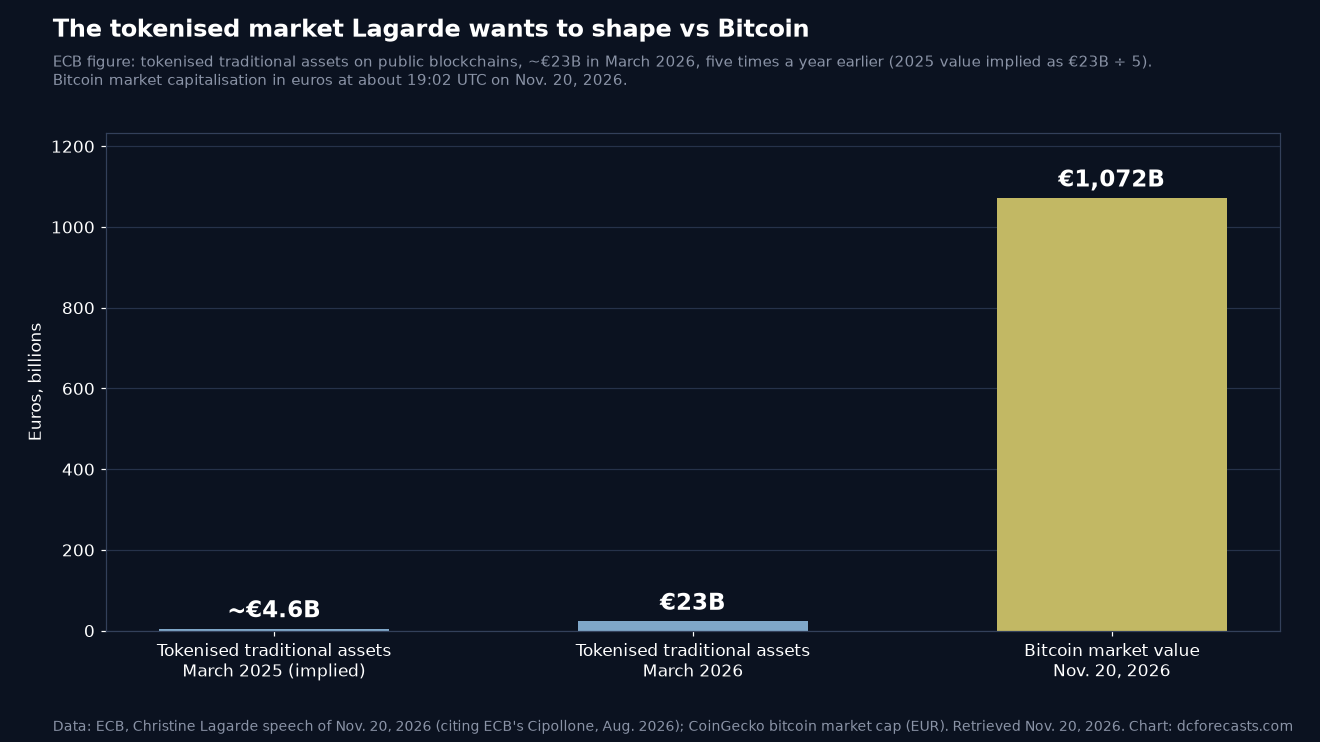
The comparison is not like for like. One measures tokenized bonds, funds and similar assets, the other a native digital asset. Still, it shows where public blockchain value already sits.
The price backdrop is not easy. Bitcoin traded near $58,440 on Friday evening, down about 6.9% in 24 hours. Yet a market value above €1 trillion during a weak stretch is a reminder of how much capital has already settled on an open network.
We believe Lagarde’s sovereignty argument also explains why many investors hold Bitcoin. A digital euro would rely on European rails rather than foreign ones. Bitcoin relies on no single operator at all, and no one can cancel a holder’s access overnight.
The two are not substitutes. A central bank currency and a fixed-supply asset do different jobs. But both stories point the same way: money and assets are moving onto digital rails, and control over those rails now matters to governments and savers alike.
What Europe Has to Decide Next
Lagarde also noted that the ECB made its EUREP repo facility for central banks permanent in February. More than 30 central banks have expressed interest.
Much of what comes next, she said, lies with legislators. The digital euro needs a law, and tokenized markets need common rules that infrastructure alone cannot supply.
For crypto markets, the takeaway is constructive. Europe’s central bank now openly treats blockchain-based settlement as core financial plumbing rather than a fringe experiment.
The coming months will show whether Brussels acts before the case becomes obvious. Meanwhile, Bitcoin’s open, fixed-supply network keeps running on its own schedule, and if the tokenized market keeps growing fivefold a year, the debate over who sets the rules will only get louder.
DC Forecasts is a leader in many crypto news categories, striving for the highest journalistic standards and abiding by a strict set of editorial policies. If you are interested to offer your expertise or contribute to our news website, feel free to contact us at [email protected]












Discussion about this post