



JPMorgan Bitcoin notes are back on the shelf, and the timing is hard to ignore: the bank filed terms for a new product tied to BlackRock’s iShares Bitcoin Trust (IBIT) on Friday, November 20, just as Bitcoin slid to fresh lows for the year.
The preliminary pricing supplement, filed with the SEC by JPMorgan Chase Financial Company, describes two-year auto callable notes that pay at least 30% if IBIT simply finishes level with its starting price after one year.
If the notes are not called, buyers get 1.5 times any IBIT gain at maturity in November 2028, with principal protected against a drop of up to 30%.
For Bitcoin investors, the most interesting part is that the starting price will be locked in on or about November 24, near the bottom of a sharp selloff.
The bigger question is whether Wall Street’s appetite for packaged Bitcoin exposure is fading or quietly reloading.
How Do the JPMorgan Bitcoin Notes Work?
The structure is simple to describe, even if the payoff has several branches.
The notes are sold in $1,000 units, pay no interest and are guaranteed by JPMorgan Chase & Co. They are expected to price on or about November 24 and settle around November 30, 2026.
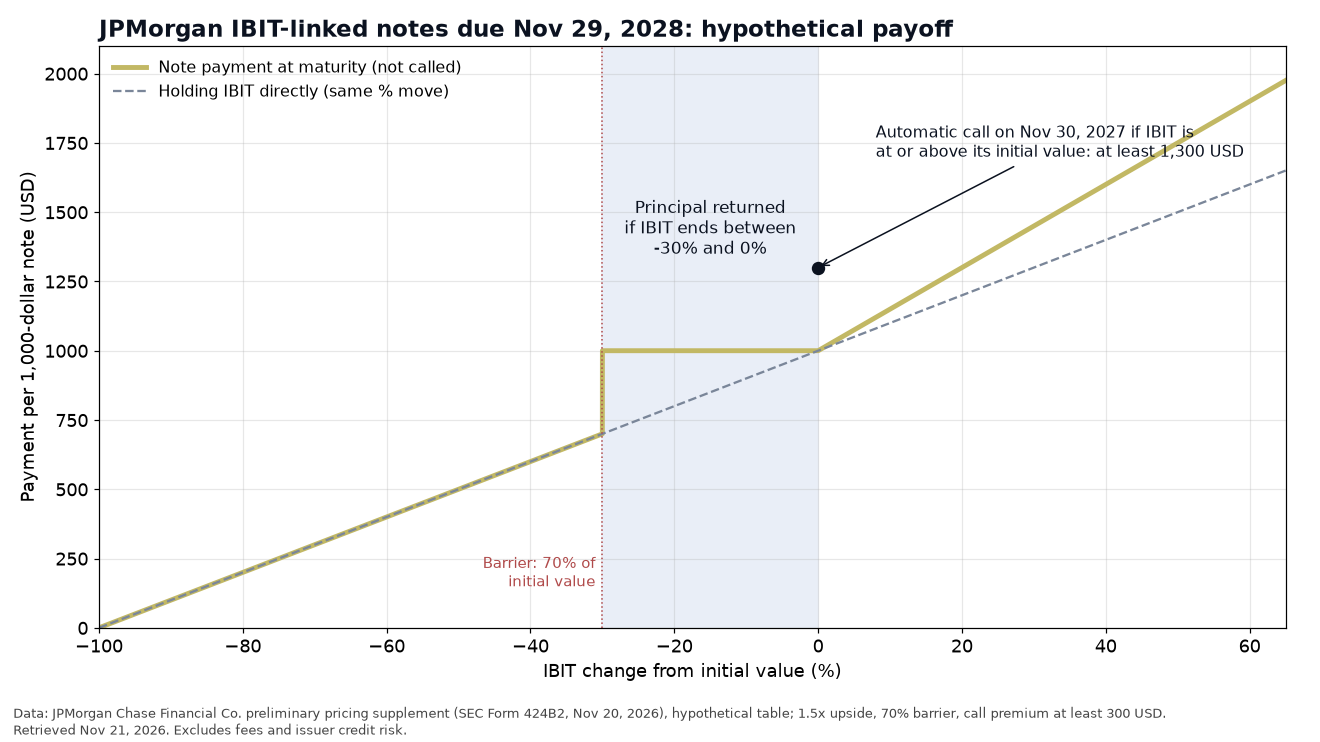
On November 30, 2027, the notes are checked once. If IBIT closes at or above its initial price, they are called and pay $1,000 plus a call premium of at least $300, to be fixed at pricing.
If that test fails, the notes run to November 29, 2028. Any IBIT gain from the initial value is then multiplied by 1.5, with no cap.

The filing’s own examples show a 10% IBIT gain turning into a $1,150 payment, and a 50% gain into $1,750.
If IBIT finishes between 0% and 30% lower, holders get their $1,000 back. Below the 70% barrier, losses match IBIT one-for-one, so a 40% drop returns $600.
The Fine Print Investors Should Read
We think the trade-offs deserve as much attention as the headline numbers.
First, a call caps the upside. If IBIT rallies 40% by November 2027, the filing shows the notes paying $1,300, not the $1,400 a direct IBIT holder would have.
Second, every payment depends on JPMorgan’s credit, not on Bitcoin held in a vault for the buyer.
Third, the bank estimates the notes would be worth about $960 per $1,000 if priced on the filing date, and says that value will not fall below $940. Brokerage selling commissions can reach $7.50 per note.
The document also warns plainly that Bitcoin has shown extreme volatility and that buyers can lose most or all of their principal.
None of that is unusual for structured products. It simply means these notes suit investors who want a defined path, not those who want to own Bitcoin outright.
IBIT Sets Its Starting Line After a Steep Slide
The filing puts IBIT’s November 19 close at $35.08. Market data shows the fund closed Friday at $33.02, roughly 41% below its 52-week high of $55.60.
Bitcoin itself traded near $56,000 early Saturday, down more than 9% in 24 hours, according to CoinGecko data, after touching about $55,600.
As we noted when the selloff undercut July’s low as gold and the Nasdaq sank together, this has been a broad risk-off move rather than a Bitcoin-only story.
That context matters for the notes. Their call level and 70% barrier are both measured from the price set on pricing day.
A lower starting point means the one-year test only asks IBIT to recover to roughly where it trades after a deep drawdown, not to its highs.
We believe that is exactly the kind of entry point that patient, structured buyers tend to look for.
Are Banks Cooling on Bitcoin-Linked Notes?
The broader filing record gives a more mixed picture, and we want to show it honestly.
A search of SEC EDGAR finds 481 Form 424B2 filings mentioning the iShares Bitcoin Trust between November 1, 2025 and November 20, 2026.
The monthly count fell from 79 in November 2025 to 16 in October 2026, with 13 so far this month.
JPMorgan has been the most consistent issuer, accounting for 245 of those filings, or about 51%. In November so far, it filed nine of the 13, with Barclays filing the other four.
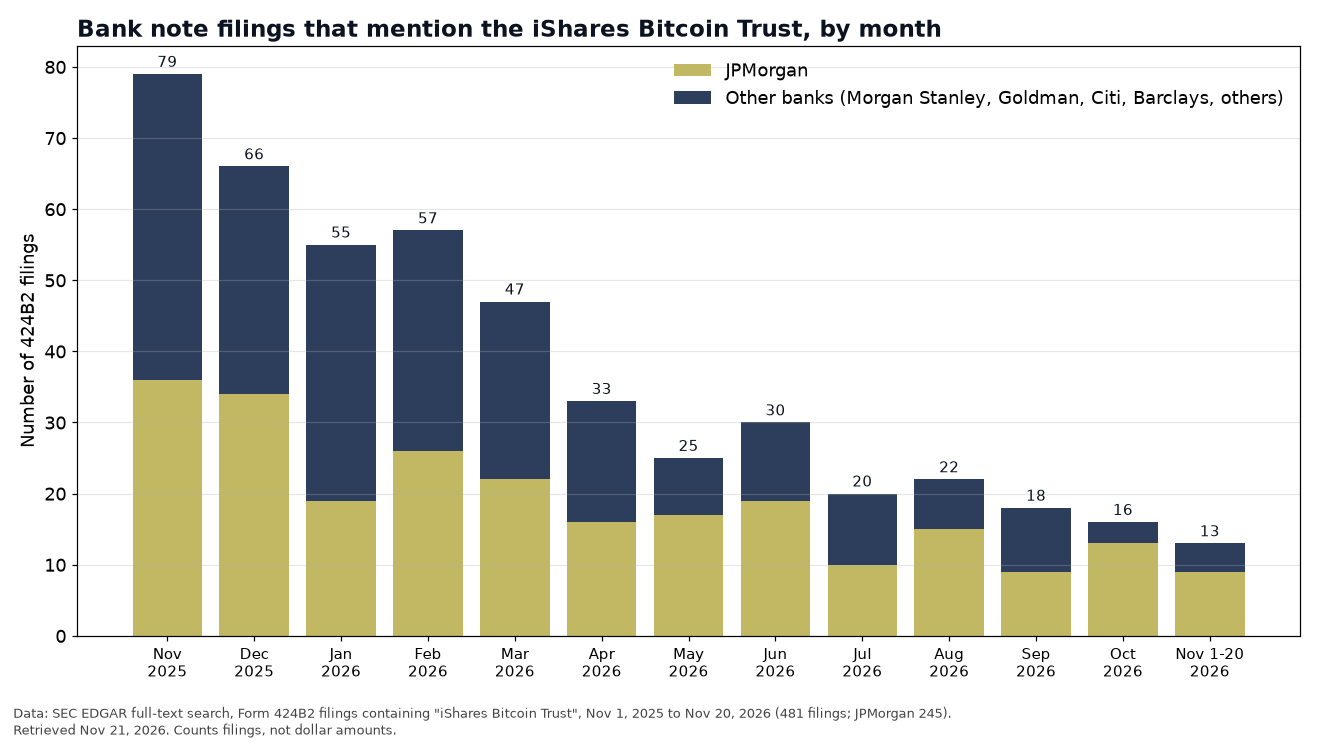
Filing counts are not sales figures, and one product can generate several documents. Still, the drop tracks the cooling in Bitcoin prices through 2026.
What stands out to us is that JPMorgan kept going. That fits what its own 13F showed when JPMorgan nearly quadrupled its IBIT shares in three quarters.
Why We Believe This Matters for Bitcoin
A major bank designing a two-year product around a Bitcoin ETF during a drawdown says something about how embedded the asset has become.
The notes do not change Bitcoin’s supply, and they will not move the price on their own.
But banks typically hedge what they sell, and a hedge on IBIT ultimately points back to a fund that holds spot Bitcoin.
We believe products like these widen the funnel. They bring in advisers and clients who would never open a crypto exchange account but are comfortable buying a bank-issued note.
The coming week will show where IBIT sets its starting line. If Bitcoin steadies from here, a product priced near the lows could look well timed by November 2027.
DC Forecasts is a leader in many crypto news categories, striving for the highest journalistic standards and abiding by a strict set of editorial policies. If you are interested to offer your expertise or contribute to our news website, feel free to contact us at [email protected]












Discussion about this post