



A Bitcoin Core vulnerability that let a single peer freeze a node for more than a dozen seconds at a time was made public on Friday, and the first warning came from an AI code scanner.
The flaw, logged as CVE-2026-117348, is rated Medium severity by the Bitcoin Core project.
Fixes are now out in versions 32.1, 31.3 and 30.5, with the last two released on Nov. 20, the same day the advisory went live.
For Bitcoin users, the more interesting part is how it was caught, fixed and disclosed.
The bigger question now is how quickly node operators install the update, because as of Saturday morning many still had not.
How One Repeated ID Could Stall a Node
Bitcoin nodes keep “orphan” transactions, whose parent transactions they have not seen yet, in a holding area called the orphanage.
When a peer announces one of those orphans, the node checks every missing parent against its mempool and its recent-transaction filters before asking for them.
According to the advisory, that check was added in version 29.0, and the node did not skip duplicate entries in an announcement.
A single inv message can carry up to 50,000 entries.

So an attacker could send an orphan with thousands of missing parents, then repeat its ID 50,000 times in one message.
Each such message stalled the node for over a dozen seconds, during which it processed nothing from other peers, including new blocks.
The fix is simple: each announced transaction is now processed only once per message.
We think that matters. The advisory describes a temporary stall, not a crash, and it does not describe any path to wallets, private keys or consensus rules.
An AI Scanner Flagged the Bitcoin Core Vulnerability First
The advisory credits an automated scan using a large language model, run as part of Elias Rohrer’s Project Loupe at Spiral, the Bitcoin development group backed by Block.
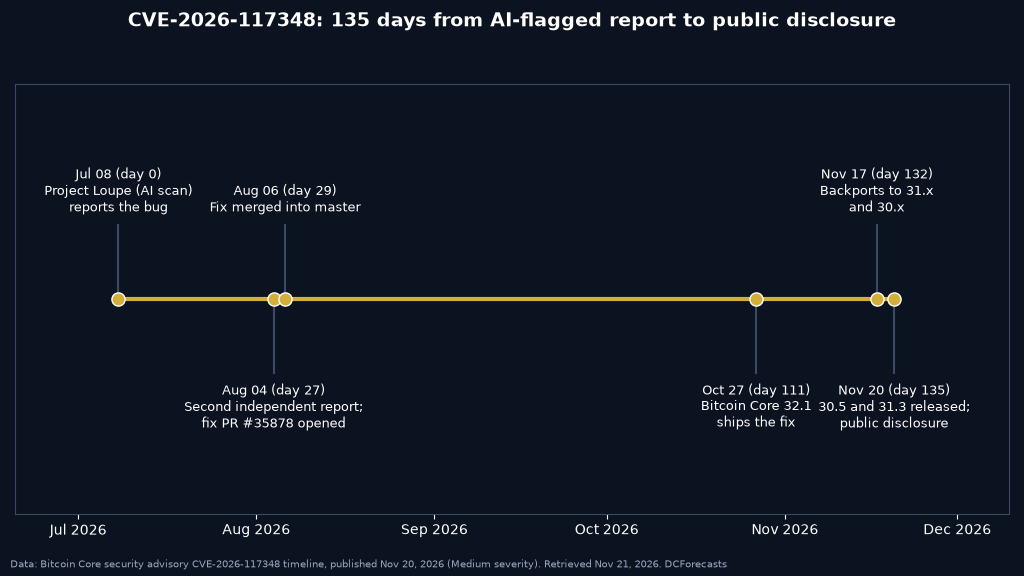
Project Loupe reported the issue on July 8, 2026. Bitcoin Core developer Gregory Sanders validated the finding and brought it to the project’s security team.
A second researcher, Stutxo, independently reported the same bug on Aug. 4.
Sanders opened pull request #35878 that day, and it was merged on Aug. 6, just 29 days after the first report.
That is the evidence. Our reading is that it shows AI tooling being put to work on the defensive side of Bitcoin, pointed at the most widely used node software by people whose goal is to harden it.
Earlier this month, we covered how Bitcoin Core fixed a mining bug a year before revealing it, and the same deliberate rhythm shows up here.
Why Disclosure Took 135 Days
The fix sat in the main code branch from August, but the details stayed private until versions carrying it were widely available.
Bitcoin Core 32.1 shipped the fix on Oct. 27. Backports to the 31.x and 30.x branches followed on Nov. 17, and versions 31.3 and 30.5 were released on Nov. 20.
From first report to public disclosure, that is 135 days.
The release notes for 31.3 and 30.5 list the fix under one line, “process unique tx INVs only,” without spelling out the attack.
We believe that quiet sequencing is a strength. It gives operators time to upgrade before the recipe for an attack becomes public.
The trade-off is honest, though. The 29.x series has reached end of life and will not receive a fix, so those operators need to move to a newer series.
How Many Bitcoin Nodes Still Need the Update?
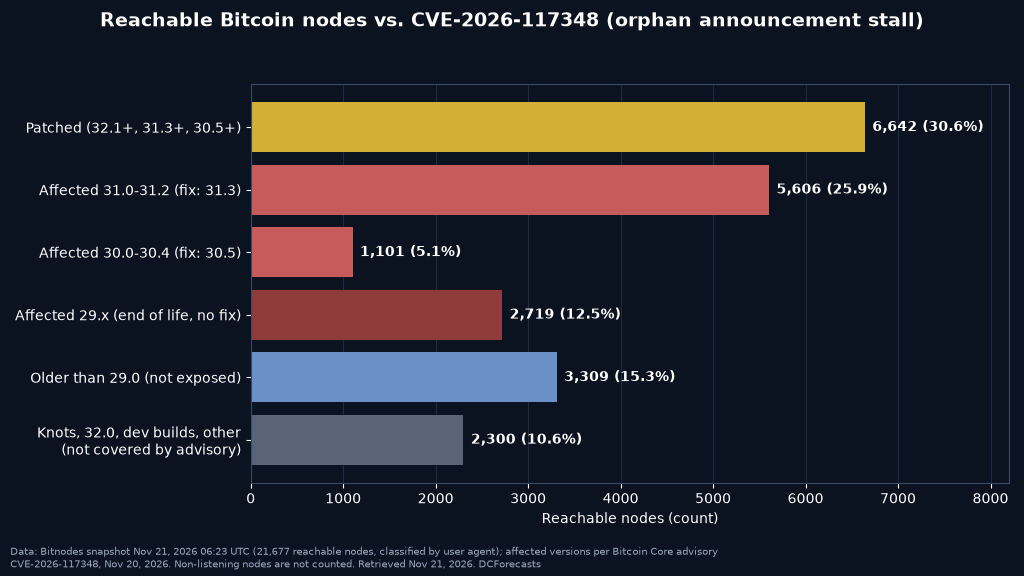
To gauge exposure, we classified a Bitnodes snapshot taken at 06:23 UTC on Nov. 21 by the version each reachable node reports.
Of 21,677 reachable nodes, 6,642, or 30.6%, ran versions that already include the fix, mostly 32.1.
Another 9,426 nodes, or 43.5%, reported versions the advisory lists as affected.
- 5,606 nodes ran 31.0 to 31.2, which can move to 31.3.
- 1,101 nodes ran 30.0 to 30.4, which can move to 30.5.
- 2,719 nodes ran 29.x, which gets no patch and needs a series upgrade.
A further 3,309 nodes ran versions older than 29.0, which predate the code involved.
The remaining 2,300, including Bitcoin Knots and development builds, are not covered by the advisory, so we make no claim about them.
Two caveats apply. Bitnodes only sees nodes that accept incoming connections, and the 31.3 and 30.5 builds were less than a day old when the snapshot was taken.
Bitcoin Node Security Looks Healthier Than the Headline Suggests
The bug is Medium severity, and it slows a targeted node rather than halting the network. An attacker would need to connect to each node it wanted to stall.
The network also runs on many versions at once. Under this advisory, the 15.3% of reachable nodes on releases older than 29.0 were never exposed, and nearly a third already carried the fix before disclosure.
For us, the key takeaway is that Bitcoin’s security process keeps finding and closing problems in public view, with named reporters, dated timelines and fixes across three release lines.
As our report on a reused nonce exposing Bitcoin private keys showed, most real losses come from weak implementations at the edges, not from the protocol itself.
What Node Operators Should Watch Next
The practical step is short: operators on 31.0 to 31.2 or 30.0 to 30.4 can upgrade within their series, and those on 29.x should plan a move to a supported line.
We would watch how fast the patched share climbs over the coming weeks, since that is the clearest test of how responsive Bitcoin’s operators really are.
We would also watch whether AI scanners like Project Loupe surface more findings, since more eyes on the code should mean fewer surprises.
Bitcoin’s fixed supply gets the headlines, but its long-run strength also rests on this kind of patient maintenance.
The coming weeks will show whether node operators upgrade as quickly as the developers delivered the fix.
DC Forecasts is a leader in many crypto news categories, striving for the highest journalistic standards and abiding by a strict set of editorial policies. If you are interested to offer your expertise or contribute to our news website, feel free to contact us at [email protected]












Discussion about this post