



Russia’s communist lawmakers want seized crypto to stop gathering dust and start sitting in the country’s official reserves.
Five deputies from the Communist Party (KPRF) faction in the State Duma have asked Bank of Russia Governor Elvira Nabiullina to create a mechanism for adding cryptocurrency confiscated in corruption cases to Russia’s gold and foreign exchange reserves, according to a Nov. 19 statement on the party’s website.
Those reserves stood at $718.9 billion on Nov. 13, Bank of Russia data shows.
For Bitcoin holders, the striking detail is the model the deputies chose: they pointed to the United States and its Strategic Bitcoin Reserve.
The bigger question is whether Russia’s central bank, which has long called crypto risky, will treat the idea as anything more than a letter.
What the Deputies Asked the Bank of Russia
The appeal was signed by Yuri Afonin, Georgy Kamnev, Maria Drobot, Ksenia Aitakova and Alexander Ivachev.
Ivachev, who sits on the Duma’s digital development and AI committee, explained the logic in an interview quoted by the party.
“Recent changes in legislation have allowed bailiffs to seize digital currency more effectively, but it could end up lying as dead weight if we limit ourselves to confiscation and storage,” he said, in DCForecasts’ translation from Russian.
The proposal covers only assets that already belong to the state under a court ruling that has entered into force.

It is not a bill, and it does not set a timetable. It is a formal request for the central bank to study the idea.
Why Seized Crypto, Not New Purchases
The deputies went out of their way to rule out buying.
“Of course, the state treasury is not a venue for gambling,” Ivachev said. “We are not proposing to buy bitcoin with budget money. We are proposing to decide how to manage what already belongs to the country.”
He also said the deputies agree with the Bank of Russia’s view that cryptocurrency is a risky and unstable asset.
That framing matters. Managing coins the state already owns is a far smaller ask than spending public money.
The statement does not say how much crypto Russian authorities have confiscated so far, and we could not find an official total.
A Cap to Contain the Volatility
To answer the obvious risk, the deputies want the crypto share of reserves limited in advance.
“If the share of digital currencies in reserves is limited in advance, even a sharp fall in the exchange rate will affect only a small part of their total value,” Ivachev said, adding that transparent accounting and clear storage rules would also reduce risk.
The deputies did not name a number. To show the scale involved, we ran the arithmetic on the latest reserve figure.
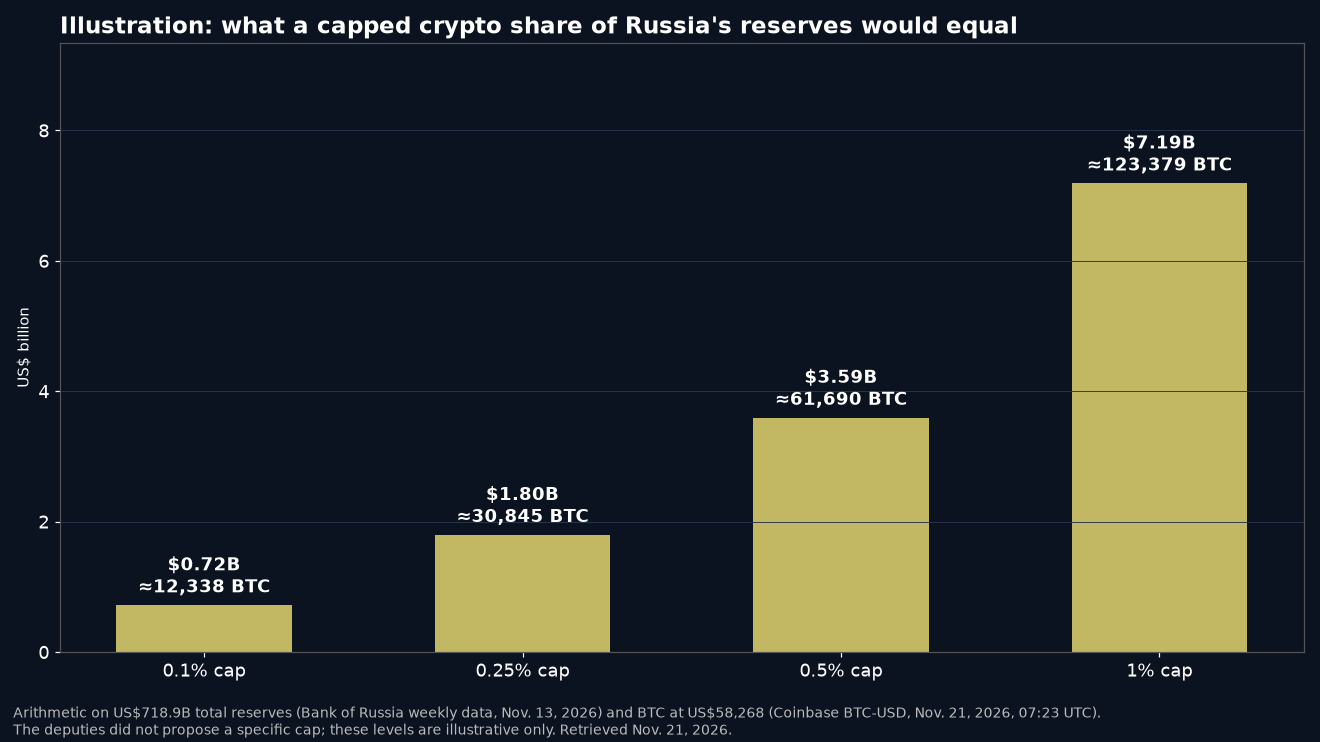
A 0.1% cap would equal about $719 million, or roughly 12,300 BTC at Saturday morning’s price of about $58,270.
Even a 1% cap, around $7.2 billion, would hold roughly 123,400 BTC.
We believe that is the point the deputies are making. At those sizes, a deep bitcoin drawdown would barely register against a reserve pile of more than $700 billion.
Russia Already Bet on a Scarce Asset Once
Russia has spent years shifting its reserves toward an asset no other government can print.
At the end of 2017, monetary gold made up 17.7% of Russia’s international reserves, $76.6 billion out of $432.7 billion, according to Bank of Russia data.
By Oct. 31, 2026, gold accounted for 40.5%, or $292.0 billion of a $720.9 billion total.
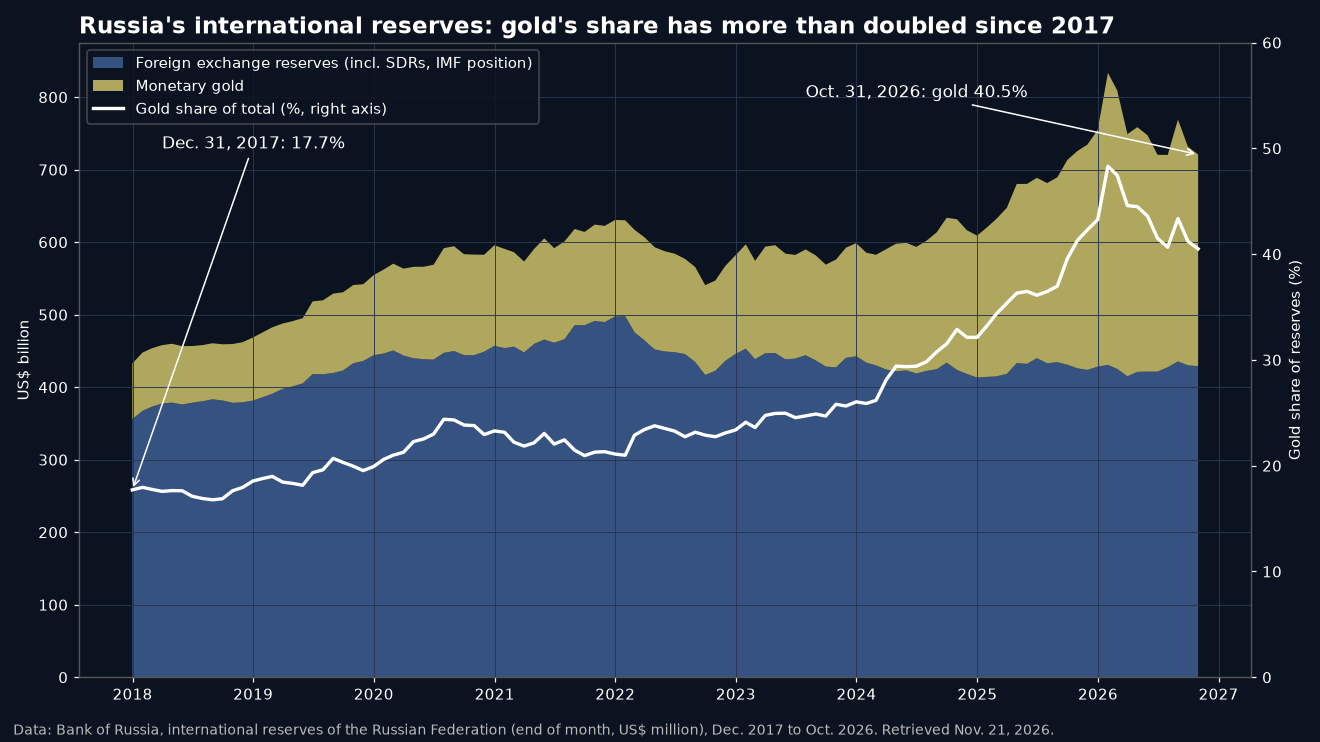
The share peaked at 48.3% on Jan. 31, 2026, when total reserves hit $833.6 billion. It has since eased as the gold price pulled back.
Reserves already carry a volatile, non-yielding asset. A capped slice of seized bitcoin would follow the same logic on a far smaller scale.
Crypto is also moving closer to Russia’s mainstream. As we covered earlier this month, Russia opened retail Bitcoin trading from Nov. 17 under a ₽300,000 annual cap per intermediary.
The US Strategic Bitcoin Reserve as a Template
The US example the deputies cited works in much the same way.
The March 6, 2025 executive order capitalizes the Strategic Bitcoin Reserve with bitcoin the Treasury holds after final criminal or civil forfeiture.
Coins placed in the reserve “shall not be sold,” the order says, and any strategy to acquire more must be budget neutral.
Russia’s proposal borrows the funding source, forfeited coins, while adding a hard cap the US order does not set.
Kazakhstan is another neighbor moving in this direction. Its central bank has invested $190 million of a $700 million crypto reserve and plans to add seized and mined coins.
What to Watch From the Bank of Russia
We found no public response from the Bank of Russia to the letter as of Saturday morning.
KPRF is an opposition faction, and an appeal from five deputies does not bind the central bank. Approval is far from certain.
Still, we think the direction of the debate is the real signal. Lawmakers who share the regulator’s caution about crypto are now arguing over how to hold bitcoin, not whether it has value.
Next, watch for a formal reply from the central bank, any disclosure of how much crypto Russia has confiscated, and any draft rule on handling seized digital assets.
Bitcoin’s fixed 21 million supply is exactly why governments keep returning to the reserve question, even in a week when the price is under pressure.
If more states decide seized coins belong in reserves rather than at auction, fewer confiscated bitcoin would return to the market.
DC Forecasts is a leader in many crypto news categories, striving for the highest journalistic standards and abiding by a strict set of editorial policies. If you are interested to offer your expertise or contribute to our news website, feel free to contact us at [email protected]











Discussion about this post